 |
 |
 |
 |
 |
 |
 |
 |
 |
| TAILOR-MADE: Bollywood actresses and their favourite designers |
The Big Fat Indian Wedding continues to get fatter with every passing day. And for a celebrity bride with the fattest of pockets, there’s this surmounting pressure to look dazzling on D-day, what with remote chances of a retake. The pièce de résistance is unarguably the empress’s new clothes for which no price is too big and no designer beyond reach. And what could be better than having leading designers help you drape up for the special occasion?
Some of India’s top actresses have been doing just that. Quite a few of them walked up the altar in recent times in saris created by their favourite designers. The bond is so strong that when you think of Vidya Balan’s sartorial sense, you think of Sabyasachi Mukherjee; or you take Kareena Kapoor’s and Manish Malhotra’s names in the same breath when the actress’s love for jazzy formal outfits comes up for discussion.
Of the recent crop of newlyweds, Balan, who has turned the sari into quite an item number, relied on Sabyasachi Mukherjee to give her the right look when she tied the knot with UTV head Siddharth Roy Kapur in December last year. In October, when Kareena Kapoor hitched up with the Nawab of Pataudi, Saif Ali Khan, she turned to her dear friend Manish Malhotra. And just a month ago, when Hema Malini and Dharmendra’s daughter Esha Deol married businessman Bharat Takhtani, she went with Neeta Lulla for significant chunks of her wedding trousseau.
Of course, it’s no coincidence that while these designers have risen to the top in the cut-throat world of fashion design, they’ve also left their mark in the realm of Bollywood. They are the brains behind some of the elaborate attires in Bollywood blockbusters. Malhotra designed the clothes in Kabhi Alvida Na Kehna (2006) and Heroine (2012), while Neeta Lulla was the designer for Devdas (2002) and Jodha Akbar (2008). Sabya was the man behind the leading ladies’ skirts in Black (2005) and Guzaarish (2010), and the designer who won much acclaim for Paa (2009) and Sridevi’s Rs 400-a-piece saris in English Vinglish (2012).
While each of these couturiers flaunts a distinctive style — which makes their creations the cynosure of all eyes — it was left to avant-garde designer and 2013 Padma Shri award winner Ritu Kumar to work largely on restoring and embellishing the three-generation-old traditional gharara that Kareena wore for her nikaah. This was the same gharara that her actress mother-in-law Sharmila Tagore had worn during her wedding to Tiger Pataudi and by Saif’s grandmother on her D-day in 1939.
Kumar recreated this ancient costume in gold Benaras fabric, woven in the likeness of the fabrics used for the original ensemble. The traditional bridal attire consists of a kurta, farshi paijama and dupatta made of rust and gold tissue which contrasts subtly with the soft green satin gote at the hem. The neckline, sleeve ends, hem and side slits of the knee-length kurta are all edged with a decorative zardozi border.
The original odhni that dates back to the last century was repaired to form the final part of the ensemble. The joda took a better part of four months of painstaking work to recreate.
Says Ritu Kumar, “Reviving an old heirloom like the one belonging to the Bhopal family was a challenge. A few older craftspeople existed who understood the stitches and their use on three dimensional surfaces. A minimum of 10 -12 craftspeople worked for four months to recreate the splendour of the old costume. The fabric was also woven on old naksha looms of Benaras to recreate an era gone by. The result was inspirational in its underplayed non-bling avataar which looked almost if not equally rich as the original.”
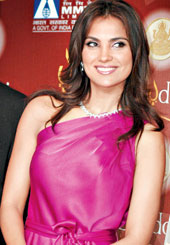
The Manish Malhotra label entered the frame both for the events preceding and following the nikaah — the old world charm in his outfits complementing the signature style of the “barefoot doctor of textiles”, as Ritu Kumar defines herself in the context of reviving India’s dormant textile heritage. Kumar also designed the bride’s lehenga when actress Genelia D’Souza married Riteish Deshmukh last July, and created the beige sari that Lara Dutta wore for her civil marriage to tennis player Mahesh Bhupati.
For Vidya Balan, too, tradition was the high point of her wedding. “The very first time that Vidya approached me, she was going through a wardrobe crisis, as she had been panned by critics about her choice of clothes,” recalls Sabyasachi Mukherjee. Later, of course, she emerged as one of fashion’s divas, encouraged perhaps by the designer who to some extent helped Vidya understand the essence of fashion. As Vidya later put it, “Fashion is what’s you, and not what’s not you.”
That is what came to light during her wedding — her strong traditional roots and preferences, as defined by her rich Kanjeevaram drapes and a red Banarasi sari that she wore soon after the nuptials. “For weddings in the south, the bride is required to change five or six times,” says Mukherjee. So of the 18 saris that she had ordered, there were a couple that she did wear on her wedding day.
Designer Tarun Tahiliani, whose bridal clientele includes not just Indian actresses such as Shilpa Shetty but international celebs inlcuding Liz Hurley, believes it’s not just the sari that is of import — equally crucial is how it’s worn. “How you drape a sari can make all the difference,” he says. That perhaps explains why many celebrities rave about the Delhi designer’s concept saris. His traditional drapes, for instance, can be teamed with well-tailored jackets — embroidered, woven or even plain. A past infused with the renewed energy of revivalist craft and couched in contemporary fashion lingua best outlines Tahiliani’s brand story.
Natasha Madhvani — Fardeen Khan’s bride and yesteryear actress Mumtaz’s daughter — wore a blue and silver ghagra-choli designed by Tahiliani at her mehendi ceremony in 2005, while Shilpa Shetty wore a Manglorean red Bunt style sari designed by him at her wedding, and a chic two-piece sari-cum-gown at her reception. Even uber-stylish Jemima Khan wore a Tahiliani creation at her wedding to Pakistani-cricketer-turned-politician Imran Khan.
For Neeta Lulla, designer Zandra Rhodes has been the chief source of inspiration. “I fancied her design sensibilities and these totally inspired me,” reminisces Lulla. Her client list includes such A-teamers as Aishwarya Rai, Deepika Padukone and Hema Malini — Lulla is the one who got the Dream Girl, as Malini was known in the Seventies, to trade her Kanjeevarams for clinging georgettes with noodle strap blouses. Rai’s wedding sari, her fans would remember, was an exquisite gold zari affair. The creator of Esha Deol’s intricately woven wedding sari has, however, now come a long way since she began to make “structuring, colour, sensibility and texturing use” the USPs of the saris she designs.
For Sabyasachi, strong colours, extensive research and heritage weave go into the nine-yard creation. Sabyasachi, who is also Rani Mukerji’s favourite designer (“She loves saris with red borders,” he says) believes in strong colours. Extensive research and heritage weave go into his nine-yard wonders. Lulla, on the other hand, “concentrates more on the actor’s structure and skin tone to decide colour, fabric and style.” But she stresses that within that, she zeroes in on special areas. “The areas of focus for me are the pallu and back, and of course, wearability.”
Actresses apart, Oprah Winfrey was another celebrity for whom Mukherjee had to design a sari — and at a very short notice to boot. “She wanted something clingy, considering her gait. So I rustled up an apple green tussar georgette with European thread work and zardozi work.”
While that worked like magic, Ritu Kumar’s indigenous fashion handwriting is wielding the wand too. This time, though, it’s an onscreen big fat Indian wedding in Deepa Mehta’s adaptation of Salman Rushdie’s Midnight’s Children. Magic realism — at its tangible best!
Partners in style
1. Kareena Kapoor and Manish Malhotra
2. Vidya Balan, Rani Mukerji and Sabyasachi Mukherjee
3. Lara Dutta and Ritu Kumar
4. Esha Deol and Neeta Lulla
5. Shilpa Shetty and Tarun Tahiliani