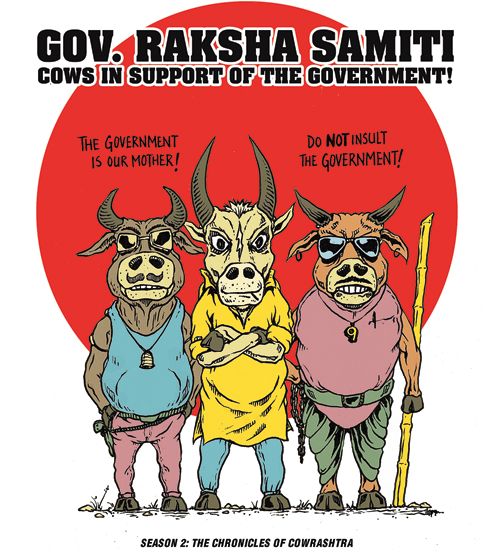

Three smart but thuggish looking cows stand in a row. Two of them have dark glasses on. One of them has a lathi. All of them have a menacing look and a no-nonsense body language. The big bold lettering over their heads reads: "Gov. Raksha Samiti. Cows in support of the government". The speech bubbles below strike a cautionary note: "The government is our mother!" and "Do not insult the government!"
This is a page from Cowrashtra, an imaginary nation created by the Bangalore-based graphic novelist Appupen (real name George Mathen).
In Cowrashtra, there is the Cowboy - Half Man. Half God. Full Hero. He is in hot pursuit of the super nationalist, saffron cape-swirling Rashtraman, who is hand in glove with the corporates and media.
For a lot of Indians who grew up with Phantom, Spider-Man and Amar Chitra Katha, these graphic stories may appear somewhat bizarre. But with increasing Internet penetration, this new breed of comics is fast turning into a virtual auditorium where young Indian artists can vent their social and political angst.
"The totalitarian world is a nightmare for me; so I came up with Rashtraman, a muscular vigilante in the fantasy universe of Halahala (of which Cowrashtra is a part) early in 2016," says Appupen.
The student unrest at JNU took off a few months after this. Needless to say, post the Kanhaiya Kumar episode, Appupen's work seemed less comic and more prophetic. "I am trying to show how the state, religion, corporates and the media come together in the totalitarian world," says Appupen, whose current series talks about the religious realm of Cowrashtra where a Supercow reigns supreme.
Appupen's graphic stories hit you hard with their impeccable artwork and strong political commentary, but there are many more pursuing the trend. The beauty of the webcomic canvas is that there is room and a following for every style and manner of expression.
Bangalore-based Aarthi Parthasarathy and Chaitanya Krishnan's Royal Existentials juxtaposes the settings of Mughal miniature paintings with thought bubbles to reflect the angst of the millennials.
"Our graphic stories are inspired by Wondermark, an online comic strip that mixes Victorian art and contemporary social comments," says Aarthi, a filmmaker and artist.
Royal Existentials was launched in 2012, soon after the Nirbhaya gang rape stunned and enraged the nation. "We don't reference any event directly, rather we bring out social insights," Aarthi says. For instance, a recent strip reflected how urban Indians were discussing a possible Indo-Pak war a tad too casually, with little concern for its long-term implications. The comic strip is updated every Friday, often with a different theme.
Not all webcomics wade into prickly issues, though.

Priya Kurien is the creator of Delhittante, a strip that attempts to capture the essence of Delhi life. "I've been living in this city for nine years, I still feel like a migrant, an observer looking at the city from the outside." For Priya, there's no dearth of amusing characters around. She says, "I started sharing these sketches on social media and found many who could relate to them... People are finally beginning to understand that the graphic novel is a form of literature, not just a sanitised version of children's comics."
The newfound appreciation is stoking new talent. Many more trained graphic artists are discovering how powerful graphic storytelling can be on the Web, where creators and audiences can share a common space and build a conversation.
Take the case of Kaveri Gopalakrishnan whose stories Before You Step Out and Basic Space question the safety and security of a woman and how she deals with sexual aggression. "This encouraged women to imagine an ideal world for themselves, a world without restrictions - from dreams of napping in a public garden to jogging down a lonely road to enjoying a lust-free Holi."
Kaveri, Aarthi and six other feminist storytellers formed Kadak Collective at the East London Comics Festival in June this year. London-based Aindri Chakraborty, who helped these multi-disciplinary artists - illustrators, film-makers, graphic designers and comic creators - band together, says the driving factor for her was the "lack of visibility for minority and female voices in comic fests". In other words, an ef- fort to step away from the stereotype of superhero comics steeped in male chauvinism.
Most of these artists have art school training and put a lot of emphasis on form. But there are others who thrive on powerful content alone.
One such would be Rachita Taneja. Despite no formal training in drawing, Rachita started her stick figure comics, Sanitary Panels, in 2014. It was in response to the arrest of students who had criticised politicians, including the newly elected Prime Minister, Narendra Modi.
"They were using Section 66A to arrest these students. I got angry. My first comic strip was about how anyone who speaks against Modi is being jailed." The draconian law was eventually scrapped by the Supreme Court, but Rachita carried on with her sarcastic picture notes. These went on to garner thousands of shares and comments on social media.
Two years and over 150 comic strips later, her stick figures and the sanitary napkin logo have become recognised symbols in the Web world. "I always wanted to be confrontational," says the human rights activist who deals with communal violence, censorship, LGBTQ rights and women's rights.
Gurudev Kallahaly's Sarcanomics is also based on stick figure drawings that mix "comics" with "sarcasm". He says, "I have always loved to work on taboo topics, issues, but only if I understand and empathise enough, and there is a joke to be written on it at all."
This "over-exhausted software engineer" takes on issues as diverse as politics, space projects, rationale behind fairness creams and gay marriages. He is excited about the happening world of webcomics in India. "Some of the illustrations I find on my social media timeline are simply stunning. They do these just for the heck of it, but the storytelling keeps me on the edge," says Gurudev.
Sailesh Gopalan is a third-year student of Srishti Institute of Art, Design and Technology, Bangalore. His comic, Brown Paperbag, began as a leisure project in June, before it blew up and Sailesh found himself entertaining more than 75,000 people. "Brown Paperbag deals with the unspoken things in family or social relationships."
Totes Pototes, brainchild of Shreanca Bhattacharjee, has perhaps the wildest approach. Says the 23-year-old graphic designer from Bangalore, "My boldest piece was a strip on the beef ban and the porn ban combined - I found the whole situation rather childish. That particular piece was online for five months before it was taken down because "someone" reported it. I was also banned from Facebook for 48 hours." This made Shreanca happy because the "whole point of Totes Pototes was to piss off the bunch who refused to have an opinion".
Many of the webcomic artists are used to such negative feedback and online trolls. Says Appupen, "Every Friday I get abused... These aggressive comments sometimes discourage genuine people to post their views." Adds Rachita, "When there was an online article on my work, I received many nasty threats [including calls to rape her]." However, whenever a troll attacks her on her own page, her fans come forward and comment in her favour.
Attacks notwithstanding, webcomic artists are enjoying their newfound fame. Aindri of Kadak sums up the situation succinctly. "Art and patronage have a complex partnership but the Internet has created spaces for artists where endorsement comes from those beyond corridors of power and establishment." Anything for a laugh.