
.jpg)
Sripur is in Balagarh, about 65 kilometres from Howrah on the Howrah-Katwa line. It is known as the boatmakers' hub. The auto ride from the railway station to the ferry ghat on the Hooghly - where one of the biggest boat factories of the area is located - takes all of seven minutes. Right next to it is the crematorium.
You don't need very many stats and facts to say that boats are not as crucial a mode of transport as they used to be. It makes you wonder about the site of the factory - coincidence or natural prescience?
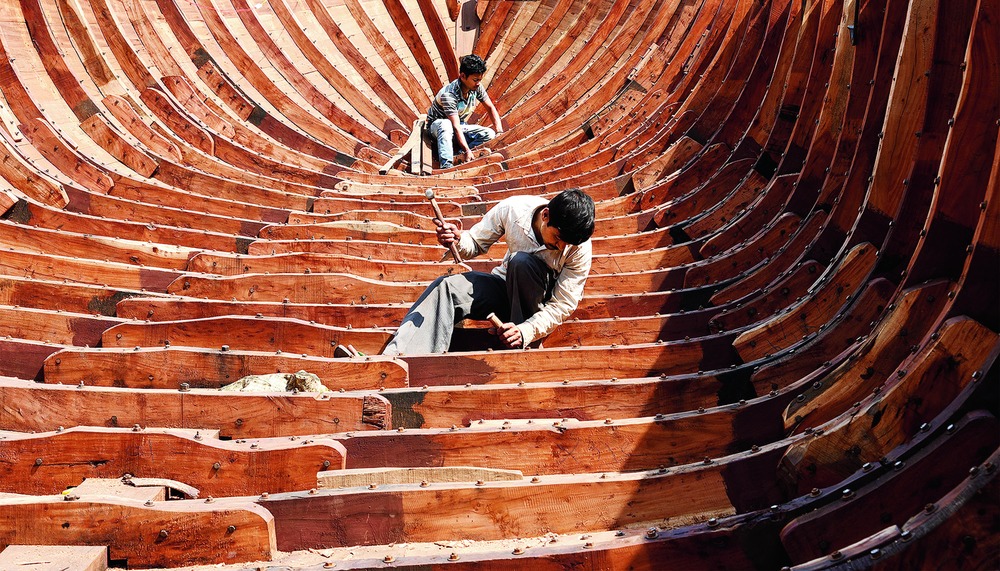
The "factory" is really a patch of land surrounded by asbestos walls. It belongs to NCB Boatbuilders Pvt. Ltd and inside it are rows of boats in different stages of completion. From certain angles they look like human carcasses, particularly the ribcage. About a dozen people are working inside the factory premises. NCB, which has been in this business for five generations now, is after all one of the big players in this market; the smaller ones employ only two to three craftsmen.
Swarup Bhattacharyya is curator of Calcutta's Maulana Azad Museum and a boat researcher. He says, "I think Balagarh's boat-making industry started in the 16th century." The 2016 publication, Connected by the Sea by Oxbow Books, mentions that Balagarh's growth as a boat-building centre might have to do with geographical reasons. "Its location close to the river promotes a riverine economy, and access to raw materials to construct the dingi, e.g. bamboo-groves which also supply accessories... for the carpenters." Most boatmakers have traditionally belonged to the Rajbangshi or fisherfolk community but local Muslim mistris (craftsmen) also do the job now.
Biswaroop Pramanick is a supervisor at NCB. Pointing to one boat he tells you, "This is a vessel boat. It can carry 100 to 200 people. These heavy boats are built near the ghat because it is easy to push them into the water. It takes about 40 people to push a boat this size." The buyer in this case is the Bengal government. Other regular buyers include fisherfolk and private players.
"Our boats are mostly sent to Shankarpur and the Andamans. The last contract we had was for a consignment of boats for the Andamans; each boat was 65-foot long," he continues.
Pramanick might be invoking metric measures, but between hammering away at a dingi nouko (fishing boat) and puffing a bidi, Manik Majhi tells you that around here they talk in terms of haat (an arm's length). The boat he is working on now measures 13 haat and costs around Rs 14,000.
The base of the boat is generally made of sal because it is strong and sturdy. The body is made of Malaysia, babla, kapur and shirish - names of different types of durable wood. But years and years of indiscriminate felling of trees has led to shortage of wood and spiked prices. According to Majhi, when he started working babla cost Rs 200-300 per cubic metre. It now costs Rs 1,000-1,200 per cubic metre.
Supriyo Barik, who is at the helm at NCB, says, " Bhaabchi nouko kora bondho kore di... ebar aapni bujhe jaan (I am considering shutting shop. Make of it what you will)." Indeed, glorious creations such as the saptadinga madhukar, mayurpankhi, aswamukhi are now the stuff of Bengal's boat lore. Expensive wood, cheaper and newer alternatives, scant government attention to water transport, waning profits and a general disinterest on part of the new generation in this very specialised craft is bleeding the boatbuilders of Balagarh. Demonetisation, too, has done its bit. Typically, legally, only the government can sell wood through timber auctions. But post the cash crunch, auctions have stopped, leading to a wood crunch.
The shrinking market has forced boatmakers to fan out to neighbouring areas such as Shankarpur, Kakdwip, Namkhana and Digha - far away in south Bengal - in search of work. Only when the monsoons return and with them the surge in demand for boats in the area, do Balagarh's boatmakers flock back like homing pigeons.
Bhattacharyya explains that structuring the boats requires an intricate understanding of the waters that will be its workspace - depth of the river, current, wave, wind velocity. The way the boat builders work is this: the client gives a list of specifications, these are then converted into a drawing by a naval architect and thereafter passed on to a head mistri who is responsible for a designated number of boats. A target date and a budget are given to him. It is then up to him how many people he wants to work with.
In the case of government purchases, once a boat is designed, the statutory authority has to inspect and approve it and issue a certificate. But in many cases it seems no one is bothered about standard operating procedures anymore. Suprojit Majhi, a mistri-turned-small time entrepreneur says, "Earlier boat-construction was centred in and around Balagarh but not anymore. Ghore ghore nouko toiri hochchhe (Anyone and everyone seems to be making boats) without any care for standards, quality, stability and scientific factors," he laments.
Bhattacharyya mentions that the boatmakers of Bangladesh are more prized. Of course, there is the fact that our neighbour is a riverine country and Bengal's rivers are not networked. But even so, according to him, there is scope for the government to intervene and improve. In Bangladesh, for instance, Runa Khan has set up a "living museum" to preserve and showcase the country's unique cultural heritage of boat-building. Here people can watch as boat carpenters build 40 types of traditional boats.
Balagarh, meantime, continues to haemorrhage. The latest issue is a drug menace which Bhattacharyya links to the temperamental boat business. "For most of the time there is little work. Then, certain times of the year, they [the younger lot of boatmakers in Balagarh] get so much work and have a short time to complete it. They resort to drugs then."
Walking back to the station we come across a house in front of which boats are being made. The enterprise belongs to the Dafadars. Brothers Raja and Raj's grandfather was a fisherman-turned-boatmaker. Now, Raja, who was getting married that evening, manages the business with his father. He complains that there are no special government incentives or concessions for boatmakers. He has to work in a saw mill to supplement the income. He points to an upturned boat, browning in the sun. It seems there were no takers and now it is just another rotting corpse of a boat.
And the metaphor returns. Coincidence or prescience? You decide.