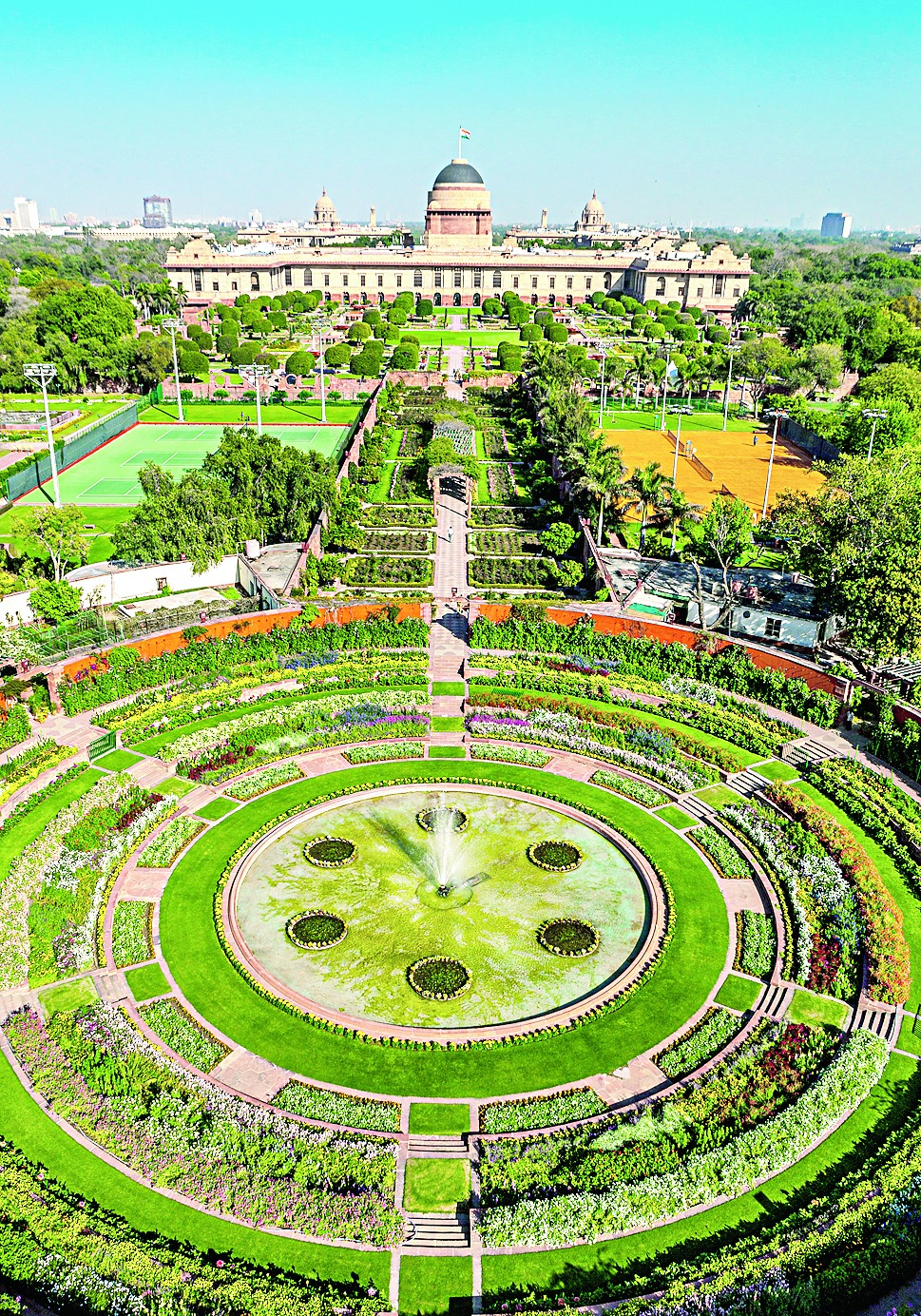
Right in the middle of Delhi is a sprawling mansion that houses the President of India. But the grounds surrounding the imposing pink sandstone edifice are home to various kinds of flora and fauna. For the first time, the rich biodiversity of the majestic Rashtrapati Bhavan, spreading over 330 acres in Lutyens's Delhi, has been mapped and presented in a book called First Garden of the Republic: Nature on the President's Estate.
Development sociologist Amita Baviskar and two other contributors, ecologists Ghazala Shahabuddin and Pradip Krishen, spent over 18 months studying the swathe of green - 160 kinds of trees, plants and climbers and hundreds of species of insects, birds and mammals. Baviskar spoke to T.V. Jayan about the unique features of the estate. Excerpts:

Pics: Narendra Bisht
Q: What's so special about the President's estate?
A: Many people think that the Viceroy's House, as it was called, is a fusion of Eastern and Western architecture. However, the estate's land use is exactly like an English country mansion. Formal gardens close to the house, including the Mughal Garden, give way to rolling lawns and parkland, kitchen gardens (the Dali-khana), orchards and stables. And in the distance are woods (the Ridge) for shooting and riding. The scale and opulence symbolised the power and prestige of the British Empire.
[Edwin] Lutyens's design for the gardens was rigidly geometrical. William Mustoe, who also planted the avenue trees of New Delhi, put in beds of flowering annuals to relax and soften the severe lines of Lutyens's sandstone grid. Mustoe was a rose expert and is said to have grown more than 250 varieties in the Mughal Garden. In the last decade, the garden has become more famous for its tulips.
Q: What surprised you about the estate?
A: Most people focus on the famous 15 acres of formal gardens. For us, the wild part of the estate was a revelation. It was a real surprise to stumble upon the son khair, a tree native to southern India and Sri Lanka, flourishing. This handsome tree is found nowhere else in Delhi and was probably brought by Mustoe as an experiment. None of the avenue trees of New Delhi are planted on the estate.
Another striking thing is the sheer variety of birds. The estate includes a diversity of habitats - forests, orchards, ponds, fields and flower gardens - creating an ecological mosaic that attracts more than 120 bird species. To imagine that all this natural wealth lives right in the heart of the capital city!

Q: What were the major difficulties you encountered during the documentation?
A: Getting historical images was a challenge. While we found photographs of the estate taken soon after construction in the early 1930s in the UK archives, and we could take our own photographs for the current period, Rashtrapati Bhavan's archives have pictures of only presidential activities. There are no pictures to show what the gardens looked like, say, in the 60s or even the 80s. So it was difficult to piece together a continuous narrative. We know from written records that the Dalikhana was used to grow wheat as a patriotic gesture in the days of food shortages in the 1950s but we found no visual record. We tried to record oral history by talking to retired malis and others, but they could tell us only so much.
Q: What problems and challenges do you forsee for the estate?
A: The biggest challenge is to maintain the biodiversity. This means protecting open areas and wilderness that shelter wild plants and animals. Over the years, the Dalikhana has shrunk, the forest nibbled away by new buildings, and some of the lawns converted into parking lots and so on. This has to stop. The other big challenge is maintaining the cultural heritage. How do you make an estate built for expressing colonial power and pomp represent the values and aspirations of a democratic, struggling nation?
A.P.J. Abdul Kalam's gesture was to improve public access and build musical fountains, a menagerie and herbal gardens for their amusement and education. These well-intentioned impulses need to be refined by a historical, ecological and aesthetic sensibility. It is disconcerting to see that, despite ample funds, these sensibilities are missing. The bureaucratic culture of the Central Public Works Department is resistant to innovation and imagination.