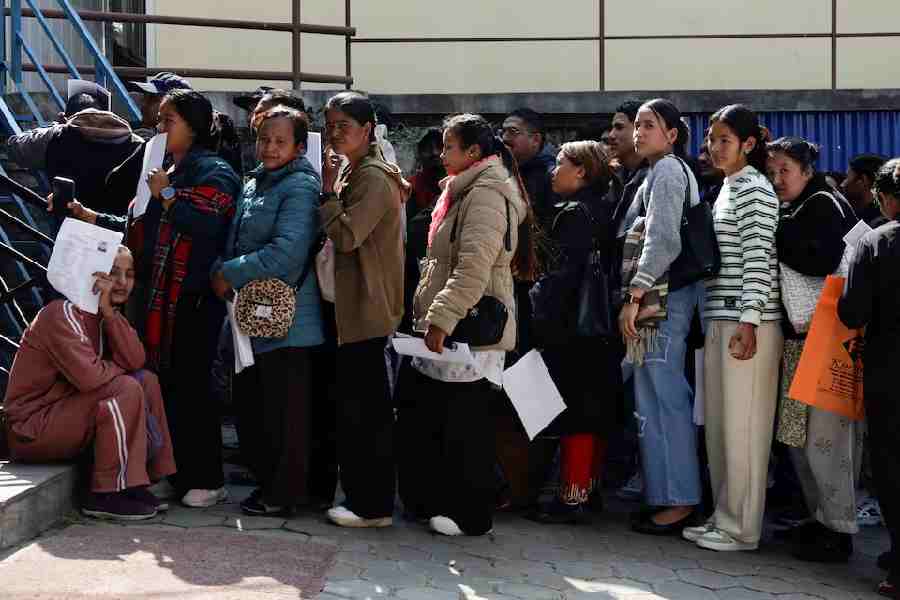
At a training centre in Nepal's capital Kathmandu, Rahul Pariyar carefully hooks his harness to a rope, learning the basic skills he will need for painting walls, cleaning high rises and other construction work in the United Arab Emirates.
"I am not happy to leave my family back and go for work in a foreign country. But what to do?" said the 21-year-old in a yellow hard hat, explaining how wages in Dubai are about four times that of Nepal. The Himalayan nation, perched between China and India, will go to the polls on March 5, an election triggered by historic youth-led protests fuelled by the lack of jobs and endemic corruption that forced an elected prime minister to resign.
But Pariyar said: "I am not interested in the upcoming elections. It does not pay my wages."
Nepal's youth unemployment rate of 20.6% is the highest among all of South and Southeast Asian nations, according to World Bank data, underscoring the failure of successive governments to solve a jobs crisis. At least three million of Nepal's 30 million people - many of them part of the generation that revolted last September - currently work overseas, mainly in the Middle East, according to industry officials.
Around 1,500 young Nepalis leave the country every day for foreign employment, according to data from the Rastriya Shramik Mahasangh Nepal (RSMN), a national federation of labour unions.
"Over the past six months the number of people going for work abroad has increased," said Mahesh Raj Dahal of Motherland Overseas, the recruitment agency where Pariyar is training.
"This is because of the political instability, lack of jobs in Nepal and low wages for workers."
The exodus has left many villages in Nepal's hinterland without most of their working-age men and women, with mainly children and the elderly remaining.
PARTIES VOW OVER A MILLION JOBS
On the campaign, Nepal's biggest political parties are vowing to fix the outflow of workers that began when the country liberalised its economy in 1991 and private recruitment agencies set up shop.
The exodus accelerated as a Maoist insurgency took hold of the countryside in following years.
Widely seen as the frontrunner riding on the popularity of its prime ministerial candidate Balendra Shah, the Rastriya Swatantra Party (RSP) has promised to create 1.2 million jobs to reduce forced migration.
The Nepali Congress, the country's oldest political party, has said it will generate 1.5 million jobs and slash the outflow of workers by half in the next five years.
But there is widespread scepticism they can deliver. Many youth blame Nepal's political parties - some of whom have stoked decades of instability through a merry-go-round of coalitions and elections - for the lack of development and the lack of jobs.
"Nepal was always an agricultural economy, and it directly shifted to the service sector. The politicians here bypassed the manufacturing sector, which created this crisis of jobs," said economist Keshav Acharya, who previously worked at Nepal's central bank.
"They come and make promises, but they hardly act on it."
A range of structural challenges, including policy volatility, inadequate infrastructure, weak governance and skills shortages, have stymied Nepal's industrial sector.
"The manufacturing sector, historically an engine of growth in other developing countries, has been on a constant decline," the World Bank said in a report last year.
"Increasing remittances have also not translated into significant job creation or higher productivity in key sectors." In the fiscal year ending July 15, 2024, Nepal's foreign workers sent 1.44 trillion rupees ($9.93 billion) in remittances, according to central bank data, up 16.5% from the previous year and equalling nearly 25% of Nepal's GDP.
INADEQUATE WAGES
Although Nepal's services sector accounts for more than half of its $42 billion economy, agriculture still provides more than 60% of jobs in the country, where around a fifth of the population earns less than $2 a day.
"Even where people are counted as employed, a bigger problem is under-employment - wages that are not enough to sustain a decent living," said Astha Bhatta of Kathmandu's Institute for Integrated Development Studies.
"That gap between effort and earnings is a major reason why many people try to leave the country."
At Nepal's main international airport in Kathmandu, Ramesh Bahadur B.K. Nimaile was preparing to walk into the departure terminal for a job in Romania.
The eldest of six siblings, 31-year-old Nimaile said he is the family's sole breadwinner and previously worked in Dubai for two years as a labourer before returning home due to poor working conditions.
"Will this election give me a job? No, right? Inflation is soaring, everything is expensive," he said.
"I carry a family debt of over 2.5 million rupees ($17,200). What option do I really have except to migrate for work?"