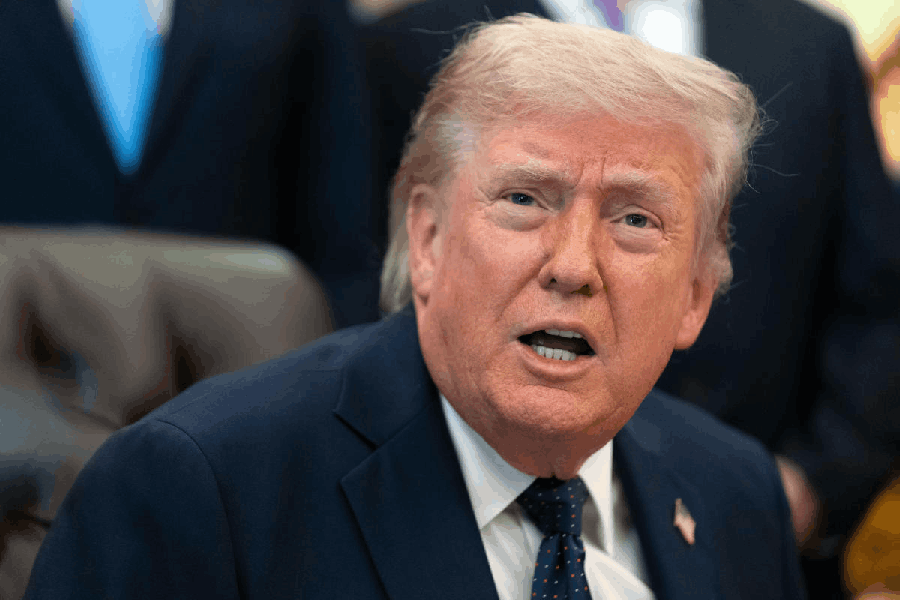
U.S. President Donald Trump's administration created a nearly $1.8 billion fund to settle claims that the Justice Department improperly targeted his political allies in exchange for the president voluntarily dismissing his $10 billion lawsuit against the Internal Revenue Service.
The settlement creates an "Anti-Weaponization Fund" that will pay out legal claims to people who show they suffered "weaponization and lawfare" by the U.S. government.
The Justice Department said there are no partisan requirements to file a claim, but those terms have frequently been used by Trump and his allies to describe the criminal cases against them, including those who stormed the U.S. Capitol on January 6, 2021.
“The machinery of government should never be weaponized against any American, and it is this Department’s intention to make right the wrongs that were previously done while ensuring this never happens again,” Acting Attorney General Todd Blanche said in a statement.
Blanche, a former personal lawyer to Trump who defended him in three criminal cases, will appoint four of the five members of the commission who will decide the merits of the claims.
Trump, his adult sons Donald Trump Jr. and Eric Trump, and the Trump Organization, sued the IRS in January, arguing the agency should have done more to prevent a former contractor from disclosing their tax returns to media outlets during the president's first term.
The case arose from former IRS contractor Charles Littlejohn's leak of Trump's tax returns to media outlets, including the New York Times and ProPublica, in 2019 and 2020.
These returns showed that Trump paid little or no income taxes in many years, the Times reported in 2020.
Prosecutors charged Littlejohn in 2023 with leaking tax records of Trump and thousands of other wealthy Americans to the media, saying he was motivated by a political agenda. Littlejohn later pleaded guilty to improper disclosures, and a judge sentenced him to five years in prison.
Trump filed the lawsuit personally, not in his official capacity as president.
The litigation against the IRS raised novel legal questions, including conflicts of interest, about whether a president can sue his own government.
Under the U.S. Constitution, federal courts may only hear genuine disputes between litigants with opposing stakes in the outcome.
U.S. District Court Judge Kathleen Williams in Miami, who oversees Trump's lawsuit, wrote last month that it was unclear whether the parties to the lawsuit were "truly antagonistic to each other."
Williams had set a court hearing for May 27 to hear arguments on whether she should dismiss the case on those grounds.