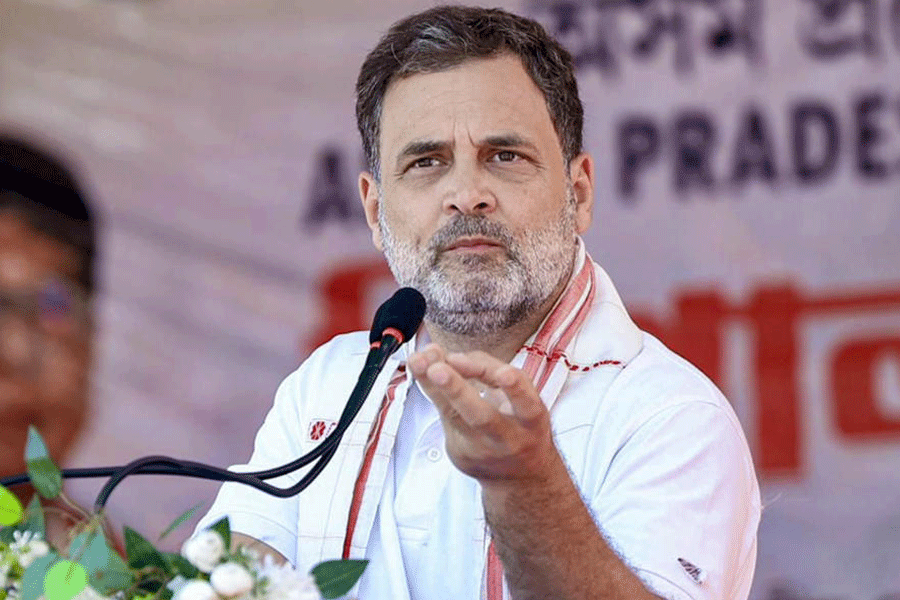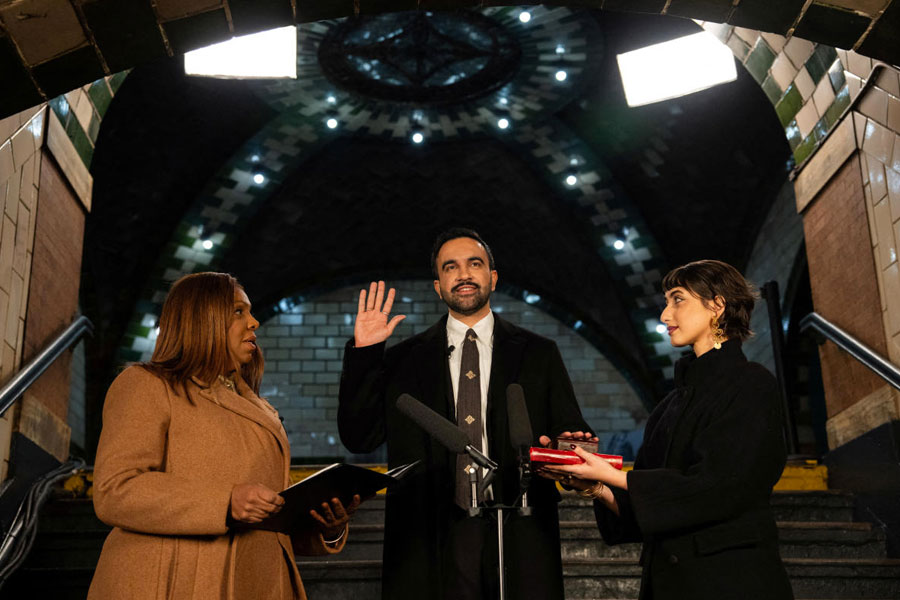
Zohran Mamdani was sworn in as mayor of New York City just after midnight on Thursday, taking the oath of office at the decommissioned City Hall subway station in Manhattan—a site celebrated for its arched ceilings and ornate design.
Mamdani, a Democrat, became the first Muslim leader of America’s largest city, placing his hand on a Quran as he took the oath. “This is truly the honour and the privilege of a lifetime,” he said. The ceremony was administered by New York Attorney General Letitia James, a political ally.
At 34, Mamdani also becomes the city’s first South Asian mayor, the first African-born mayor, and one of the youngest to hold the office in generations. He will be sworn in again at a public ceremony at City Hall at 1 pm on Thursday by U.S. Senator Bernie Sanders, one of his political heroes, followed by a public block party on Broadway’s “Canyon of Heroes,” known for its ticker-tape parades.
For the midnight inauguration, Mamdani placed his hand on two Qurans: one belonging to his grandfather and a pocket-sized manuscript dating to the late 18th or early 19th century, part of the New York Public Library’s Schomburg Center for Research in Black Culture.
“It’s a small Quran, but it brings together elements of faith and identity in New York City history,” said Hiba Abid, the library’s curator for Middle Eastern and Islamic Studies. “The importance of this Quran lies not in luxury, but in accessibility.”
The historic Quran, modest in appearance with a deep red binding and simple floral medallion, was intended for everyday use rather than ceremonial display. Scholars traced its origins to the Ottoman period in the region encompassing present-day Syria, Lebanon, Israel, the Palestinian territories, and Jordan.
Most previous mayors were sworn in on a Bible, though the oath itself requires only allegiance to the federal, state, and city constitutions. Mamdani’s use of the Qurans reflects both his personal faith and his layered background as a South Asian New Yorker born in Uganda, married to American-Syrian Rama Duwaji.
Throughout his campaign, Mamdani emphasized affordability and frequently appeared at mosques across all five boroughs, garnering support among first-time South Asian and Muslim voters. His platform included free child care, free buses, a rent freeze for approximately 1 million households, and a pilot program for city-run grocery stores.
“I will not change who I am, how I eat, or the faith that I’m proud to call my own,” Mamdani said in an emotional speech days before the election. “I will no longer look for myself in the shadows. I will find myself in the light.”
Mamdani faces a city with both promise and challenges. Violent crime has fallen to pre-pandemic levels, tourism has rebounded, and unemployment has returned to pre-COVID norms. Yet residents continue to confront high living costs and rising rents, while the mayor must also manage everyday responsibilities such as trash, snow, rats, potholes, and subway delays.
The new mayor must navigate complex political terrain, including relations with Republican President Donald Trump. During the mayoral race, Trump threatened to withhold federal funding and suggested deploying the National Guard to the city. However, he later surprised many by inviting Mamdani to the White House, stating, “I want him to do a great job and will help him do a great job.”
Mamdani also faces scrutiny from some members of New York’s Jewish community over his criticism of Israel’s government. To ensure continuity, he persuaded Police Commissioner Jessica Tisch to remain in her position, easing business community concerns about potential radical policing changes.
Following the inauguration, the historic pocket-sized Quran will be placed on public display at the New York Public Library. Abid said she hopes the ceremony, which drew both support and criticism, encourages broader engagement with the library’s collections on Islamic life in New York. “This manuscript was meant to be used by ordinary readers when it was produced,” she said. “Today it lives in a public library where anyone can encounter it.”