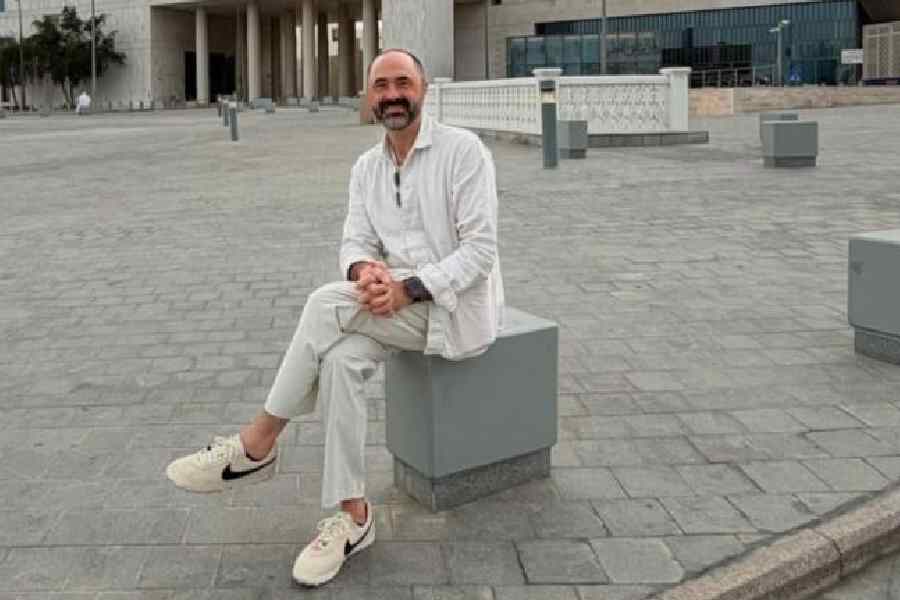
Dr Jay Miller’s once-in-a-lifetime family vacation to India took an unexpected twist on February 28 when his Qatar Airways flight to Dallas made a U-turn about an hour after taking off from Doha, Qatar.
Israel and the US had attacked Iran, which was launching rockets and drones in retaliation. Countries across West Asia, including Qatar, had closed their airspace and cancelled flights, stranding tens of thousands of travellers.
Back on the ground in Doha, Miller heard explosions so powerful that his hotel room’s windows shook.
“It was one of the moments when you tell your spouse you love them, which I did,” he said.
Miller, a 45-year-old pulmonary and critical care specialist, had left India a week earlier than his wife, Swathi Narra, and 5-year-old daughter, Devi, to return to his patients. It was Devi’s first trip to the country, and the family had seen wild leopards and visited the village where Swathi’s deceased father grew up.
Now, he would be spending the next five nights alone in Doha on an emotional roller coaster, trying to distract himself by cautiously exploring the city. Some of his fellow guests at the Andaz Doha, too afraid even to go to their rooms on higher floors, sheltered in the hotel lobby all day.
He tried calling the US state department, filling out forms, and reaching out to Louisiana politicians — all fruitless. By March 4, a day after the state department announced that travellers should not rely on the US government to evacuate them, he decided to escape the region any way he could.
He and Swathi, still in India, furiously searched for flights that would get him anywhere outside West Asia. The Doha airport was still closed, and flight options were scarce. Some jets were departing from Riyadh, Saudi Arabia, a roughly nine-hour drive away. Miller tried his luck.
He found a spot on a flight from Riyadh to Addis Ababa, Ethiopia, selecting it because the departure time was a good fit given the long overland journey. He quickly applied online for visas to the two countries.
“We felt we had to move on our own. There was not time or the circumstances to wait for someone,” he said, adding that an itinerary that initially felt “so crazy and far-fetched” no longer was.
He hired a hotel-recommended driver to take him to the border with Saudi Arabia, then had to find another to get him through the visa and customs checkpoints, and a third to drive him from the border to King Khalid International Airport in Riyadh. In all, the car services cost about $3,000 (₹2.75 lakh).
During a phone interview as the car sped across the Saudi desert, Miller said that his anxiety spiked each time the vehicle passed through routine checkpoints. His overwhelming emotions were “desperation and fear and anxiety to just flee and get out”.
When he arrived at the airport in Riyadh on March 5 evening, the terminal was eerily quiet, with most of the departures — to places like Abu Dhabi, Delhi, Hong Kong and Colombo — cancelled. Sitting in an empty airline lounge, he nervously awaited his 3.40am flight to Addis Ababa.
That flight, operated by Ethiopian Airlines, was packed. He barely slept a wink.
Ethiopia had not been on Miller’s travel wish list before this trip.
But he had 15 hours to fill in Addis Ababa after his flight landed at 6.40am on March 6, and he didn’t feel like spending them at the airport. Though he was running on empty, he seized the chance to visit the National Museum of Ethiopia, home to the skeleton of Lucy, a 3.2-million-year-old hominin that was discovered in the country in 1974. As a self-described die-hard disciple of Charles Darwin, Miller joked by text message that there was no way he’d miss the chance to see “my one true love”.
He also sought out a strong cup of coffee, a beverage Ethiopia is famous for.
He arrived back at the airport about three hours ahead of his 10.40pm departure, but it still turned out to be a close call. To keep him from missing his flight, airport employees whisked him to the front of the security line. His passport was checked five times.
He still had many gruelling miles to go. His Chicago-bound Ethiopian Airways flight made a refuelling stop in Rome six and a half hours later, but passengers did not disembark. Then, with its tanks filled, it took off for Chicago, where it landed shortly before 8am on March 7, about a full week after his first flight made its midair U-turn.
At O’Hare International Airport, he faced a potential gauntlet passing through US customs and immigration, which has been affected by the ongoing shutdown in Department of Homeland Security funding. Even without Global Entry, an expedited entry programme the government suspended because of the shutdown, the line moved at a steady clip. Miller collected his checked bag and
waited three hours for his next departure, a United Airlines flight to New Orleans.
Despite being in the homestretch, he almost didn’t take off.
Backing out from the gate at O’Hare, the plane struck a baggage cart. But the flight was still able to depart, and it landed in New Orleans a little after 2pm on March 7. It had been more than 60 hours since he fled Qatar, and in all, Miller estimated, the journey home cost almost $10,000 (₹9.1 lakh).
About an hour later, he stepped into his house in the Marigny and cracked open a beer. That night, he slept 16 uninterrupted hours. The state department finally called him back that evening, but he was fast asleep in his own bed. The call went to voice mail.
Miller’s voice mail from the state department:“Yes, hello, greetings! I am calling on behalf of the US Department of State’s overseas citizens’ services. We are reaching out because we received an inquiry about your request to depart from Qatar. Please continue to watch your email for assistance from the — from the State Department. If you need to contact us, please call +1 202 501 4444.”
New York Times News Service