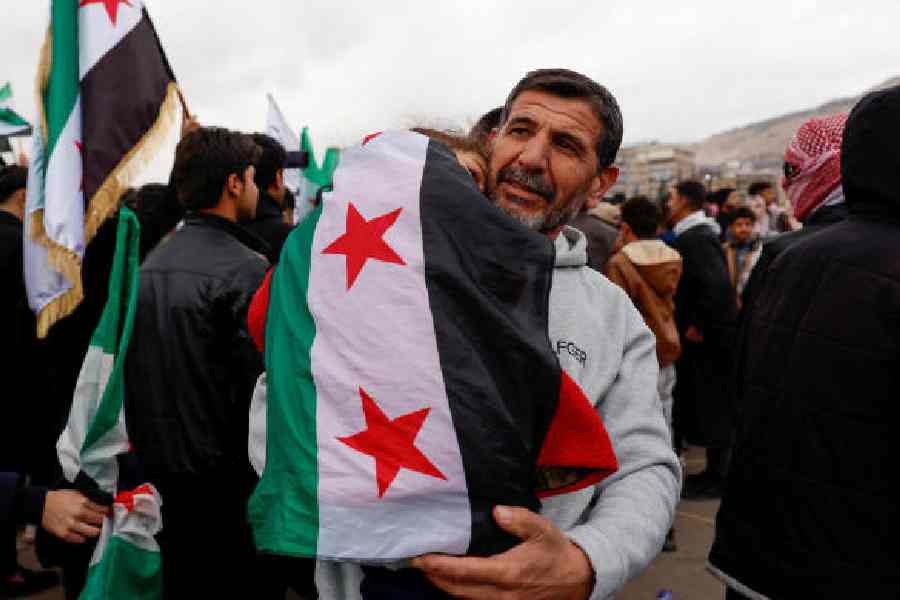
The call to prayer rang out through the cold, still air at dawn on Monday from the historic Umayyad Mosque in Damascus, Syria’s capital, officially beginning the celebrations commemorating a year since the fall of the dictator Bashar al-Assad and the end of his family’s decades-long tyrannical rule.
The festivities come as the country grapples with sectarian violence, deep economic challenges and security gaps that hinder any meaningful recovery. Its new leaders are also contending with how to build institutions that govern equitably for Syria’s estimated 25 million people, while balancing competing regional interests and navigating longstanding social, political and religious divisions.
But for the days leading up to the anniversary, many Syrians said they found reason to unite in joy in their newfound freedom.
Fireworks lit up the sky, music blared from cars and the country’s new flag was waved from balconies. Billboards, with slogans like “One country, one people” and "The dark era is over", reminded people of what they had endured — and what they were now celebrating. At a military expo, officers demonstrated how their weapons, some handmade, helped topple a dictatorship.
On Monday, President Ahmed al-Sharaa joined the events, arriving at the Umayyad Mosque before sunrise to meet the throngs waiting for him.
“The oppression has ended,” said Mohamed Hariri, 48, a trader originally from Daraa, in southwestern Syria, but who was now in Damascus. “We now remain optimistic about the future.”
Hariri’s optimism was a stark contrast to the brutal legacy of the Assad dynasty, which ruled Syria for over five decades. Under both Bashar al-Assad and his father, Hafez al-Assad, the regime maintained control with an iron fist, silencing dissent through torture, imprisonment and fear.
Their ironclad control over the country held firm until the outbreak of civil war in 2011, which spiralled into a nearly 14-year catastrophe and claimed over a half-million lives by some estimates. Syrian refugees scattered across the globe and the country’s once-vibrant cities lay in ruins.
But all of that came undone last December, as rebels seized government strongholds, broke through army posts and swiftly captured the capital. Al-Sharaa, a former commander of a rebel group allied with Al Qaeda, emerged as the country’s de facto leader and immediately began navigating the complex path to rebuilding Syria’s international standing.
Al-Sharaa met with President Donald Trump and spoke at the United Nations in September, the first for a Syrian leader in almost 60 years. He succeeded in getting the US to lift most sanctions that crippled its economy. He urged international investors to fund Syria’s reconstruction through investment and trade.
“No challenge, no matter how great or heavy, will stand in our way,” al-Sharaa said at the mosque on Monday. “No obstacle will deter us. We will face every challenge ahead.”
Despite the optimism, worries persist.
Cuts to subsidies on bread and fuel have left citizens struggling with rising prices. With few job opportunities and low wages, many young Syrians said they saw emigration as their only hope for the future.
New York Times News Service