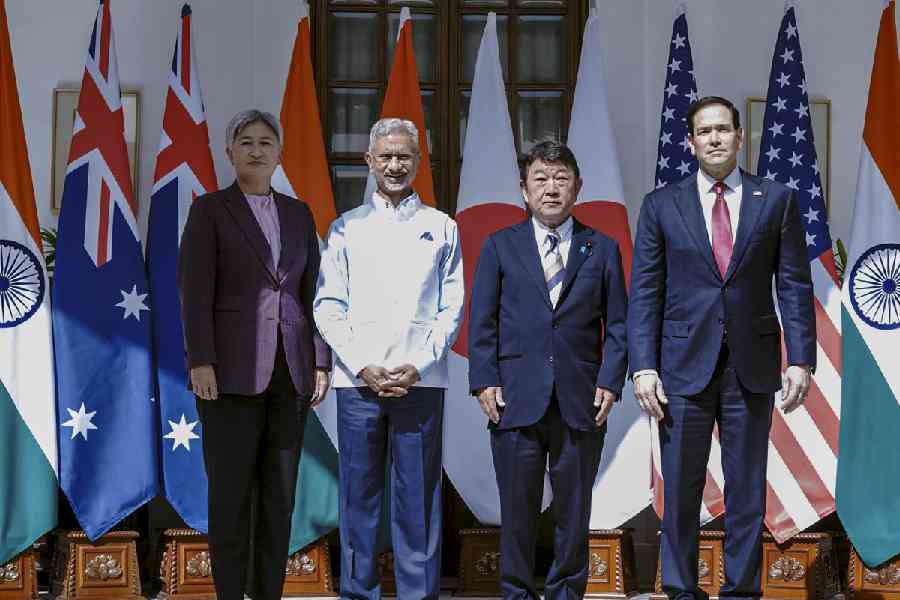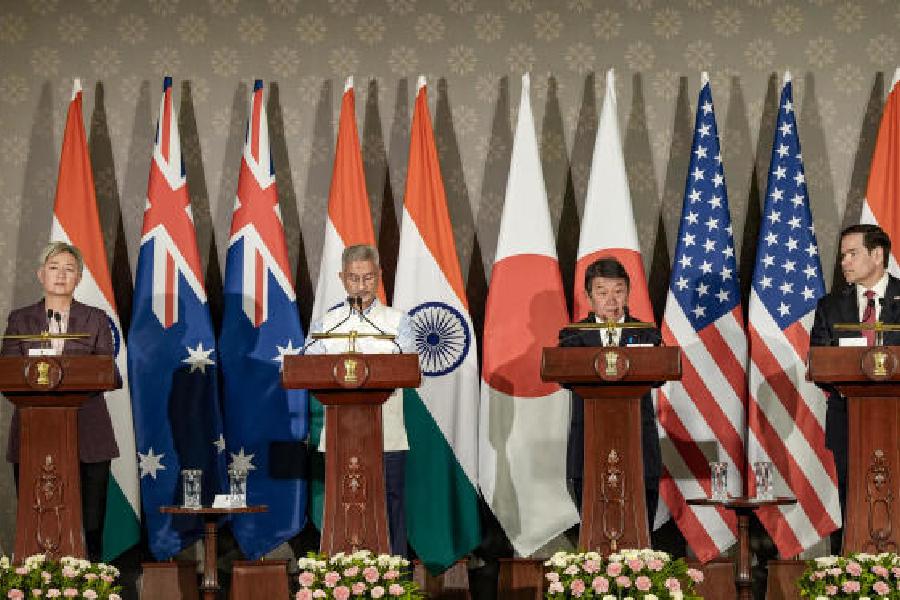
The foreign ministers of India, Australia, Japan and the US on Tuesday agreed to launch a maritime surveillance initiative in the Indo-Pacific and cooperate with the government of Fiji to jointly advance its port infrastructure while expanding cooperation in critical minerals and energy.
The decisions to launch the first-ever Indo-Pacific Maritime Surveillance Collaboration (IPMSC) initiative and partner with Fiji on further developing its port infrastructure drew a sharp response from China.
When the Chinese foreign ministry was asked for a response to the two developments at the daily briefing, spokesperson Mao Ning said: “Cooperation between countries should be conducive to regional peace, stability and prosperity, and not target any third party. We oppose forming exclusive groupings or engaging in bloc confrontation.”
Responding to the criticism from China, K. Nagraj Naidu, additional secretary (Americas) in the external affairs ministry, iterated India’s position that the Quad is not directed at any particular geography. “The focus has been to deliver practical projects,” he said.
As for the Indo-Pacific Maritime Surveillance Collaboration, Naidu maintained that it “should not be seen as militarisation of the Quad; neither is the Indo-Pacific Partnership for Maritime Domain Awareness (IPMDA)”.
According to him, the international waterways today are getting clogged, while at the same time there are a lot of grey and dark ships around.
Grey ships are naval vessels painted that colour to blend with the ocean haze to avoid easy detection. Dark ships are those that switch off their automatic identification systems to avoid detection while transporting smuggled or sanctioned goods.
Pointing out that countries in the Indo-Pacific often do not have access to technologies to monitor such maritime activities, he said the Quad partners had come together to help countries in the region access technologies that are available commercially but are very expensive.
As an example, Naidu cited India getting data on the Indian Ocean Region from the US and circulating it to friendly countries that need such information for their own safety.
Naidu, and earlier in the day, the foreign ministers sought to counter the perception that the US under the second Donald Trump administration had lost interest in the Quad. Through the day, ministers and officials underscored the fact that the Quad foreign ministers had met thrice in a year-and-a-half, insisting that the Trump administration remained invested in the grouping. However, there was no announcement of the long-delayed leaders’ summit that India was to have hosted last year.
There was an articulation of expectation of the leaders’ summit in the joint statement but no mention of when it would be held.
“As four leading democracies and maritime nations, we remain committed to a region where all countries can prosper free from coercion. We look forward to the convening of the Quad Leaders’ Summit, the next Quad Foreign Ministers’ Meeting, and continuing our engagements that advance peace, stability and prosperity in the Indo-Pacific and beyond,” the concluding paragraph of the joint statement said.
In his statement to the media after the meeting, external affairs minister S. Jaishankar said issues like supply chain resilience, connectivity choke points, manufacturing and resource concentrations, and gaps in critical infrastructure offered a new argument for more partnerships, stronger growth, and realising the promise of technologies.
US secretary of state Marco Rubio said the Quad Initiative on Indo-Pacific Energy Security announced on Tuesday would help strengthen regional energy resilience. As per the joint statement, this seeks to address the disruptions to global markets for energy products and important downstream derivatives such as fertilisers, the brunt of which is borne heavily by the Indo-Pacific region.
“Recognising shifts in the global energy landscape, we are launching the Quad Initiative on Indo-Pacific Energy Security to cooperate on energy security and resilience. Quad partners will work together to ensure open, well-functioning and stable energy markets, and resilient and diversified supply chains. Maintaining open trade flows in essential goods is critical for the security and prosperity of the Indo-Pacific region,” the joint statement said.
In her media statement to the media in the morning, Australian foreign minister Penny Wong said: “We are also today announcing the strongest ever commitment from the Quad to the Pacific through the Quad Ports of the Future Partnership, where we are launching a pilot for port infrastructure in Fiji.… It’s a practical demonstration of our collective ability to deliver high-quality, resilient infrastructure in partnership with the region and in response to Pacific priorities.”
About the IPMDA and the IPMSC, she said this would enable partner countries to access near-real-time unclassified satellite tracking data to combat illegal fishing and trafficking, and also enable the Quad to better support humanitarian disaster response.
Elaborating on the Critical Minerals Initiative Framework announced at the meeting, Japanese foreign minister Toshimitsu Motegi held out the hope that it would strengthen the supply chain of critical minerals.
Rubio added that the framework would guide the four countries on how to leverage economic policy tools and coordinate investment to strengthen critical mineral supply chains, including in mining, processing and recycling.