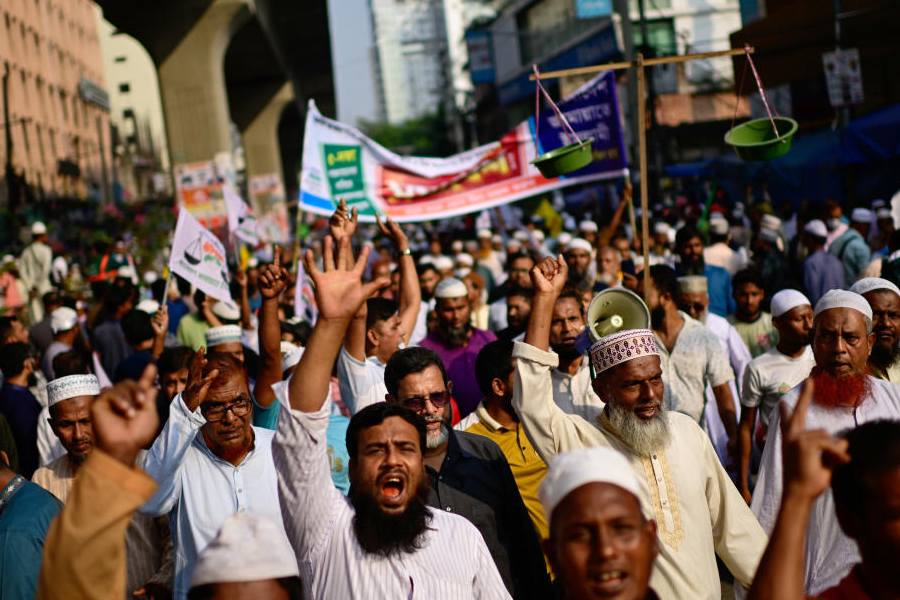
An overnight rupture has surfaced within Bangladesh’s student-led National Citizen Party (NCP) over its proposed electoral alliance with the Jamaat-e-Islami ahead of the February elections, exposing fault lines inside a party that rose rapidly after last year’s political upheaval.
At least 30 NCP leaders have issued a joint letter opposing the plan, while two senior figures have announced their resignation.
The dissent has brought into focus questions of ideology, political memory and the limits of compromise for a party born out of protest.

The NCP emerged in February with the backing of interim government chief Muhammad Yunus, growing out of the Students Against Discrimination (SAD), the platform that led last year’s violent July Uprising.
The movement eventually toppled then prime minister Sheikh Hasina’s Awami League government and pushed a new generation of activists into formal politics.
The first public sign of trouble came on Saturday night, when the party’s joint member-secretary Mushfiq Us Saleheen confirmed that a memorandum had been sent to party convenor Nahid Islam.
Titled “Principled objections to a potential alliance in light of the accountability of the July Uprising and party values”, the document lays out why the signatories believe an alliance with the Jamaat contradicts the NCP’s stated ideology.
The memorandum argues that such a tie-up clashes with the party’s position on the July Uprising and its commitment to democratic ethics.
It flags the Jamaat’s political past, particularly its opposition to Bangladesh’s independence and alleged collaboration in genocide and crimes during the 1971 Liberation War, calling this record incompatible with both Bangladesh’s democratic spirit and the NCP’s core values.
It also alleges that Jamaat’s student wing, Chhatra Shibir, has in recent years infiltrated and sabotaged other parties, spreading misinformation and attempting to blame the NCP for various incidents.
According to the memo, an alliance would erode political credibility and public trust, and create confusion and disappointment among “many of our activists and supporters, especially among the younger generation and ordinary citizens who support new politics”.
The internal note became public soon after a high-profile resignation. On Saturday evening, senior joint member-secretary Tasnim Jara announced she was stepping down from her post.
In a Facebook post, the doctor said, “Due to the current political realities, I have decided not to contest the election as a candidate of any specific party or alliance.”
She said she would contest the parliamentary polls as an independent from a Dhaka constituency.
Jara did not say whether her decision was linked to the Jamaat talks, though newspaper reports said her husband and NCP joint convenor Khaled Saifullah had also quit the party.
Hours later, another senior figure followed suit. NCP joint convener Tajnuva Jabeen, also a doctor and a founding member of the party, announced her resignation in a Facebook post.
Referring to the alliance discussions, she wrote that it was “a political strategy... I would say it was planned”. “It was carefully engineered and brought to this point,” she added, saying she was leaving the party with mental agony as she had no “honourable option”.
Reports in The Ittefaq newspaper suggested that opposition to an alliance with the Jamaat runs deep among women leaders in the party.
According to the report, senior joint convenor Samata Sharmin, senior member-secretary Nahid Sarwar Niva, joint convenor Taznuva Jabin and joint member-secretary Nusrat Tabassum have all expressed reservations about aligning with the Jamaat or any religion-based party.
Most of the signatories to the memorandum, however, are male members. The NCP leadership has so far avoided a formal statement on the proposed alliance.
Yet the Daily Star has reported that the party may finalise a seat-sharing arrangement with the Jamaat within a day or two. Jamaat secretary general Mia Golam Parwar told the newspaper that discussions were continuing.
“There is a possibility of sharing seats, and the issue will become clear very soon,” he said.
Earlier, Prothom Alo reported that the NCP had explored a possible seat-sharing deal with the Bangladesh Nationalist Party (BNP), led by former prime minister Khaleda Zia, but talks did not yield an agreement.
“Since then, NCP talks with Jamaat have progressed positively,” the report said.
The wider political backdrop has added to the tension. With the Awami League disbanded by the interim government through an executive order, the BNP has emerged as the frontrunner in the new political order.
Its former ally Jamaat, once a partner during the BNP’s 2001–2006 tenure in power, is now positioned as a key rival.
For the NCP, still defining itself as a party of “new politics”, the debate over whether to align with the Jamaat has turned into a test of identity.