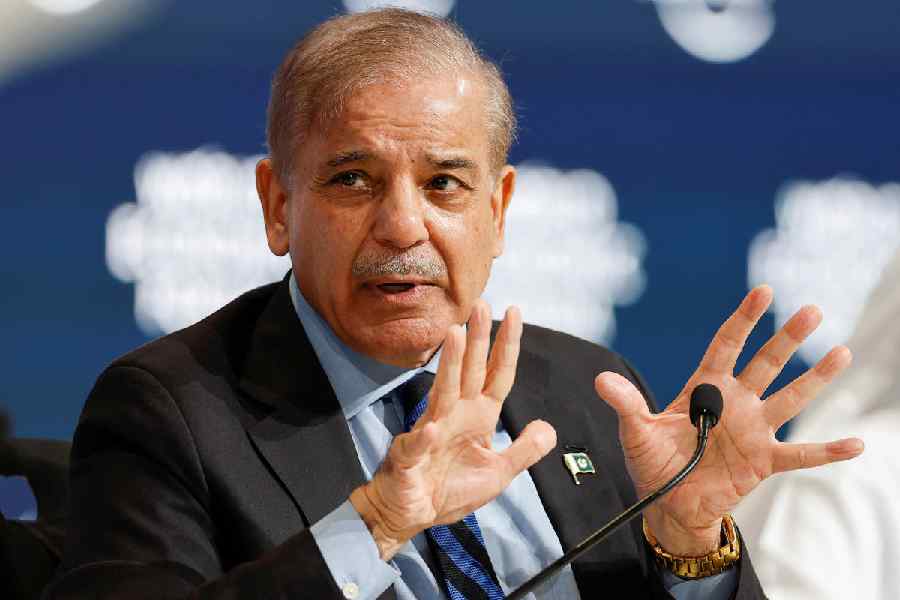
Pakistan Prime Minister Shehbaz Sharif on Monday announced the successful conclusion of high-level talks between the United States and Iran in Switzerland, saying the negotiations had produced “encouraging progress”, including an agreement on a roadmap aimed at reaching a final deal within 60 days.
The talks, held over two days at the Swiss resort of Bürgenstock under the framework of the Islamabad Memorandum of Understanding (MoU), brought together senior representatives from Washington and Tehran, with Pakistan and Qatar acting as mediators.
Announcing the outcome on X, Sharif said: "The First High-Level Committee Meeting under the framework of the Islamabad Memorandum of Understanding has concluded successfully in Bürgenstock, Switzerland."
He added: "The discussions were held in a positive and constructive atmosphere and yielded encouraging progress, including agreement on a roadmap toward a final deal within 60 days, the establishment of a High-Level Committee to provide political oversight, and the commencement of further technical talks."
A joint statement issued by Pakistan and Qatar described the negotiations as constructive and confirmed that both sides had agreed to establish a mechanism for further technical discussions. The statement said a High-Level Committee would oversee the mediation process, receive reports from chief negotiators and supervise working groups focusing on nuclear issues, sanctions and dispute-resolution mechanisms.
The committee has also agreed on a roadmap towards a final agreement within 60 days, paving the way for immediate technical negotiations.
Sharif praised both sides for maintaining dialogue and thanked countries that supported the process.
"I commend the leadership of both the United States as well as Iran for their continued commitment to constructive engagement, and thank all brotherly and friendly countries for their valuable support in advancing this historic process."
He also singled out Qatar for its role in facilitating the talks.
"In particular, I would like to express my gratitude to our brotherly country Qatar, for its critical support in creating the conditions necessary for these negotiations to move forward."
Sharif further thanked Swiss authorities for hosting the negotiations, saying: "A word of thanks to the Swiss Government for their facilitation in hosting these talks."
The Pakistani prime minister also acknowledged the contributions of Pakistan's military and diplomatic leadership.
"I would like to pay special tribute to Field Marshal Asim Munir whose untiring efforts made these talks a success. His dedication, commitment and perseverance are indeed commendable without which there would have been no progress."
He added, "I would like to pay my warm compliments and heartfelt gratitude to Deputy Prime Minister Ishaq Dar, for his diplomatic efforts along with his team at the Foreign Office. I also deeply appreciate the hard work of Interior Minister Mohsin Naqvi who contributed immensely to the success of these talks."
According to the joint statement, a dedicated communication channel has been established between the parties to prevent incidents and miscommunication, and to facilitate the safe passage of commercial vessels through the Strait of Hormuz, a critical global oil transit route that has faced disruptions amid recent regional tensions.
The parties also agreed to create a de-confliction cell involving Lebanon, facilitated by the mediators, to help ensure adherence to commitments regarding the cessation of military operations in Lebanon.
The talks were attended by Pakistan Prime Minister Shehbaz Sharif and Qatari Prime Minister Sheikh Mohammed bin Abdulrahman Al Thani, while the US delegation was led by Vice President JD Vance and the Iranian side by Parliament Speaker Mohammad Bagher Ghalibaf.
Speaking at the summit, Vance described the meeting as a landmark moment in diplomacy.
"This is a historic meet. Never before have Iranian and American leadership met at such a high level outside of Islamabad," he said.
Emphasising the importance of the next phase of negotiations, Vance added, "What today really represents is the beginning of a technical negotiation that's not going to solve every disagreement, but is going to allow us to sit together as teams, for the first time really in history, to figure out what matters most to the respective parties, to settle those issues, to solve those issues, and get to a better tomorrow."
He further said, "The reason why the political leadership of the respective countries is here is because we wanted to, first of all, set up the structure for these technical negotiations, and second of all, make sure that our teams have our full support and know they can always call on us to break through any barriers."
Thanking US President Donald Trump, Vance said a great deal had already been achieved and expressed optimism about future progress.
"Can we change relations in the Middle East, or do we go back to doing things the old way?" he said. "Where Iran and the Gulf have had an unfriendly relationship, or Iran has been a driver of regional instability? We see a future where everyone can work together to promote peace and prosperity for everyone."
Iranian Foreign Minister Abbas Araghchi also welcomed the outcome, saying Pakistani and Qatari mediators had delivered “major progress” toward ending the conflict in Lebanon, adding that the newly created deconfliction mechanism would be the first real test of the process.
The Bürgenstock meeting marked the first formal review of progress under the Islamabad MoU signed last week following diplomatic efforts by Pakistan and Qatar to facilitate dialogue between Washington and Tehran amid heightened regional tensions. The agreement was signed by US President Donald Trump and Iranian President Masoud Pezeshkian, with Sharif signing as a guarantor.
Reaffirming Islamabad’s commitment to the process, Sharif said, "Pakistan will continue to play its honest and sincere role in advancing dialogue and diplomacy towards a peaceful and lasting resolution."