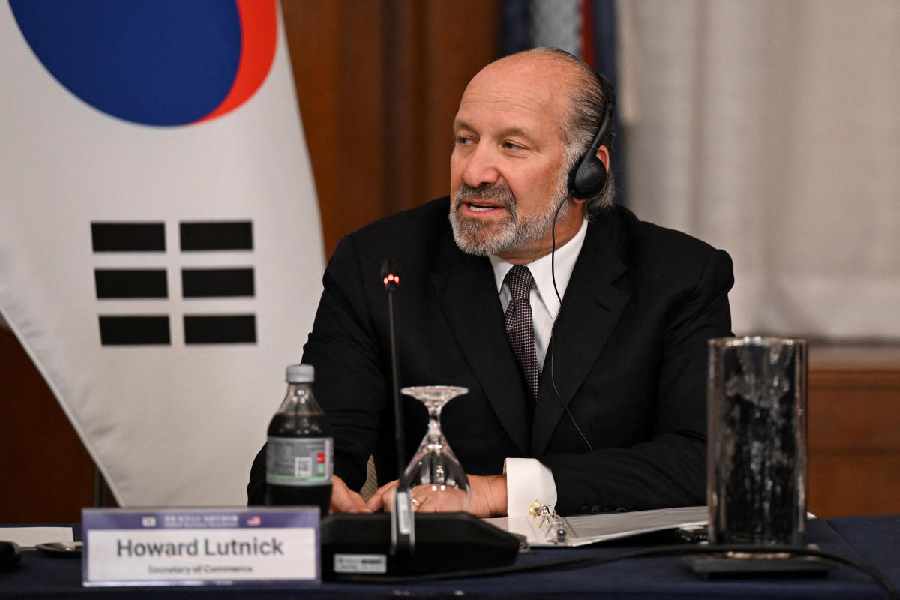
India on Friday contested as “not accurate” US commerce secretary Howard Lutnick’s claim that New Delhi had “missed the train” on signing a trade deal with America because Prime Minister Narendra Modi had not called President Donald Trump within the timeframe set by Washington.
“The characterisation of these discussions in the reported remarks is not accurate,” external affairs ministry spokesperson Randhir Jaiswal said when asked to comment on what Lutnick had said in an interview to the All-In Podcast.
Lutnick said he had set up the whole deal and told India “you have to have Modi call the President".
"They were uncomfortable doing it. So, Modi didn’t call,” he said.
Following this, he said, the US struck trade deals with Indonesia, the Philippines, Vietnam and other countries at a rate higher than India’s.
“Then India calls back and says, ‘Okay, we are ready’…. I said, 'Ready for what? Are you ready for the train that left the station three weeks ago?'…. Sometimes there’s a see-saw and people are on the wrong side of the see-saw,” Lutnick said.
He said Trump’s policy in deal-making was like a staircase where the first stair got the best deal, and indicated the President was hoping to strike his second trade deal with India after having clinched a pact with the UK.
“India just was on the wrong side of the see-saw…. They couldn’t get it done when they needed to…. All other countries did deals and they went further back in the line…,” Lutnick said.
India pushed back on Lutnick’s narrative and underlined that Modi and Trump had spoken to each other eight times in 2025.
“We have seen the remarks. India and the US were committed to negotiating a bilateral trade agreement as far back as February 13 last year. Since then, the two sides have held multiple rounds of negotiations to arrive at a balanced and mutually beneficial trade agreement. On several occasions, we have been close to a deal,” Jaiswal said.
“The characterisation of these discussions in the reported remarks is not accurate. We remain interested in a mutually beneficial trade deal between two complementary economies and look forward to concluding it.”
Jaiswal added: “Incidentally, the Prime Minister and President Trump have also spoken over phone on eight occasions during 2025, covering different aspects of our wide-ranging partnership.”
He sidestepped the question whether India had reached out to the Trump administration on May 10 —the day of the Operation Sindoor ceasefire — through a lobby firm, as mentioned in the filings made under the US Foreign Agent Registration Act (FARA).
The lobby firm, according to the FARA filings, had made four calls on May 10 to senior members of the Trump administration, including trade representative Jamieson Greer.
Trump has repeatedly claimed that he leveraged trade with India and Pakistan to get the two countries to agree to a ceasefire. New Delhi has steadfastly denied Trump’s claim that he had told India and Pakistan that the US would not do a trade deal with either if they continued fighting.
Asserting it’s normal practice in the US for embassies to hire lobbyists and consultants, Jaiswal said India had been hiring such lobbying firms since the 1950s. He, however, did not respond to the specific question whether India had used the lobby firm to reach out to the Trump administration on May 10.
The Congress targeted the Prime Minister for the regular comments from Washington on India, particularly Trump’s claims about New Delhi’s oil purchases from Russia.
In a post on X, Congress president Mallikarjun Kharge said: “US President Trump is commenting daily on India’s Russian oil exports. But Modiji is silent. He is averting his gaze. The ‘sir’ thing looks more like ‘surrender’.”
The allusion appeared to be to Trump’s claim that Modi had addressed him as “Sir” while seeking a meeting with him to fast-track the delivery of the Apache helicopters India had ordered.
Kharge said: “For us, foreign policy means prioritising national interest above all. But the Modi government has dealt a severe blow to our Non-Aligned and Strategic Autonomy foreign policy. The Modi government’s foreign policy swings like a wild pendulum — now this way, now that way — and the people of India are bearing the cost of it.”