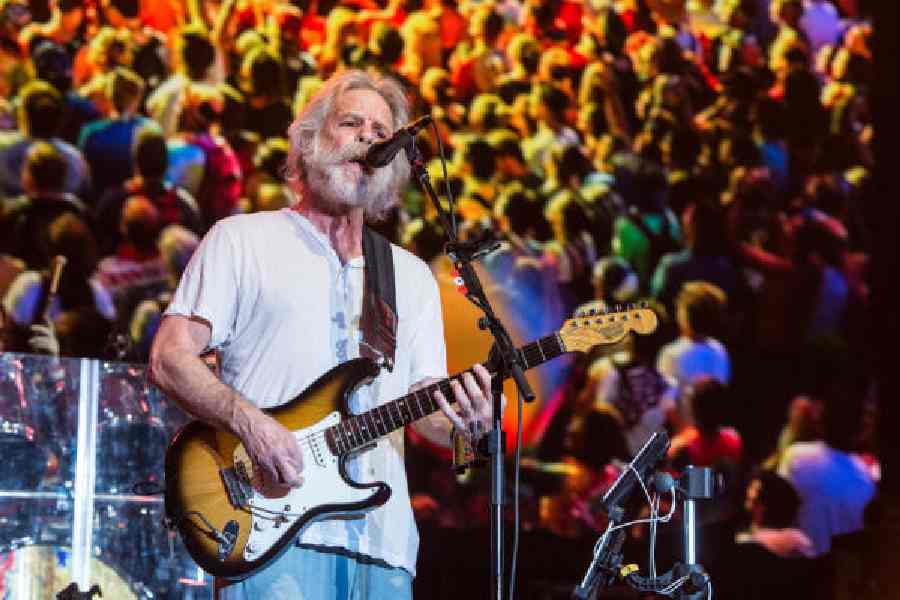
At a young age Bob Weir ran away with the “circus”, which, in this case, was the Grateful Dead, the San Francisco Bay Area band that blended rock, folk, blues and country into a distinctly relaxed and exploratory sound. A co-founder of the most durable psychedelic enterprise of the twentieth century, Weir has died at the age of 78.
The ponytailed guitarist and songwriter sang verses on Truckin’, the band’s most indelible boogie — beloved, among others, by Apple co-founder Steve Jobs — and wrote and co-wrote songs that became fixtures of the Dead’s wandering songbook, including Sugar Magnolia, Playing in the Band and Jack Straw. He died after complications related to lung disease, following a cancer diagnosis disclosed in July.
Weir was sixteen when he joined the jug band that would soon rename itself the Grateful Dead. In the 1960s, he often returned to his parents’ house at daybreak, having played through the night, ate breakfast, and then went to school, an obligation that gradually fell off the radar. When his mother pressed him on the matter, he chose the band.
Jerry Garcia’s presence inevitably dominated the Dead’s mythology, but Weir carved out a role that was both subtler and, in the long run, indispensable. His rhythm guitar avoided the blunt force of chordal strumming, favouring instead a web of counterpoint and texture that slipped between Garcia’s solos and Phil Lesh’s roaming bass lines. After Garcia’s death, in 1995, Weir became the band’s de facto steward, the figure to whom Deadheads looked for continuity, whether through RatDog, the Other Ones, Furthur or Dead & Company.
At the outset, Weir was hardly a virtuoso but eventually influential enough to make him a touchstone of rhythm guitar. Born Robert Hall Parber on October 16, 1947, he was adopted as an infant and raised in Atherton, California, by Frederic and Eleanor Weir. He played guitar, piano and trumpet, and, in an episode now fixed in Grateful Dead lore, wandered into a Palo Alto music shop on New Year’s Eve, 1963, drawn by the sound of a banjo. The banjo belonged to Garcia, who was teaching lessons. By late 1965, the group — having briefly called itself the Warlocks — debuted as the Grateful Dead at Ken Kesey’s Acid Tests.
For a time, Weir was known as “Mr Bob Weir Trouble”, a nickname earned through a combination of loyalty and mischief. When Sue Swanson, an early devotee of the band, threw water balloons from the roof of the house
the Dead occupied in the late sixties, Weir claimed responsibility and was arrested in her stead. Years later, an airline barred the band after he discharged a cap pistol near a ticket agent.
Though never the Dead’s dominant vocalist, Weir was essential to the band’s layered harmonies, which reached their most refined expression on albums like American Beauty and Workingman’s Dead. In his later years, he remained restless, working on a memoir, streaming performances from his Marin studio, and signing with Jack White’s Third Man Records. Dead & Company played extended, well-attended residencies at the Sphere in Las Vegas in 2024 and 2025.
In an interview with Rolling Stone in March 2025, Weir spoke with characteristic plainness about mortality. “I’ll say this,” he said. “I look forward to dying. I tend to think of death as the last and best reward for a life well lived.”
He is survived by his wife, Natascha, and their daughters, Monet and Chloe. One imagines him riding off, at last, to the Dead’s own summary of the journey: What a long, strange trip it’s been.