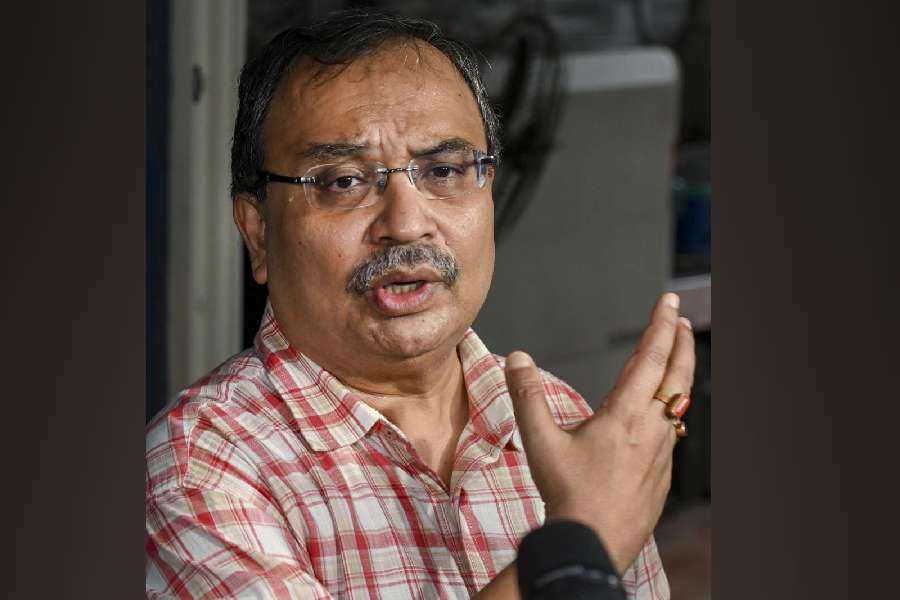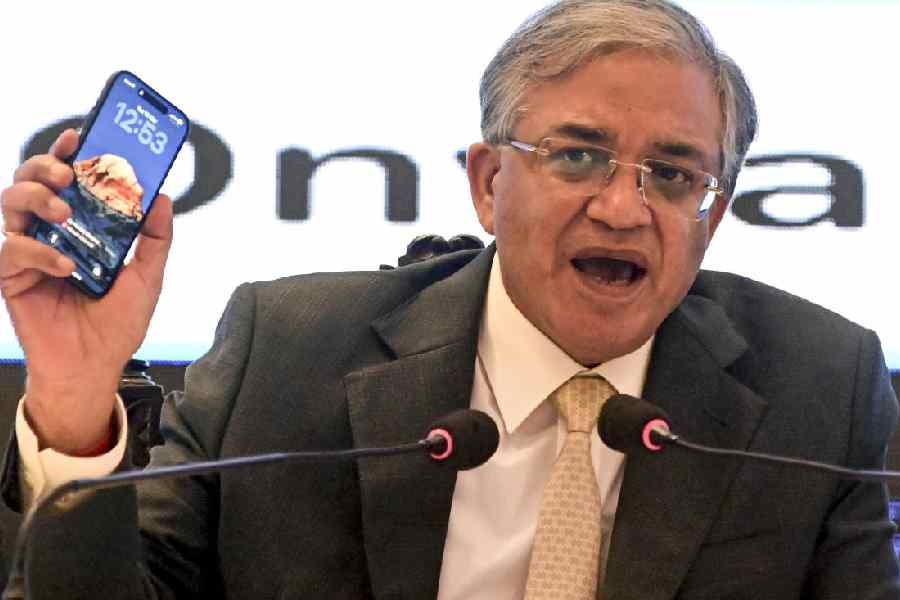
Chief election commissioner Gyanesh Kumar did not have an answer on Tuesday to Bengal’s most-asked question: Will the verification of all the 60.06 lakh under-adjudication voters be completed before the Assembly polls?
Kumar sidestepped the query during an interaction with journalists at a New Town hotel. All he stated was the obvious fact that the voters found eligible by the judicial officers would have their names uploaded on the Election Commission website.
“On supplementary lists, as per the directive of Supreme Court, once the learned judges clear the names, supplementary lists would be published and will be uploaded on the website. It will be updated time to time,” Kumar said.
Those on the under-adjudication list, therefore, continue to remain in the dark about their chances of voting in the upcoming Assembly polls.
Led by Kumar, the full bench of the Election Commission had been on a three-day visit to Calcutta from March 8 to 10 to review Bengal’s poll-preparedness.
Having met political parties, state government officials, representatives of central enforcement agencies and some BLOs over the past two days, the bench left for Delhi in the afternoon after holding the news conference.
Kumar said that instances of logical discrepancies had been found in all the 12 states where the SIR was carried out, but voters’ papers had to be checked particularly stringently in Bengal. This was because a large number of
cases had remained unresolved at the level of the electoral registration officers (EROs) and assistant EROs in the state.
“(In other states) wherever logical discrepancies or unmapped cases were found, the BLOs, the AEROs and the EROs met the electors and conducted the hearings and corrective steps were taken where correct papers were given,” Kumar said.
“However, in West Bengal there were a lot of undecided cases at the level of AEROs because of which micro-observers had to be appointed and documents had to be verified in a stringent manner.”
A poll panel official said it was not possible for the CEC to say whether all the under-adjudication cases would be settled before the polls.
“The cases are being adjudicated by judicial officers under Supreme Court directions. It’s the chief justice of Calcutta High Court who will decide when and how many times the supplementary lists would be published,” an official said.
These 60.06 lakh voters with unresolved “logical discrepancies” were added to the preliminary “final” rolls, published on February 28, but marked “under adjudication”.
They can vote only after the judicial officers appointed by the chief justice of Calcutta High Court approve them for inclusion in the final rolls, and provided the supplementary lists with their names are published before the last date for nominations in their respective constituencies.
A voter, still unsure whether he would be able to vote this time, said: “When the SIR was rolled out, the EC had said that those who could map themselves to the 2002 voter list would be included in the final electoral rolls. Then, how can so many mapped voters like myself be under adjudication?”
The full bench of the poll panel made it clear that multiple measures would be initiated to ensure that free and fair polls were held in Bengal.
The poll panel sent several messages to state government officials during its meetings with the chief secretary, director-general of police, district magistrates and the superintendents of police (SPs). Some of the instructions:
- The rule of law must be enforced without fear or favour;
- Government employees’ conduct should be absolutely nonpartisan;
- The enforcement agencies should remain absolutely impartial;
- All the pending work should be done impartially.
A poll panel source said the commission had emphasised the maintenance of law and order and sent stern messages to the district magistrates and SPs on this.
Kumar made it clear that although the Opposition parties had sought a single or two-phase election, the full bench would go back to Delhi and consider the information collected during its Bengal visit before deciding the number of phases.
“The number of phases would depend on the preparedness and on the law-and-order situation,” the CEC said.