 |
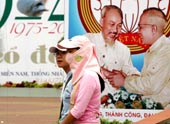
| Women walk past posters on Sunday marking the anniversary of the end of the war in Ho Chi Minh City. (Reuters) |
Ho Chi Minh City, April 24 (Reuters): Thirty years ago Vietnam?s communists won a war over the US and its allies that reunified the country.
As the 30th anniversary of the end of what Vietnamese call ?The American War? approaches, its leader can now claim ? almost ? that they have also won the peace.
Coffee plantations cover the scene of epic battles like Khe Sanh; abandoned American tanks that for decades stood on beaches as reminders of the war have disappeared and been replaced by the laid back sunbeds of five-star seaside resorts.
Vietnam is the world?s biggest exporter of the instant coffee the world drinks; it is the world?s third biggest rice exporter and a net exporter of oil.
Property prices in its biggest metropolis Ho Chi Minh City, known as Saigon in the French and American eras, as well as the capital Hanoi, are soaring to levels of European capitals.
On the weekend, work started on building the country?s tallest building, a nearly 90-storey structure.
In the year ahead, loom landmarks that if achieved would end any final debate about Vietnam?s place in the world ? a possible historic visit this June to the White House by a Vietnamese leader; possible entry into the World Trade Organisation opening global markets to its goods by the end of this year; hosting of a summit next year in Hanoi of Apec, a group including the US and wartime allies like Australia and South Korea.
On my previous visits to Vietnam in 1985, 1995 and 2000, the war always seemed somehow still present. Not anymore. The billboards on highways and cities advertise new businesses, projects and luxury goods, not the achievements and slogans of wartime.
Markets in the smallest village to the biggest towns were bursting with food as though the rice rationing of the years immediately after the war had happened in an ancient time when all the world was hungry.
Foreign tourists are everywhere ? on the beaches, in the villages in the cafes and bars. From the end of April, tourists from Sweden, Norway, Denmark and Finland join Japanese, another nation that occupied Vietnam in World War two, in enjoying visa-free travel to Vietnam.
The notorious Ho Chi Minh Trail, down which the communists poured the troops and supplies that won the war, is now a paved highway not a hidden jungle path.
So is Vietnam still a secretive communist state then?
There still remains a bloated bureaucracy, a tangle of outdated business rules and other regulations that need sweeping away before Vietnam can truly declare itself an open society. The media remains tightly controlled.
But farmers own their land; fishermen own their boats; three bedroom townhouses that would not be out of place in a European city are snapped up for nearly half a million dollars almost the instant they come on the market.
As Saturday?s anniversary approaches, perhaps a sign on a store in Ho Chi Minh City sums up how the old and the new, the communist and the capitalist come together. ?Thirty per cent off all clothes on April 30,? the store advertises.