 |
 |
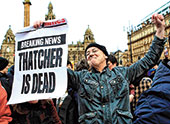
| Two posters in London speak of divided reactions to Thatcher’s death. A man celebrates the former Prime Minister’s death while a written tribute (above) outside her house thanks her. (Reuters and AFP) |
London, April 9: BBC newsreaders have upset some people in Britain by allegedly failing to show respect to Margaret Thatcher with their decision not to wear the traditional black tie on television last night.
The omission provoked a Twitter user to protest: “Would it be too much for the BBC newsreaders to put on a black tie and show some respect!?”
Another user, MediaUK.com managing director James Cridland, tweeted: “No black tie for BBC News Channel presenter? Surprising.”
A BBC spokesman would only say: “The guidance is to dress as appropriate, to dress soberly.”
He had good reason to be evasive. Thatcher received fulsome tributes from politicians and commentators across the spectrum following her death yesterday at the age of 87, but more than a minority openly rejoiced at her death.
A street party was held in Glasgow, almost recalling the celebrations headed by self-styled Sikh leader Jagjit Singh Chauhan in Southall in 1984 after Indira Gandhi’s assassination.
Thatcher’s funeral service is to take place in St Paul’s Cathedral on April 17, with the Queen and Prince Philip in attendance and world leaders flying in.
Thatcher was Queen Elizabeth II’s eighth Prime Minister and the first woman in the job. Their relationship, it is said, was “more businesslike than warm”. The Queen, who too is 87, must have decided that Thatcher could be ranked alongside Winston Churchill, whose funeral too she attended in 1965.
Newspapers published today with wall-to-wall coverage of Thatcher’s death and her life and times are likely to become collectors’ items. What is clear today is that perhaps another 50 years must pass before a dispassionate analysis of the pluses and minuses of Thatcher’s rule can be conducted.
The Daily Mirror was incredulous about plans for a ceremonial funeral, saying Thatcher’s politics had left “bruised and bloodied casualties”. The newspaper’s editorial called her premiership “disastrous”. and said: “Margaret Thatcher broke Britain and replaced what had come before with something crueller, nastier.”
Among the regional newspapers, the front page of the Star in Sheffield, a city that felt a deep impact from her policies on mining, said “we can never forgive her” while The Herald in Scotland summed it up: “Thatcher: Passing of a political giant loved and hated in equal measure.”
The Guardian commented: “There should be no dancing on her grave but it is right there is no state funeral either. Her legacy is of public division, private selfishness and a cult of greed…”
Actually, there was dancing on her grave, metaphorically speaking, at least in Glasgow, where some 300 people gathered in the city’s George Square. Some wore party hats and launched streamers into the air, while a bottle of champagne was opened with a toast to the demise of Thatcher. There was violence when police broke up the celebrations.
In Brixton, a black area in south London and the scene once of riots, some 150 people gathered, opened champagne bottles and shouted: “Maggie, Maggie, Maggie, dead, dead, dead.”
Pop star Morrissey, a long-time critic of Thatcher, said in a statement: “Thatcher is remembered as The Iron Lady only because she possessed completely negative traits such as persistent stubbornness and a determined refusal to listen to others.”
He added: “Every move she made was charged by negativity; she destroyed the British manufacturing industry, she hated the miners, she hated the arts, she hated the Irish Freedom Fighters and allowed them to die, she hated the English poor and did nothing at all to help them, she hated Greenpeace and environmental protectionists; she was the only European political leader who opposed a ban on the ivory trade; she had no wit and no warmth and even her own cabinet booted her out.... As a matter of recorded fact, Thatcher was a terror without an atom of humanity.”
The reaction from miners was visceral. “It looks like one of the best birthdays I have ever had,” rejoiced ex-miner David Hopper, general secretary of the Durham Miners’ Association, who turned 70 today.