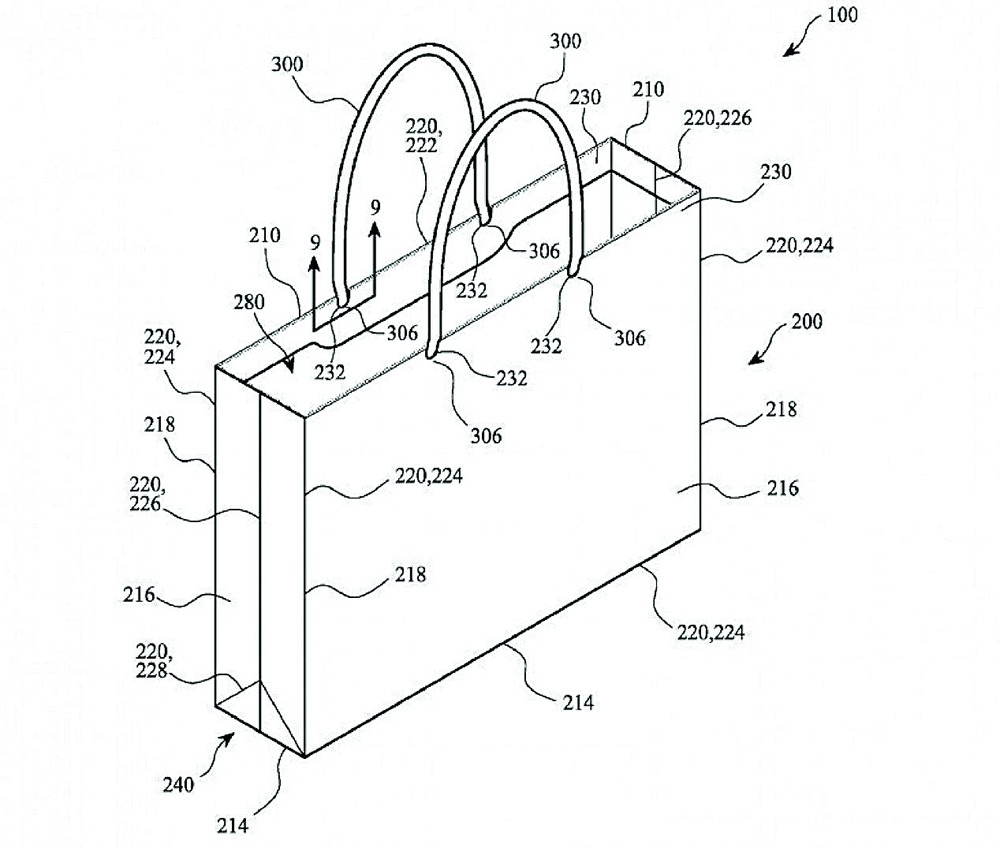

New Delhi, Sept. 22: Apple Inc, the US company that sprang from ideas germinating in a suburban garage and gave the world the iMac, the iPhone, and the iPad, among other products, has now filed a patent application for a paper bag.
The application, published by the US Patents and Trademarks Office on September 15, describes a retail shopping bag made from white paper with 60 per cent "post-consumer content", the paper industry's terminology for recycled paper.
Apple has pointed out in its application that the greater the proportion of recycled paper in white or solid bleached sulfate (SBS) paper, it gets weaker and becomes easier for it to crack or tear.
That is why conventional SBS paper bags are made with 50 per cent or less post-consumer content.
The company said SBS paper with greater than 40 or 50 per cent of post-consumer content would "be considered too weak for use in a bag, particularly a bag with multiple folds such as corner or expansion folds that give it shape or allow it to expand from a flat to an open configuration".
The patent filed by the Cupertino, California-based company, also describes "reinforcement inserts" crafted out of the same material as the bag at key locations such as corners and edges to augment strength and resistance to tearing.
The application says the SBS paper may be used to form high-end retail bags "since it provides sophisticated fit and finish, in contrast to, for example, craft paper (used in conventional grocery store bags) which has rough and dull fit and finish".
Paper scientists say the innovation in the product appears to lie in the combination of materials, design, and the augmented strength of the paper bag.
"Recycled paper is not as strong as virgin paper," said Rita Tandon, director of India's Central Paper and Pulp Research Institute, Saharanpur, Uttar Pradesh.
"The proportion of recycled paper in this shopping bag is large compared to standard paper bags, and the special reinforcement adds to the bag's strength," she told The Telegraph.
"The design also describes the bag's handles completely made from paper - this would be another innovation," Tandon said.
The patent document points out that typical paper handles are "stiff and inflexible" which gives conventional paper handles "a rough and unfinished feel".
The bag handles that Apple has proposed are intended to provide the "feel and flexibility" of a hollow textile tube, like a shoelace.
The patent says: "To effect this feel and flexibility, the handle may be formed of knitted paper fibres in a tight-knit pattern with a large diameter. For example, the handle may be forned in an 8-stitch pattern, and have a diameter greater than 6.5 mm."
Apple, which emerged from efforts by co-founder the late Steve Jobs to build personal computers from out of his parents' garage, transformed personal technology through the introduction of the Macintosh in 1984 and, since then, other innovative products, including the iPhone and iPad.