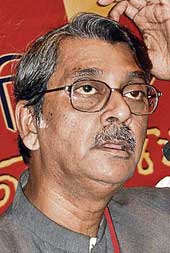

Less than five months left of his term, Bengal's environment minister Sudarshan Ghosh Dastidar says he has plans to fight Calcutta's alarming air pollution that he wants to share with other departments.
While Ghosh Dastidar - not seen or heard in all this time - was presumably hatching these plans, pollution has escalated by over 60 per cent from 2010-13, much of it under his watch. A study conducted by the Delhi-based Centre for Science and Environment and highlighted by Metro, which shows that the people of Calcutta are exposed to higher air pollution than those in Delhi, has thrown up this figure.
Ask the environment department, though, and its answer for lack of action is that vehicular pollution is not its business. Or, ask the minister and he would say: "Though air pollution is definitely a major problem, Calcutta's situation is better than Delhi's."
In a strange twist that makes Bengal different from other places, an environment department exists but vehicular pollution is apparently not under its jurisdiction. A pollution control board has been working for decades but, again, controlling vehicular pollution is not its responsibility. Or, so say their officials.
They take shelter behind the Motor Vehicles Act, which empowers the transport department and police to penalise polluting vehicles.
"We can hardly do anything about containing vehicular pollution as it does not come under the environment department or pollution control board's ambit under law. We, at best, can offer technical support to the transport or police department," said an official.
So what does the board do? Well, among other things, it spends crores on public toilets, crematoria, tube-wells and light and sound fountains.
Environmentalists and former government officials, however, challenge the argument that vehicular pollution is beyond the pale of the environment department and the board. They contend that the none-of-our-business attitude is a consequence of the government's unconcern for the environment.
"It's a complete misrepresentation of fact. The environment department and the agencies under it, particularly the state pollution control board, have ample powers and provisions under the Environment Protection Act and Air Act to act against air pollution from any source - industrial or vehicular," said Biswajit Mukherjee, former chief law officer of the environment department as well as the board.
He recalled the environment department's order of July 2008 through which it had banned all commercial vehicles above 15 years of age and two-stroke autos as well as imposed fines on erring auto emission testing centres. "If we did not have the sanction of law, how could we bring that notification?" asked Mukherjee.
As evidence of the lack of interest in controlling pollution, board sources pointed out how even the practice of catching polluting cars through surprise raids jointly with the motor vehicles department and police had long stopped. Anumita Roy Choudhury, an air pollution expert, said: "All over the country state environment departments and pollution control boards play a key role in containing vehicular pollution. I wonder why that should not happen in Bengal."
Environmentalist Subhas Datta agrees. "There is enough scope within existing environmental norms to act against vehicular pollution but successive governments have never shown either the desire or the drive."
Naba Datta, secretary of Sabuj Mancha, an organisation of environmentalists, recalled the occasion when a team met Ghosh Dastidar after he took charge.
"The delegation demanded action on some key issues, including vehicular pollution. Despite his promise to act soon, nothing has happened in the past four-and-a-half years," he said.
A senior minister said with a twinkle in his eyes: "Ghosh Dastidar is one of the few ministers who have never been ticked off by the chief minister for his department's performance simply because his performance has almost never been reviewed."
Asked if he had been underutilised and his department given less importance, Ghosh Dastidar responded guardedly: "I don't think so."
Pressed some more, he said: "This is the trend (ignoring the environment) everywhere, nationally and internationally."