 |
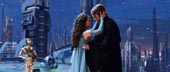
| Padme (Natalie Portman) and Anakin (Hayden Christensen) in a tearful farewell |
The force is strong with the Star Wars legend. Born in 1977, the six-movie epic has come to an end nearly 28 years later with its narrative culmination in Episode III: Revenge of the Sith. But there is little reason to believe that George Lucas?s epoch-making saga won?t live to be as old as Yoda.
The clock has not run out on the tale of Jedi knights fighting the lords of the dark side. As long as there are TV shows on air, novels on bookshelves, action figures in toy stores and video games on consoles and Australians who name Jedi knight as their religion, the legacy is alive.
What makes this rather basic story ? albeit told with unparalleled visual spectacle ? last longer than most film stars? careers? How does it work, time and again, despite the suspect acting and dialogue and two prequels that were widely panned? Despite the fact that audiences know how the story will end, and have known for the past 20 or so years?
Is it all hype and hoopla, gimmickry and gizmos? Certainly not, a Jedi hopeful would say. Here are a few of the elements that have elevated Star Wars to heights few classics can achieve?
Some true wisdom
Lucas did not prioritise his actors, on set or script. No wonder then that his most remarkable creation is Yoda ? first a puppet, then pure computer-generated genius. The Jedi Master of undetermined planetary origin is a diminutive elf-like being who delivers the most weighty lines, with impeccably inverted sentences, in five of the films (he does not appear in A New Hope). Voiced by veteran Frank Oz, here are some samples of Yoda?s truths on?
Ageing well: When nine hundred years old you reach, look as good, you will not.
The nature of evil: Fear is the path to the Dark Side. Fear leads to anger; anger leads to hate; hate leads to suffering.
The ultimate wisdom: Death is a natural part of life. Rejoice for those around you who transform into the Force. Mourn them, do not. Miss them, do not. Attachment leads to jealousy. The shadow of greed, that is. Train yourself to let go of everything you fear to lose.
Machismo: Great warrior, hmm? Wars not make one great.
Tall talk: Size matters not. Look at me. Judge me by my size, do you?
Crystal-ball gazing: Always in motion is the future.
Fighting death: Strong am I in the Force? but not that strong.
The franchise
Nothing works better than a well-oiled marketing machine. If Sith became the biggest ever box-office grosser on debut day in North America, much of the credit goes to perfectly-orchestrated hype, with a few wildly imaginative franchised products thrown in. Star Wars M&Ms ? made only of dark chocolate, of course ? are perhaps the most innovative.
The pre-release mayhem aside, the ?extended universe? of the three-decade old property cuts across boundaries of media and imagination. The movies are really just a tiny piece of this universe that now includes comic books, an animated TV series, novels exploring new adventures, action figures (including Darth Tater, a comic morphing of Darth Vader with Mr Potato Head), video games and even a version of intergalactic Monopoly.
So if Lucas abandoned the idea of a third trilogy, fear not, the excitement ? and the big bucks ? will be around for a long, long time?
 |
 |
| Anakin takes on Obi-Wan (Ewan McGregor) during the final face-off and (above) Yoda wields his lightsaber in Revenge of the Sith |
Light & magic
In an industry where digital tricks create movies like The Mummy and Anaconda, it is easy to forget the magic brought to the big screen by early endeavours like ET and Jaws. But no one came close to Lucas in the path-breaking artistry he put into special effects. The only limits to film-making, Lucas believed, are those of vision.
As a result, just about every film that followed the early Star Wars series owes something to the man. EditDroid, an editing software invented in the 1980s by Lucas?s engineers, was sold to Avid and has become an integral part of post-production outfits everywhere.
His 3-D software unit grew into Pixar. Refusing to be hemmed in by what convention said could be done, Lucas created his own special effects studio, Industrial Light & Magic, which was behind Jurassic Park and Terminator II as well.
His obsession with sound (he sees his movies as silent films that could operate just as well without dialogue) lead to THX certification, a standard of excellence for audio systems.
Keeping it simple
Remove all the visual stunts, and what you are left with is a very simple story ? the best kind ? where good confronts evil and wins.
There could be major planet-shattering hurdles along the way, and nothing is black and white (remember what Obi-Wan had to say ? only a Sith deals in absolutes), but we have known all along that Luke is just a generation away, waiting to save the day.
He sticks to the time-tested ? the Jedi code clearly borrows, robes and all, from Buddhism. There are no controversial gods here, just heroes and villains, right and wrong and the all-pervasive Force.
If that still doesn?t work for you, there is even more simple psychology. Freud for dummies, in fact. Boy separated from mother, immediately falls in love with older woman and will do anything for her. Cut to the next generation where son kills father. And everyone who?s heard of Star Wars has also heard that the lightsaber, a Jedi?s weapon, is actually Freud?s favourite phallic symbol.
What?s not to like?