 |
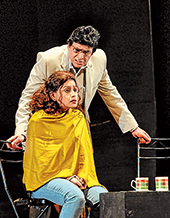
| A scene from Fingerprints 26/11 staged at Madhusudan Mancha. (Sanjoy Chattopadhyaya) |
The Mumbai terror attack of 26/11 has inspired a play on its second anniversary. Rooted in the documentary-theatre tradition of the Spandan group, Sangram Guha’s latest production, Fingerprints 26/11, combines diverse narrative and technical threads to present a collage of real-life events. The play was staged at Madhusudan Mancha on January 13.
The story follows journalist Raka’s investigations into the disappearance of Pakistani musician Suleiman from one of the sites of the terror strike. To unearth the real identity of the man she had been in love with once, Raka has to encounter nerve-wracking situations at every step.
Coming face to face with the aftermath of the violence and the trauma of the attack victims gradually takes a toll on Raka’s sanity. She becomes neurotic and in that state finally deciphers, and becomes one with, the essence of Suleiman’s music.
The characters in the play are based on real people and their experiences. Digital projection of documentary footages lends an edge to the narrative. As does Yanni and Phillip Glass’s music.
Sangram Guha as Suleiman and Shampa Sen as Raka lead a cast of actors who look the part.
Uttiya Jana’s elaborate lighting and Shampa Sen’s starkly minimalist stage décor enhance the interplay between musicality and grimness.
Collector’s choice
Sujoy Roy stood proudly beside his 100-year-old gramophone, its horn gleaming with polish. He had more to show — cuttings of newspaper reports on Tagore that had appeared when the Bard was still alive. “I have 150 of them but this place is not large enough to hold all of them,” Roy said with a hint of pride in his voice.
Many senior citizens like Roy got a chance to display their prized possessions at the Passionate Collections Exhibition 2011, organised by Dignity Foundation at Nehru Children’s Museum on February 9 and 10.
The exhibits included hand-written letters by Netaji Subhas Chandra Bose, curios, rare coins, a miniature painting, match boxes, picture postcards and lace handed down generations.
Also on show were some paintings by veteran danseuse Amala Shankar.
“Till now only my relatives knew about my priceless possessions.It was great to see so many people appreciating my family heirlooms,” said Sheela Bhaduri, who displayed a 250-year-old statue of Lord Shiva and a clarinet dating back to the 18th century.
 |
| A troupe from Tajikistan performs at Sufi Sutra. (Sibendu Das) |
Bollywood bridge
They were speaking Pashtun. The audience understood Hindi and English. An interpreter was trying valiantly to bridge the gap at the Sufi Sutra festival in Nicco Park. After a few Pashtun numbers, the musicians from Afghanistan began playing a familiar tune. It took the audience a few seconds to realise it was of Ae meri zohra jabeen from the 1965 film Waqt but when they did, they were on the their feet, clapping and dancing to the Manna Dey hit. A qawali team from Murshidabad joined the Afghan musicians. And the interpreter was not needed anymore.
 |
Let there be lessons
These days, it is not enough for Saraswati to be worshipped. She has to spoon-feed her worshippers too, much like tutors do. That is perhaps why Saraswati with a kid on her lap and giving him hatey khori has proved such a hit this year. The novel iconography is Uttam Pal’s brainchild. “I made 65 of them and charged Rs 50 more than a traditional idol for each. The demand was such that I fell short,” says the artisan from Chetla. Would he be making the model in greater numbers next year? “No way. I don’t want it to get so popular that others start copying it,” comes the canny retort. The goddess of wisdom also grants common sense. (Sudeshna Banerjee)
(Contributed by Arijit Bhattacharya, Chandreyee Ghose and Sibendu Das)