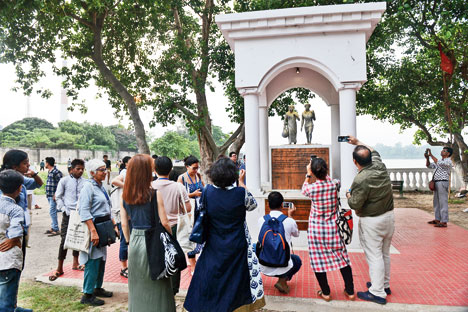

Metiabruz: Thirty students and teachers from universities in China, Japan, South Korea and Hong Kong explored the lanes and bylanes of Metiabruz on Saturday evening.
The stops included Nawab Wajid Ali Shah's private mosque, the imambara where the Nawab as well as his son Birjis Qadr are buried, the Bichali Ghat where Wajid Ali Shah landed on his arrival in Garden Reach way back in May 1856 and Suriname Ghat from where thousands of Indians were packed off to Suriname as bonded labourers.
The tour started with a stop at Suriname Ghat, named after the Carribean country where many Indians were taken as bonded labourers. It is now maintained by the Calcutta Port Trust.

A small statue of a man and a woman with a potli in her hand was installed at the ghat in 2015. "It is a replica of the Baba and Mai monument in Parimaribo, capital of Suriname," said Nabanita Mukherjee, a teacher of English at Bijoy Krishna Girls College in Howrah and one of the three guides for the tour.
The Nawab was allowed to travel to Calcutta after the British annexed Awadh in February 1856. The Nawab spent the rest of his life till he died in 1887 at Metiabruz.
The students, in Calcutta for two weeks for summer school at Jadavpur University, were taken to Bichali Ghat, now a busy ghat ferrying people from Nazirganj in Howrah district to Garden Reach.
The visits were interlaced with facts from the Nawab's life.
"The Nawab had 377 wives. Three of them were nikah wives who the Nawab had married. The three women were permanent wives while the rest were temporary wives with whom the Nawab would sign a contract of marriage for two months to three years," said Samim Ahmed, who wrote the Akhtarnama on the life and times of Wajid Ali Shah.

The marriage became null and void once the contract lapsed. "They were called the mutah (temporary) wives or khilwati (servant Wives). Most of the mutah wives were artistes. They sang and danced," said Samim, the head of the philosophy department at Ramakrishna Mission Vidyamandira, Belur.
The team also visited a private mosque of the Nawab. The last stop was Sibtainabad Imambara, a smaller and less ornate version of the Sibtainabad Imambara in Lucknow.
"Wajid Ali Shah wanted to build a Chhota Lucknow in Metiabruz but didn't have sufficient money," Samim said.
While Sibtainabad Imambara in Lucknow has the grave of Amjad Ali, Wajid Ali's father, the Calcutta imambara is where Wajid Ali and his son were buried. Their graves are still visited by tourists everyday.
The students and teachers were earlier taken for a walk in central Calcutta. On the cards is a a tour of the Chitpore area.

Among Wajid Ali Shah's literary contributions were a history of Hindustani music, several plays and poems. He wrote under the pen name Akhtar.
A teacher at Jadavpur University's film studies department, which is hosting the visitors, said the idea is to expose the visitors to the multi-layered culture of Calcutta, the different kinds of people living in the city and not limit them only to Bengali localities or the colonial city.
"The neighbourhood that we visited on Saturday was very different from the neighbourhood around JU. The people dress and live differently in these two places," said Li Gu, who teaches at a university in China's Chongquing.
Debdatta Chowdhury, an assistant professor of gender studies at the Centre for Studies in Social Sciences in Patuli, was the third guide for Saturday's walk organised by Know Your Neighbour, an NGO.