 |
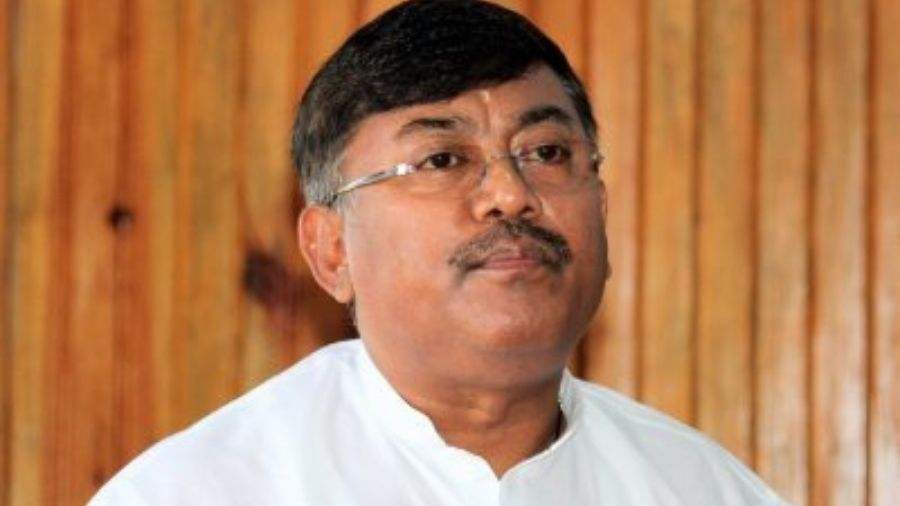
| Basudeb Saha’s potato and onion store in Lake Market. Picture by Sanjoy Chattopadhyaya |
Who says a shop selling potatoes and onions in an old-fashioned market can’t be a lifestyle store? A visit to Basudeb Saha’s store in Lake Market dispels all doubts.
The 51-year-old, who inherited the shop from his father, refuses to accept the stereotype of the dull, dirty potato-and-onion shop. So he has fitted it with a television set, a DVD player with home theatre sound effects and pictures representing many corners of the world and icons and deities of many faiths. The shop is bright and well-lit.
Saha himself is a trim, dapper gentleman, who presides with a calm smile over his neat, little world, where the vegetables do not lie forgotten in giant heaps but are carefully arranged in rows of mounted wooden trays. No, the vegetables do not cost more.
Delay duty
It is a well-known fact that bus passengers are reluctant to pay up when the conductor demands the fare. Even if the bus is relatively empty and the passenger is occupying a seat, he or she heaves a sigh of despair when the conductor stretches his hand out. “Dichchi” (Will give) is the common response. It is never “Ei nin” (Here it is).
If the bus is crowded and the conductor has the temerity to demand his due, the passenger inevitably flares up: “How dare you ask for the fare when I am sweating?” This seems to be an extension of another standard response at all government offices and nationalised banks: “Ekhon hobena. Pore asun.” (Not now. Later.)
Despite the accelerating development and a fast-changing cityscape, Calcutta has not lost the art of delaying duties.
Inner ear
Overheard in an autorickshaw from Gariahat to Rashbehari, a conversation between a kindergarten student and her mother. After a discussion on what was taught in the mathematics class and if the craft-book was submitted, the conversation shifted to the music class.
“They taught us a nice song,” claimed the daughter. The mother asked what the song was. “Aaguner poroshmoni”, came the prompt answer (a well-known Rabindrasangeet).
After some prodding from the mother, the little girl proceeded to sing. But she suddenly stopped mid-song and asked: “Ora KG One purno koro keno bole? (Why do they say finish with Kindergarten One?)”
The words she had misinterpreted happened to be “E jibon purno koro” (fulfil my life). With children getting into the grind so early, it may be natural to mistake KG One for life.