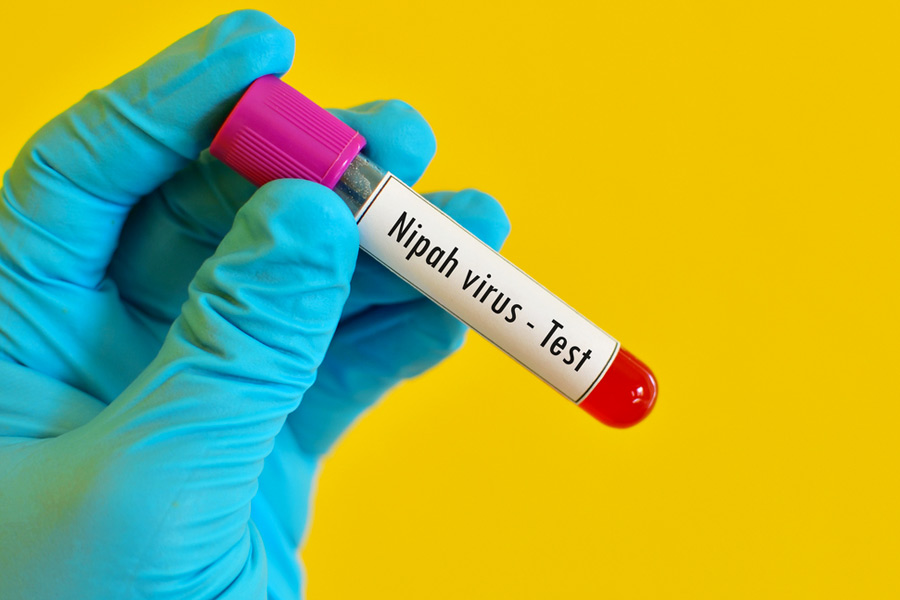
Two nurses suspected of being infected by the Nipah virus are on life support at a private hospital in North 24 Parganas’ Barasat, around 26 km from Kolkata.
The blood samples collected from both the nurses, a man and a woman, were sent to the Virus Research and Diagnostic Laboratory, ICMR, at the All India Institute of Medical Sciences (AIIMS) in Kalyani, around 50 km north of Kolkata in Nadia, and a report has been sent to Swasthya Bhawan, the state health department HQ.
Swasthya Bhawan sources said officials were handling the situation with extreme alarm as the Nipah virus infection has high mortality and potential to spread rapidly.
Top officials from the Union health ministry including the Union health secretary are in touch with Bengal chief secretary Nandini Chakravarty and state health secretary Narayan Swarup Nigam.
The two nurses, employed at the same hospital where they are admitted, are from Nadia’s Kalyani and East Burdwan’s Katwa.
The health department has started contract-tracing in Nadia, East Burdwan and North 24 Parganas.
According to sources, one of the nurses went home to Katwa around 10 days ago and took ill. The nurse was admitted to a hospital in Katwa and later moved to Burdwan Medical College.
After her condition worsened she was brought to the private hospital in Barasat and is in the ICU. The male nurse is also in the ICU on ventilator support and is critical. Both patients have been kept in isolation.
What is Nipah virus
A highly pathogenic zoonotic virus, the Nipah virus can be transmitted from animals to humans and has a mortality rate of 40 per cent to 75 per cent.
The Human Nipah virus (NiV) infection was first recognised in an outbreak of 276 reported cases in Malaysia and Singapore from September 1998 to May 1999.
In India, during 2001 and 2007 two outbreaks in humans were reported from Bengal, neighbouring Bangladesh.
Large fruit bats of Pteropus genus are the natural reservoir of NiV. Recently outbreaks have been reported from Kerala in 2018, 2019 and 2021.
Fruit bats, also called flying foxes, are the animal reservoir for NiV in nature. The Nipah virus is also known to cause illness in pigs.
The common symptoms include fever, headache, muscle pain, vomiting, sore throat and in extreme cases patients may develop dizziness, drowsiness, altered consciousness, acute encephalitis, severe respiratory distress and seizures.
Though the World Health Organization has prioritised treatment for Nipah virus, there are no dedicated drugs or approved treatment protocol yet. Doctors usually rely on broad-spectrum antivirals like Ribavirin.