The battle for control of the TMC is set to enter a decisive phase on Monday, with rival factions expected to submit documents before the Election Commission to stake claim over the party's name, symbol and organisational structure.
The contest, unprecedented in the party's 28-year history, is expected to test competing claims of political legitimacy and organisational control, as both sides seek to establish themselves as the "real" Trinamool Congress.
The EC has asked both sides to furnish documents, organisational records and evidence of support by 5.30 pm on July 6 after hearing preliminary submissions from the rival factions last week.
At the heart of the dispute lies the future of the party's iconic grass-and-flowers symbol, its organisational assets, finances and headquarters, all of which have become subjects of competing claims following an escalating rebellion that has shaken the party since its defeat in the assembly elections.
While the Kalighat camp led by Mamata Banerjee is expected to rely on organisational continuity and the party's founding legacy, the dissident faction is banking on its numerical strength within the legislature and among elected representatives.
The confrontation comes amid one of the most dramatic political ruptures witnessed in West Bengal in recent decades.
The crisis began as a legislative revolt but has since evolved into a full-fledged organisational challenge.
Last month, the dissident camp convened a special session, elected senior MLA Arup Roy as chairperson and unveiled a parallel national leadership structure, arguing that the party's existing leadership had lost the confidence of a majority of its elected representatives.
The rebels first demonstrated their strength when 58 of the TMC's 80 MLAs backed Ritabrata Banerjee's claim to the post of Leader of the Opposition, rejecting the nominee backed by the party leadership. The faction now claims the support of around 65 legislators.
The turmoil has extended beyond the assembly. Twenty-one Lok Sabha MPs led by Kakoli Ghosh Dastidar subsequently aligned with the Nationalist Citizens Party of India (NCPI), significantly weakening Mamata Banerjee's parliamentary position and adding another dimension to the battle over political legitimacy.
The organisational contest acquired a dramatic new twist on Friday when the rebel faction took control of the party headquarters, Trinamool Bhawan, in Kolkata, changed the locks, installed fresh posters and declared it would henceforth operate from the premises.
The move came barely a day after the dissident camp met Chief Election Commissioner Gyanesh Kumar and the two Election Commissioners in New Delhi to press its claim over the party's leadership, symbol, organisational structure and assets.
"We have gathered all documentary evidence and will place it before the commission. We are confident the decision will be based on facts, numbers and organisational legitimacy," a senior leader of the Ritabrata camp said.
The Mamata Banerjee camp has strongly objected to the rebels' claims, maintaining that leaders expelled from the party cannot represent it before the poll panel. Senior party leaders are expected to place their counter-claims before the commission on Monday.
The stakes are particularly high for the Kalighat camp, with senior leaders privately acknowledging that the outcome could have far-reaching implications for the party's future political identity.
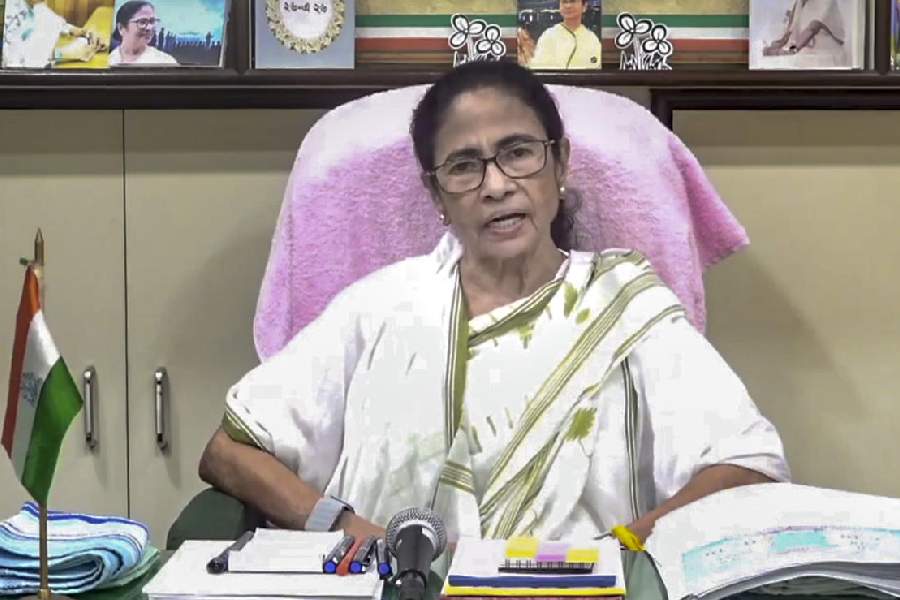
Referring to the rebel faction's move before the EC, Mamata Banerjee on Saturday sought to project confidence that the party would retain its symbol.
"I don't care about the party symbol, although I know they won't be able to snatch it away. They will not succeed since I will dangle the symbol from my neck and reach out to the people. Many have betrayed the party and walked away. They won only because I signed on their nomination papers. At the BJP's behest, they have betrayed the party," she said during a Facebook Live interaction.
In an apparent reference to Gyanesh Kumar, Banerjee added, "But even if they use 'Vanish Kumar' to snatch away the party symbol, they will not be able to silence my voice. Individuals may leave, but an institution does not cease to exist."
A senior leader of the Kalighat camp said the party's organisational structure, elected committees and founding leadership remained intact despite the rebellion.
"The TMC was built by Mamata Banerjee and continues to be led by her. A temporary numerical shift among some elected representatives cannot erase the party's organisational continuity or its connection with workers and supporters across Bengal," the leader said.
The dissident camp, meanwhile, projected confidence, arguing that the dispute would ultimately be settled by the "test of majority".
"We have compiled all documentary evidence and are ready to place it before the commission. The facts and numbers speak for themselves. We have nothing to fear from a transparent process," a senior leader of the Ritabrata camp said.
The dispute has also triggered a parallel battle over control of party properties and finances.
Following its takeover of Trinamool Bhawan- the operational headquarters of the party-- the rebel faction has begun reviewing tenancy and administrative records linked to the premises, signalling that the fight is likely to continue beyond the question of electoral recognition.
For the Election Commission, the case is expected to involve the familiar "test of majority" and scrutiny of organisational records that have shaped previous disputes involving rival factions of recognised political parties.
For the TMC, however, the outcome could prove far more consequential.
With the party's name, symbol, assets and organisational apparatus all under contest, Monday's submissions are expected to mark the beginning of a crucial adjudication process that could determine who carries forward the political legacy of a party that ruled Bengal politics for a decade and a half.