 |
 |
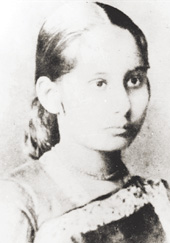
| Mrinalini (top) and Kadambari |
The red brick house at Jorasanko has guarded many a story in its andarmahal, especially about the women, who lived short but eventful lives. What were they like? What did they do? How did they cope with their illustrious husbands? What did they wear, what did they cook? A thousand other questions revolve around the beautiful, erudite ladies of the house.
Jorasanko, written by Aruna Chakravarti and to be published by HarperCollins on the 150th birth anniversary of Rabindranath Tagore, dwells on the women of the household.
An academic and a translator, Chakravarti has written a piece of “bio-fiction” about Jnanadanandini, Kadambari and Mrinalini — the wives of the brothers Satyendranath, Jyotirindranath and Rabindranath. She has also dwelt on Dwarakanath’s wife Digambari, a feisty woman who called in Brahmin pundits to find out what she should do when her husband (a Vaishnavite) began to drink and eat meat, and Debendranath’s wife Sarada, a patibrata who followed her husband’s Brahmo sect, constantly battling her inner conflict.
Why bio-fiction? “It’s based on facts with me fictionalising their conversations. It’s an imaginative recreation of their lives,” says the author.
Jorasanko is a chronological, linear story spanning 45 years from 1859 when Jnanadanandini married Satyendranath to Mrinalini’s death in 1902. All the women, who were married at ages seven to nine, coped with Thakurbari in their own way. Jnanadanandini evolved into a modern woman who started the concept of a nuclear family, living apart with her husband and children outside Thakurbari, much to the displeasure of Debendranath.
Kadambari was a sweet, nurturing woman with an inclination for poetry and music. Neglected by the brilliant Jyotirindranath who was enamoured of his elder sister-in-law Jnanadanandini, Kadambari became a muse to her husband’s younger brother Rabindranath.
While most believe Kadambari took her life after Rabindranath’s marriage, it was in fact Jyotirindranath’s indifference that killed her, says Chakravarti. “The day she died, Jyotirindranath was supposed to take her to a party to celebrate the launch of his ship. He never came,” she said.
And Mrinalini, earlier named Bhabatarini, the daughter of an employee in the Tagore household, lived in the shadows of her dead sister-in-law. While she turned to nurturing the extended Tagore household, towards the end of her life — she too died young at 28 — became a pillar of support for Rabindranath, even selling her jewellery to support his dream of Visva-Bharati.
“Yet Rabindranath never valued her during her life,” says the author.