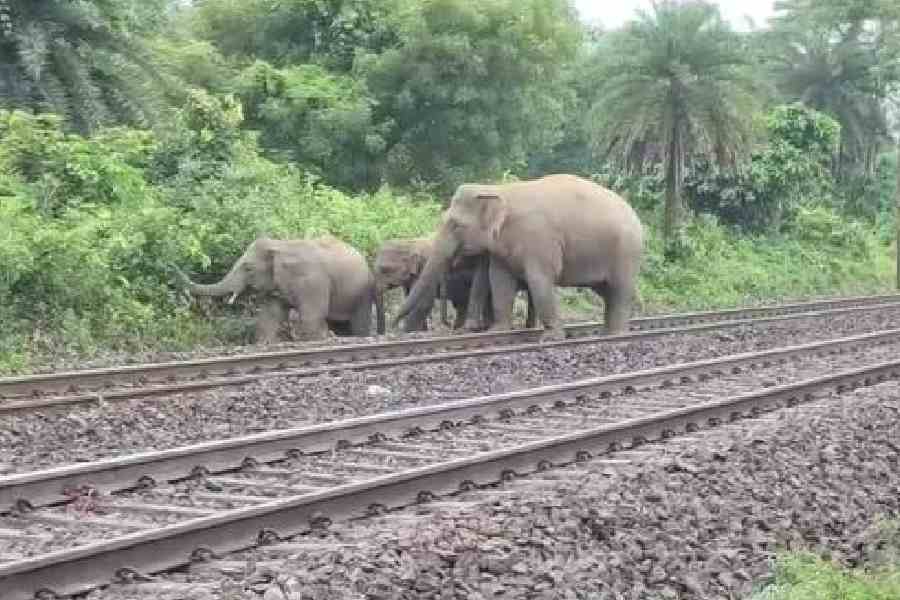
The ministry of environment, forest and climate change (MoEFCC) has decided to construct structures to help wild elephants cross railway tracks without being struck by trains.
The Union ministry will build 705 “mitigation structures” across the country, and around 20 of them will be in north Bengal forests.
“In Bengal, 17 railway stretches were surveyed, and it has been decided that ramps will be built at 15 level crossings. Three underpasses and one overpass will also be built in north Bengal to minimise train-elephant collision,” a senior official of the ministry told The Telegraph.
Bengal, particularly north Bengal, has long stretches of elephant corridors through which railway tracks pass. This makes the animal vulnerable to railway accidents. According to the Union government and other sources, at least 86 elephants died between 2020 and 2025 across the country, and Bengal’s count is 22.
The decision to build the mitigation structures was made at a workshop held on March 10 and 11 at the Wildlife Institute of India (WII), where senior officials of Project Elephant, railways and forest departments were present.
“With instances of wildlife mortality on railway tracks rising, the ministry of environment, forest and climate change, in partnership with Wildlife Institute of India (WII) and the ministry of railways, has identified 110 sensitive railway stretches in the country across elephant ranges and 17 more stretches in two tiger-range states for intervention to ensure greater animal safety,” reads a report of the ministry.
The elephant deaths on the tracks occur mostly in Assam, Bengal, Uttarakhand, Odisha, Tamil Nadu, Karnataka, Kerala, Chhattisgarh and Jharkhand.
Joint field surveys were conducted by Project Elephant, the WII, state forest departments and the railways before the decision to build the mitigation structures
was taken.
“The recommended mitigation package (includes) 705 mitigation structures designed to facilitate safe wildlife passage and reduce collisions,” the report added.
A Bengal forest department officer said increasing habitat fragmentation and expansion of railway infrastructure within elephant habitats led to a rise in the animal’s deaths on the tracks in the country. “The situation is the same in our state, and the measures planned are expected to improve elephant safety,” added the forester.
Along the Siliguri-Alipurduar railway stretch in north Bengal, about 89 elephants were mowed down by trains in four decades — 27 deaths from 1974 to 2002, and 62 from 2004 to 2015. After the narrow gauge was converted into the broad gauge around 25 years ago, train speed increased, and the number of accidents began to rise.
According to the Union ministry, Bengal accounted for about 26 per cent of train-elephant collisions in the country between 1987 and 2007.
The report by the ministry has said that, apart from physical mitigation steps, several technology-based solutions are also being tested and implemented to prevent animal deaths on railway tracks. The tech-based solutions include a specialised acoustic-based intrusion detection system, which is currently tested in north Bengal and an AI-based early-warning device, which was deployed at Madukkarai in Tamil Nadu.