 |
 |
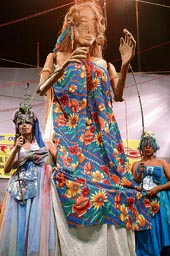
| CTO Rio, the Theatre of the Oppressed group from Brazil, presents Genders at Laalan Mancha; (above) Augusto Boal at the event. Pictures by Sanat Kr Sinha and Amit Datta |
Muktadhara II began late on Thursday. The celebrated guest who was to illustrate the link between acting and activism, Medha Patkar, was over an hour late. Augusto Boal, writer of seminal stage books like Theatre of the Oppressed, Games for Actors and Non-Actors, The Rainbow of Desire, Legislative Theatre, could wait. Theatre could wait. One even wondered whether there was any need for the show at all; after all what can theatre do?
The answer came from Boal soon after he took the podium at Curzon Park: “No, theatre cannot achieve anything. It is but a key and like a key it cannot open the door, it is the person who turns it in the lock who can open the door.”
After the speeches, the lamps were lit by Patkar, Boal and representatives of Jana Sanskriti, which is organising Muktadhara for the second time to celebrate the kind of theatre Boal advocates. And nothing could check the septuagenarian Brazilian’s enthusiasm. “I have just completed 50 years of active participation in theatre and this is a splendid gift,” he said gazing at the assembly of actors and delegates from different Theatre of the Oppressed (TO) centres in India, Palestine, Brazil, Austria, Bangladesh and other places.
Apart from seminars, a workshop and a rally, Muktadhara II is showcasing Forum Theatre presentations, giving Calcutta a four-day exposure to a form that opposes the monologue of conventional theatre. This is a theatre form that provokes viewers to come up with their own solutions and nurtures awareness, turning them into ‘spect-actors’. Inspiring them to put their ideas into practice in real life. Acting turning into activism. Its plays are open to disruptions, analysis and reinvention.
This was the theatre that had caused Boal’s arrest, torture and exile 30 years back, but today he is a man at ease. “Brazil was then under dictatorship, it’s different now. It’s so wonderful to have a President who will listen. So much can be achieved,” smiled Boal. “When I was elected vereador of Rio (a city council seat), some 20 new laws emerged from the Legislative Theatre we practised. For example, after we did Legislative Theatre on the convention of sending children of women prisoners to appointed families, the spect-actors propelled a change in laws and kindergartens were created within prisons where mothers could meet their children everyday. The government of Brazil has paid for the performers of Muktadhara II”.
At Laalan Mancha on Curzon Park, Barbara Santos and CTO Rio had just stopped their presentation of Things of Gender to ask the spect-actors to offer their own resolutions to the problems of gender equality presented. Unlike the earlier Delhi Sramik Sangathan play Humari Ladli, this one from Brazil used a lot of props and costume.
“We use props on the basis of feelings and to express an idea. For instance, in one play on the power of telephones we use phones of sizes matching the relative importance of the person using it,” explained Boal.
Boal had participated in theatre since age nine so right after he had secured a chemical engineering doctorate (his “father’s ambition”) he returned to the stage. By the 1960s he was charting a new course in theatre, “I realised how bad it was, this immense power of the stage, given to it by the majority of the people watching it and making all actions on it seem powerful. Yet, very unfairly, the conventional stage gives the people no power to comment or intervene in the proceedings. So I experimented with new forms…”
There are no playwrights and directors in Boal’s theatre world because where a director thinks of one idea, spect-actors can come forward with a thousand “so there will always be that element of surprise. What we have initially is a model that emerges from a group of actors and a co-ordinator. After its presentation viewers are invited into the play to comment and suggest improvisations. This must not be a game for improvisations, the suggestions must be practical and a consensus must be reached about how best to handle the situation in the third movement,” explained Boal.
With his 30th book, Aesthetics of the Oppressed just released, Boal is gathering information on the punch of cultures, mental facilities, schools and prisons. Will conventional theatre be replaced by theatre of the oppressed? “No, I have nothing against formal theatre. I myself have written operas (though in my own style)… this is merely another language of communication,” concluded Boal.