 |
 |
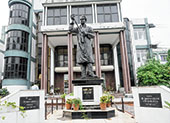
| The larger-than-life statue of Satyajit Ray at the entrance of Roopkala Kendro; (above) students sharing a computer at the editing room. (Anindya Shankar Ray) |
Roopkala Kendro, housed on a sprawling campus in Salt Lake’s Sector V, is a film and social communication institute that was born of a 1995 project of the India and Italy governments. It was later handed over to the department of information and cultural affairs.
Inaugurated in 2002, the institute was conceived of by Satyajit Ray in the 1980s to produce educational audio-visuals for addressing socio-economic challenges faced by the poor and the marginalised.
Metro takes a look at some problems that are preventing the institute from scaling the heights it was meant to achieve.
Audio-visual set-up
Spread over two floors, the institute has four editing rooms, two animation classrooms, four sound edit rooms and one room for recording and mixing. There are no smoke or colour-correction machines.
The faculty feels the need for greater space. “The editing department, for instance, should ideally have eight rooms — one for each student in the department, each with computers — but because there aren’t enough, the students need to use headphones and share a room. The work gets done but clarity of sound doesn’t come through on headphones,” said a faculty member.
‘Practical’ problems
The institute offers six two-year postgraduate diploma courses: direction, editing, cinematography, sound design, animation creation and direction and development communication.
Experts rue the lack of practical training. “The course is theory-based,” said veteran cinematographer Soumendu Roy, an adviser to the cinematography department. “There should be more practical lessons and outdoor training, which do not happen because of inadequate infrastructure.”
The institute has a studio on the ground floor rented out for television shoots while students use a makeshift room to practise. “I used to take students from the first few batches to Technicians’ Studio for practicals but then it got busy and it became difficult to go there all the time. A dedicated studio floor for the students is needed,” Roy added.
Infrastructure
The current infrastructure can only allow for one batch of 56 students. “We take in students in alternate years. When a batch graduates to the second year, it’s called the zero year,” said a faculty member. “We’ve requested for two batches many times but nothing was done.”
It’s a classic Catch-22 situation: while multiple batches would give the institute a much-needed boost, it can hardly support multiple batches because of the lack of infrastructure. “To run more than one batch would be a struggle with the existing set-up. Increasing the student strength would necessitate a bigger faculty and a 100 per cent increase in equipment, implementation and space in terms of classrooms,” the teacher said.
Money matters
Roopkala Kendro receives an annual grant of Rs 1 crore, which goes towards buying equipment, paying teachers and meeting administrative costs. The faculty, however, feels more funds are needed.
“More funds would ensure better maintenance, upgrade of equipment, purchase of the latest software, books and DVDs and in bringing in faculty from Pune, Delhi and Mumbai,” said Roy. “There never has been an upgrade of cameras from the time the institute started.”
“The cameras needed for training purposes have to be bigger and better,” said Roy. “Video technology is changing fast and students graduating from here will have to be adept at these new modes.”
Poor heritage show
The institute possesses a rich collection of memorabilia but these aren’t properly displayed or stored. The collection includes microphones that were used while recording Pather Panchali’s music. A model of the Mitchell camera that was used to shoot the film is kept in a corner of the cinematography room and a collection of rare film stills taken by Bangshee Chandragupta, Arriflex cameras more than 80 years old and old film posters are kept stashed inside a steel almirah.
“An exhibition room with glass doors was created in 2005 on completion of 50 years of Pather Panchali to display the items but the room had to be vacated because of the lack of enough classrooms,” said Roy.