
What happens when two young entrepreneurs, a fashion designer and a wedding planner meet every Sunday? No, they don't discuss latest gadgets, nor the newest trends in high-street fashion. They ensure hundreds of homeless people on the city's streets get a meal and have a reason to smile.
A group of young professionals have come together on social network to feed the homeless in the city, carrying forward a nationwide initiative. The group calls itself Robin Hood Army after the English outlaw because it takes from the rich - in this case eateries with excess food - and distributes among the poor.
Neel Ghose, born and bred in Calcutta and now based in Delhi, started Robin Hood Army in Delhi along with friend Anand Sinha, a 27-year-old entrepreneur, before floating the Calcutta chapter.
Neel, vice-president (international operations) at Zomato, a popular online restaurant finder, had been a part of the Re-Food movement in Portugal during a professional stint in Europe and wanted to start something similar in India.
'In Calcutta, the group started informally, going to a few restaurants, collecting food and giving it to the homeless,' said Chitvan Jaipuria, 26, a wedding and events planner, who along with fashion designer Ankita Dokania, 27, handles the city chapter of the army.
Calcutta is the fifth city with a Robin Hood Army after Mumbai, Hyderabad and Bangalore followed Delhi's lead. The movement has found about 2,000 volunteers nationwide. The 14-volunteer-strong army in the city is a couple of months old and still trying to figure out how to source more food and reach out to more people. The army depends heavily on caterers who rustle up khichdi and a handful of restaurants and cafes that have come on board.
'We are trying to involve more restaurants. At the moment we are even buying food because what we get from restaurants is not enough. But the signs are positive,' said Dokania, a part of the Calcutta army since Day One.
Mustard, Govinda's, Au Bon Pain and Paris Café are some of the city restaurants that have joined the movement. 'The Govinda's general manager came with us and distributed food and he really enjoyed it. He has been giving us food every week. Paris Café and Au Bon Pain have been helping us as well. Our target is to add a restaurant to our contributors' list every week,' added Ankita.
Personal initiatives are critical till more restaurants and caterers are on board. Udayan Bubna, 27, who runs fashion brand Miss Chase, helps out with rice from his mill for khichdi. 'I always wanted to be part of something like this and when I came across Robin Hood Army on Facebook, I had to be join,' Udayan said.
The volunteers connect on WhatsApp and Facebook all week and the core group meets mid-week to chalk out a plan.
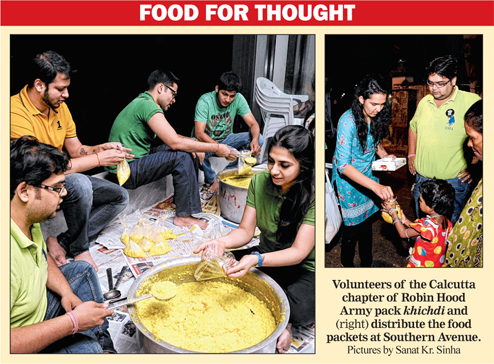
'On Sundays, some of the volunteers pick up food on their way to the meeting point,' said Jaipuria, whose contacts as a wedding planner helped the group approach caterers for support. They start off by putting the food into packets, while exchanging ideas on how the distribution network can be improved. Around 7.30pm, the army heads out in small groups in their personal cars to distribute food. Metro watched the volunteers in green, each sporting a badge saying 'Stop Hunger Now', distribute around 300 packets of food on a recent Sunday evening.
Most volunteers have a specific role in the operation. Some are in charge of social media interaction, a few scout for volunteers and try to get more restaurants on board and others recce for places where food can be distributed.
'We started by distributing food on Chetla Bridge and Southern Avenue, and in Park Circus and later panned out to Sealdah station and Gariahat. We make it a point to explore new areas on every distribution trip,' said Jaipuria.
The long-term plan is ambitious, much like that of the Re-Food programme in Portugal, which aims to end hunger and food wastage.
'Re-Food does what we do in a much, much advanced way. It is very decentralised and community-based,' said Neel, who was a part of the first distribution drive in Calcutta on October 6. So was Ashwika Kapur, wildlife and natural history filmmaker and close friend of Neel's. 'It was absolutely wonderful, if you drive past the city roads at night and look a little harder, you will see so many homeless people. So immensely gratified they are for a small box of food. It's a very small thing that we are doing but it's very satisfying,' said the Green Oscar winner.
The city chapter does not just aim to spread its reach but also to make distribution a daily instead of a weekly event.
In Delhi, food comes not only from restaurants but many more sources. 'We contacted restaurants for food... But the problem with restaurants is that the supply is erratic. So in a lot of cases, we have come up with local kitchens that serve dal chawal and in some places we tied up with parathawalas. This is a far cry from the original model but we have taken the middle path. There are two objectives, serving the homeless and avoiding wastage of food. And here the first objective is much more important,' said Neel, according to whom the Delhi chapter is now in 'auto pilot mode' and teams are being split into small chapters.
The members treasure the response. 'The experience of sharing the food is great. That is actually the best part and the highlight of the day. We distributed chocolates among some children in Park Circus and you have to see them to believe their reaction! The kids love us and we love them too and every Sunday they look forward to meeting us,' said Chitvan.During Diwali, Robin Hood Army initiated a drive #BeRobinThisDiwali wherein they asked people to help the homeless, click a picture and tag Robin Hood Army and hashtag #BeRobinThisDiwali and spread the joy of giving. The campaign went viral and many cities participated in the drive including Faridabad, Jaipur, Shillong, London and Lisbon.