
 |
Whether Birinchi Baba claiming control over celestial objects and making the sun rise on time or Tarini Kabiraj convincing the patient “Hoye, hoye, zanti paroni”, the endearing characters and images from Rajshekhar Basu’s — or rather Parashuram’s — Birinchi Baba and Chikitsa Sankat are immortalised in the minds of Bengali readers.
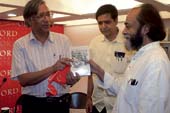
To reach these modern classics to a wider audience, Penguin in its series of translations has brought out a volume of Selected Stories of Parashuram translated by Sukanta Chaudhuri and Palash Baran Pal. The launch of the volume was marked by a function at Oxford Bookstore in the presence of the two translators (picture by Sanat Kr Sinha).
Parashuram’s characters and images are set in late colonial Bengal, and most of his stories are mercilessly satirical, tearing into the fraudulent company promoter in Shri Shri Siddheshwari Limited, the godman in Birinchi Baba, and the various systems of medicine in Chikitsa Sankat. “Rajshehkar’s two chief strategies in these tales exploit his two greatest gifts: brilliant satiric characterisation worked through close detail of speech and conduct and ingenious plot construction,” comments Chaudhuri.
The stories are footnoted in detail so that readers don’t miss out on the nuances. Dialogues have also been translated so the pronunciations match the characters portrayed. Pal, who translates Parashuram’s later works including Paras Pathar, says: “Translating him is challenging as his works are liberally interspersed with quotes from Rabindranath, Puran and other literary texts.”
A bonus for the readers is the reproduction of the original illustrations by Jatindrakumar Sen. Just as Parashuram sketches his characters with economy of words, Sen brings to life his characters using simple black and white sketches. “These are as much a part of Bengal’s cultural heritage as the stories themselves,” writes Sukanta in his introduction.