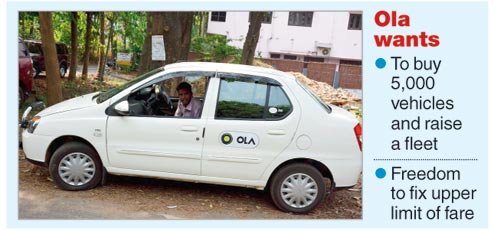

App-cab company Ola has written to the state government proposing to "purchase and invest" in a fleet of 5,000 commercial vehicles in the next 12 months, a move that could potentially change the way taxi aggregators have so far operated in India.
Ola's operations so far, just like its rival Uber's, have been all about "aggregating" car owners who would sign up with the company for a technology platform that allows a passenger to hail a cab through a mobile phone application.
Deciding to buy a fleet of cars for its business would mean a departure and entering the domain of the commercial transport business, a classification Ola had protested when the Bengal government had sought to impose a series of conditions for passenger safety.
The company has specified in the letter that it plans to use the fleet in "Calcutta and the state", adding that the expansion would "translate into an investment upwards of Rs 350 crore".
In exchange, it wants the government to restrict itself to fixing a floor price that should not be below that of yellow taxis, which is Rs 12 a kilometre. Ola wants its say on the upper limit since the fleet is "meant for business users and luxury customers".
Metered taxi operators - the fleet numbers 35,000-odd - have been long demanding the freedom to fix their fares like Ola and Uber. They think this is the only way they can stand up to the competition from app cabs. The Mamata Banerjee government has so far ignored the demand.
Ola and Uber have their pricing patterns. But with Ola now planning to own a fleet of cars and play the market with a flexible price band, the contours of the app-based taxi business could see a big transformation.
So, why this plan?
Diptimoy Nayak, regional head of Ola's new car purchases (east), said the idea was to grow the market and benefit more people. "There are many who want to be a part of our team but can't afford to buy a car. We can lease out the vehicles that we purchase to these people while encouraging them to come on board with us," Nayak told Metro. "It's quite early in the day. This would be done in a phased manner and we are seeking the Bengal government's support in rolling out the plan."
Ola wouldn't spend on incentives to drivers under the new business plan. Instead, the company would offer them the scope to buy out the vehicle at the end of four years with a lump sum payment.
"What it would do in a highly competitive market is retain people with the company," said Sudakshina Gupta, who specialises in transport economics at Calcutta University.
"By retaining people, the company can reap the benefits from the skills that would be developed over a period of time. But this is a new model."
Dipanjan Purkayastha, founder and CEO of TYGR, an app-based transport provider that seeks to bring yellow cabs under one tech platform, isn't so sure it will work. "From a non-asset company to become an asset-based company will be counter-productive and put more pressure on their balance sheet," he said.
The proposal from Ola spells out that given the massive investment and potential for employment generation, the government should consider striking a partnership with the company. If any such agreement were to materialise, the government would need to ensure that all applicants from the company get luxury taxi permits.
The government currently offers up to Rs 1 lakh in subsidy under the Gatidhara scheme to youths planning to buy cars and operate them with luxury taxi permits. Ola has argued that a deal with the company could potentially save the state Rs 50 crore.
Officials of the transport department said they were "looking into" the proposal.