 |
 |
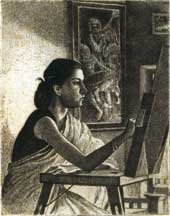
| (From top) Works by Ramendranath Chakraborty |
As in its first show of sculptures, Gallery Rasa has organised an exhibition of the prints of Ramendranath Chakraborty that may not have a high market value but would be of interest to students, academics and people who love art.
The gallery has brought out a catalogue which contains informative essays on an artist whom few remember. The works displayed here were collected in the 1990s from the artist’s family. The paper has become brittle as they date back to the 1930s.
The artist, who was born in Tripura in 1902, was trained in Calcutta at the Government School of Art. Later he moved to Santiniketan to be trained at the newly-formed Kala Bhavan where he encountered French artist Andre Karpeles, who was an expert woodcut artist.
A contemporary of such talented artists as Dhirendra Krishna Deb Burman, Benode Behari Mukherjee and Vinayak Rao Masoji, Chakraborty had the rare ability of focusing on everyday reality and transforming it into visually delightful works. Although his works in other media contained a few paintings in which he fell back on mythology for inspiration, Chakraborty took a great deal of interest in the techniques of Japanese and European art as well.
However, it is in his woodcuts, engravings, linocuts, aquatints and etchings that the artist, who was also a remarkable teacher, came into his own, and the current exhibition provides ample proof of this. The artist played the role of a pioneer in his bid to popularise prints and printmaking about which a lot of confusion still prevails among both artists and the public. In this exhibition there is a series on the artist getting ready to take out a print and a busy litho press.
Later, Chakraborty picked up from the visiting Mexican artist Fryman the technique of creating multi-colour woodcuts. He pursued higher studies at the Slade School of Art, London. Quite a few of his works have been displayed on both floors of the gallery in New Alipore and they demonstrate his mastery of the technique of woodcut.
Chakraborty excelled in depicting the idyllic lives of the Santhals who were his neighbours in Santiniketan. In a particularly powerful work he had delineated the head of a young Santhal man. He also took a lively interest in animal life. His roosting hen and ducks in a pond are delightful. His colour woodcuts of the Rabindranath watching a performance of Chitrangada are quite charming.
The scenic beauty of the Himalayan range, rivers and hills veiled with mist come alive in innumerable etchings, aquatints and woodcuts. There is a particularly sophisticated etching of a young woman in a studio. Those were times when women had just begun to shed their inhibitions and were embarking on careers of their own. Chakraborty presented such an independent-minded woman.
However, his evocation of life in cities as far-flung as Calcutta, Paris and London lacks the freshness that characterises his village scenes. They are flat and look quite dated. Perhaps, urban life with all its complexity did not appeal to him.
Soumitra Das
Notes of nostalgia
 |
| Avik with Sandip Ray and father Barun Chanda at the launch of his book at Crossword. Picture by Pabitra Das |
Homesickness, especially on foreign soil, can resuscitate one’s attachment with the mother tongue. It happened with Avik Chanda, now a management consultant based in Hyderabad, when work dragged him around the world a few years back.
On Wednesday evening at Crossword, a collection of his poems, Jakhon Bideshe, was unveiled by film-maker Sandip Ray, while Barun Chanda, Avik’s father and Satyajit Ray’s lead man in Seemabaddha, looked on.
“A kind of homesickness grips you when you are abroad for some time at a stretch and then you meet some Bengalis and bond with them. I would look up the Net for Durga puja coverage and there would be a sense of nostalgia in me. Jakhon Bideshe arose from that,” says the economics graduate from Presidency College who did his Masters from Delhi School of Economics.
Avik has been writing for the past four-five years and has also been published in English “on and off in the US and the UK”. It was at the instance of a few Bengali friends settled abroad that he decided to try his hand at writing poetry in Bengali.
Words came spontaneously, says the 34-year-old, when he sat down to pen his thoughts. “I was in the habit of reading Bengali literature, at times maybe Sharadiya Desh, so it wasn’t a problem. But I tried not to get influenced by the writings of other poets.”
Crisp and lucid language creating powerful imageries spouts freely from Avik’s pen. “I started thinking of a theme and came upon this idea of stitching together the poems I had written abroad. I had read Bengali poets who wrote about their experiences when they were in foreign countries. Buddhadeb Basu had written when he was in the US and so did Nirendranath Chakraborty when he was in Europe,” explains Avik.
Most places his work has taken him to — Cologne, Berlin, Amsterdam, Paris, Brussels, Milan, Rome, London — roam the pages of Avik’s poetry.
Jakhon Bideshe is published by Pratibhash. On Wednesday evening, Barun Chanda, Shankarlal Bhattacharya and Sujoy Prosad Chatterjee read out some of Avik’s poems.
Now, the young poet has set his sights on a novel in English.