Alleged attacks on Muslim migrant workers from Murshidabad district in Bengal continue unabated in Odisha and other BJP-ruled states, forcing many to flee their workplaces and return home in fear.
The latest such incident was reported on Sunday from Sambalpur district of Odisha, where a migrant worker from Murshidabad was allegedly assaulted, leaving one of his arms fractured.
While the injured worker managed to return home, numerous others working across Odisha, Chhattisgarh and neighbouring states have been compelled to abandon their livelihoods amid sustained violence, intimidation and threats to their lives.
The gravity of the situation prompted Congress working committee member Adhir Ranjan Chowdhury to rush to Sambalpur on Sunday. Chowdhury met migrant workers from Bengal, listened to their accounts of harassment and violence, and coordinated with the local Congress leadership to extend organisational and legal support to the affected migrants.
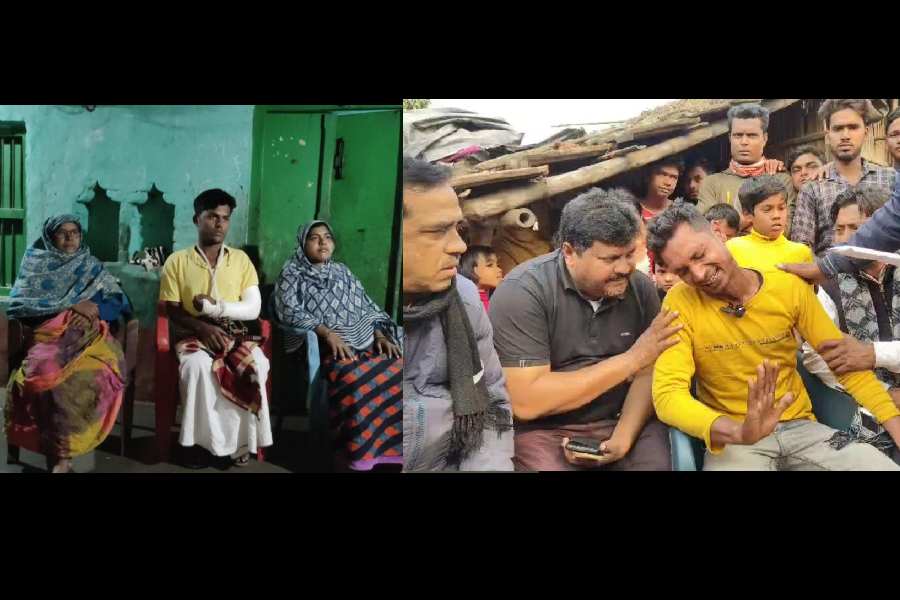
Ezaz Ali, 27, a resident of Dhulian in Murshidabad district, is one such worker whose life has been upended by the violence. A mason by profession, Ezaz had gone to the Pithebali area of Sambalpur district two months ago in search of work. Last week, a group of people allegedly entered the house where he and other workers were staying and demanded to see their Aadhaar and voter identity cards. After examining the documents, the attackers tore them up and accused the workers of being Bangladeshis.
Ezaz and his co-workers were then beaten with sticks and iron rods. While Kaber Sheikh and Rashed Sheikh sustained injuries, Ezaz suffered a fracture in his left hand. Without receiving any treatment in Odisha, he returned to Dhulian by train the following day. An orthopaedic surgeon later confirmed the fracture, and Ezaz is now confined to his home with his injured hand in plaster, unsure how he will support his wife and two children.
“I work as a mason. If I work here in Bengal, I get ₹400 daily. If I work outside, I get ₹1,000 daily. So two months ago, I went to Sambalpur through a labour contractor, along with 15 others, to work in a construction project under a promoter,” Ezaz said.
“We worked during the day and cooked for ourselves in the evening. Last week, a group of seven people wearing saffron clothes and tilak on their foreheads came and asked to see our Aadhaar and voter cards. We showed them the cards. After seeing that we were Muslims, they said, ‘You are Bangladeshi, not Indian,’ and started beating us with rods and sticks. We screamed and tried to run away. Somehow, we escaped. They took away all the money and mobile phones from our house. When I called home, my family told me to return immediately. I don’t know what to do now.”
A similarly harrowing account has emerged from Chhattisgarh, where three migrant workers from Murshidabad were subjected to extreme violence near Narayanpur town. Yadul Sheikh, 28, Niamat Sheikh, 30, and Hanif Sheikh, 65, all residents of the Sagardighi area, earn their living by peddling blankets and other goods on motorbikes across Odisha and adjoining regions. The attack purportedly occurred when they were travelling to Narayanpur in Chhattisgarh to collect orders.
According to their statements, a group of eight men stopped them on the national highway bypass near Narayanpur and demanded their Aadhaar and voter cards. After identifying them as Muslims, the attackers tore up the documents and accused them of being Bangladeshis. The trio were then beaten with sticks and rods.
Fearing the presence of CCTV cameras on the highway, the assailants dragged them into a lane near the market, where the beating intensified. Yadul and Niamat were tied with a rope to an electric pole, petrol siphoned from their motorbikes was poured over them, and the attackers discussed setting them on fire. At the last moment, one of the men intervened, preventing the act. The victims were then ordered to flee.
Without lodging any complaint, the traumatised workers somehow managed to return home by train the following day.
“Somehow I am alive, and I am grateful to the Almighty,” Yadul said. “I cannot stand properly or walk. My body is in pain and suffering, but I am alive. Words cannot describe how I came back from such a terrible death. If we had said ‘Jai Shri Ram’ in the first place, they might not have tortured us so much. But we could not say it because it is not our religion. This led them to think that we were Bangladeshis and tortured us even more.”
The anxiety among migrant communities has been further deepened by the murder of migrant labourer Juel Rana in Odisha last month, an incident that has come to symbolise the extreme vulnerability of workers who leave their home state in search of livelihood.
Adhir Ranjan Chowdhury said: "I am here to support these migrant workers. I have told the workers in Odisha to seek help from our local Leadership. If required, I will fight a legal battle for them.