 |
 |
 |
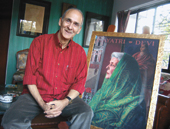
| (From top) Norman Douglas Hutchinson with his prized painting of Maharani Gayatri Devi; a portrait of Bharat Dev Varma; a portrait of Raima Sen. Pictures by Rashbehari Das |
If a young girl wins your heart and you be young also, the image of you both shall forever remain the same, and even though many years go by, you see each other the way you were when you first met…”
With these eloquent words, taken from Friedrich Schiller, Norman Douglas Hutchinson begins the preface to one of his most famed works of art, Gloria. The book, named after his wife, encompasses 63 paintings, drawings and sculptures tracing the movement of two lives (his wife and his) from innocence and hardship to a state of wisdom and well-being.
“Fifty years of painting the same woman is a remarkable endurance and a unique record of human image-making,” he says.
Sketchy scholar
Born in Calcutta to a father who hailed from Scottish aristocracy and a mother who was a local Anglo-Indian girl was never going to be easy. It was at Dr Grahams Home, previously known as St Andrews Colonial Home, in Kalimpong, that his life full of unexpected experiences began.
Hutchinson began his quest by sketching and painting the intricate lines and features of the human face and body at an early age. As a boy of five, he earned his bits of pocket money by drawing anyone he caught sight of.
Work wonders
Post scholarly pursuits, Hutchinson joined Lord Inschape?s bandwagon of companies in Calcutta. For 10 years, he struggled as an industrial designer, while painting ?all the grand people of the city, especially the very many beautiful women?, on the side.
When asked to draw a comparison with their European counterparts, he doesn?t think twice ? ?How can you compare Indian women to those from any other land (unless, of course, they?ve got a bit of Russian blood like his wife)??
At age 18, he was lucky enough to create a portrait of ?a very gorgeous British woman, popularly known as Lady Mountbatten?.
?What I liked most about Lady Mountbatten was that she made me feel like a great painter and not a child just out of school,? he recounts, with a gleam in his eyes.
Marital matters
With Gloria, whom he married in Calcutta, he has three daughters. His love for his wife (?who is simply beautiful?) has been captured magnificently within the pages of the book Gloria.
With nothing more than two recommendation letters, from Lady Mountbatten and the chairman of ICI, Hutchinson left for England to make a life for himself. ?The funny thing is I never even opened those letters!? he laughs.
For years, the artist struggled to create a niche for himself, and soon realised that ?unless you paint the cr?me de la cr?me, you can?t ask for silly amounts of money?. And without silly money ?it?s tough to buy yourself a house in England?.
Hutchinson took up a job as an industrial worker in the mornings and painted portraits in the evenings. One thing led to another and in 1971 he bought a chateau in France and lived the ?happiest days of my life?.
Family ties
The artist enjoys an enduring and endearing bond with Bharat Dev Varma (Habi) and wife Moon Moon Sen. In this family, his artistic reproductions are unique and the creative quotient leans to the personal.
?The first portrait I did was of Raima?s. I wanted to paint her as soon as I saw her. She has a kind of subliminal quality and a beauty that shows poise and dignity.?
Habi?s portrait was a surprise. ?He?s been a dear friend of mine for several years now and I would always tell him that some day I?d do a portrait of his. With a bunch of photographs of him in all his royalty, I tried to capture a time long gone, but timeless.?
Blue blood
Beyond leaders (he painted Nehru at India House but still rues the fact that he had to sell it off in hard times) and stars, family and friends, Hutchinson has managed to scale royal barriers.
While the portrait of the Aga Khan?s wife brought excitement and controversy, his paintings of the Duke and Duchess of Somerset, the Queen Mother, Queen Elizabeth II and Prince Philip brought him fame and fortune.
But what brought him the greatest satisfaction was his portrait of Maharani Gayatri Devi. ?This grand lady was extremely charming and sweet. I met her for an entire day and simple looked and looked and looked. What was most striking was not a single feature but the sum total of them all that equalled the fantastic, exemplified in her dignity and presence, of beauty and royalty. It seemed that royalty had been bestowed upon her by God.?
The portrait took five months and was complete only in November 2004, and captured that ?special quality? in its entirety.
Next in line...
Norman?s next venture is a book titled The Painter?s Daughters. ?My sketches and paintings started when each of my three daughters were one-day old! And, I?m still drawing them till date (the eldest being 50 years old).
And a dream venture: ?A bare, frank and beautiful portrait of the one-of-a-kind Moon?.