The artistic excellence of the terracotta temples of Bengal is widely acknowledged, and reams have been written on them by various researchers of eminence, foremost among whom are David McCutchion, Tarapada Santra and Hitesranjan Sanyal.
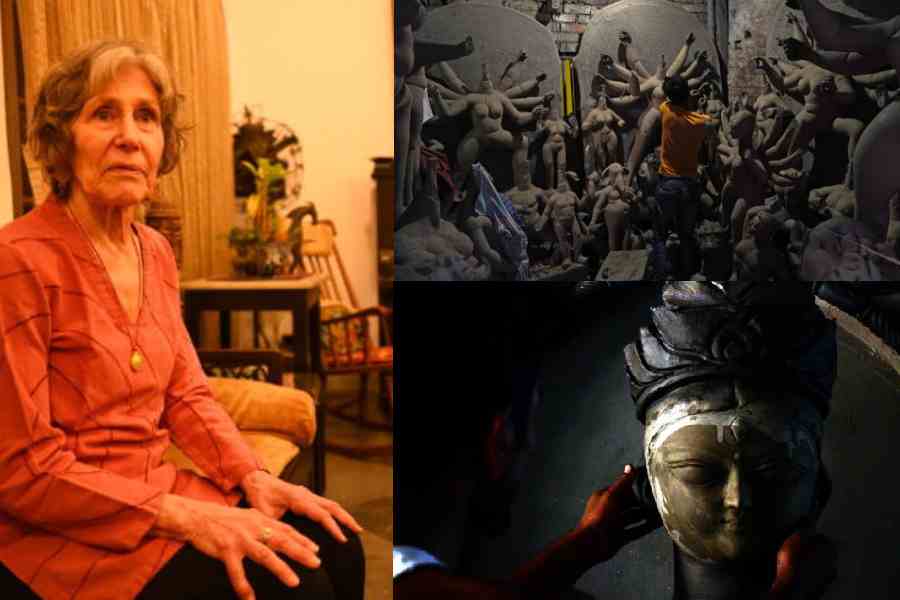
However, the impermanent, brightly hued gods and goddesses of unfired clay mass-produced in the bylanes of Kumartuli in Calcutta and Ghurni in Krishnanagar, admired and much photographed though they are for the skill that goes into their making, do not command a high place in the hierarchy of visual arts. No serious studies exist of these murtis and pratimas meant for worship.
The book titled Clay Works: Earthen Sculpture in South Asia, a Bloomsbury publication, by Susan S. Bean, a former senior curator of South Asian art at Peabody Essex Museum, USA, could help fill that gap.
Bean is known for her earlier research that sheds light on the Bengali banyans or commercial agents of American clients in the early 19th century.
She has made a strong case for the elevation of the position of these image makers and their murtis in her book, possibly the first serious study of terracruda sculpture.
US-based Bean was in Calcutta for the launch of her book at Oxford Bookstore on February 18. The event was organised by Ahava Communications and the Ahava Readers’ and Writers’ Club.
In an interview with Metro, Bean said the term she uses for air-dried sculptures or unfired clay figures is terracruda (raw earth), which, she explained, like terracotta (cooked earth), is an Italian word. “This is the best term to distinguish this medium. It seems to be a good choice”.
Grey-haired, slight and sprightly, Bean clarified: “The book is not intended to be a comprehensive survey of terracruda sculpture. Rather, I tried to bring out the most important sources on the practice, whether texts or present-day practices.”
She says she visited Calcutta for the first time on the invitation of historian Ashin Dasgupta (1932-1998) in 1988 for a seminar on Salem trade at Ramakrishna Mission, Golpark. Her first encounter with terracruda sculpture was at the Peabody Essex Museum, where, in the storage area, she saw three upended life-size studio portraits. Cards with names affixed to their midsection revealed their identity —banyans from Calcutta.
The sculptures were damaged, leading to the discovery that they were composed of air-dried clay with a straw armature. “That set me off in two directions — study of the three banyans and terracruda sculpture that culminated in this book”.
She wrote to colleagues seeking someone who could show the clay culture, and they recommended Ruby Palchoudhuri, a leading expert in crafts and textiles. Thus began Bean’s journey.
After retirement about two decades ago, she decided to pursue the matter further. She had earlier discovered K.M. Varma’s 1970 book, The Indian Technique of Clay Modelling, which was the only book available then. She excavated South Indian Agama texts (a collection of several Tantric literature and scriptures of Hindu schools) and Shilpashashtra and Buddhist references.
“This medium of sculpture goes back very far in South Asia — the first millennium of the Common Era. There were connections between practices in Bengal and Deccan and also Buddhist Bhutan.” She discovered that during an exhibition of Bhutanese textiles in 2016, and she returned there in 2024.
“When I saw the connection, I had to expand the scope of my research to cover Bangladesh and Afghanistan,” she says. “I ended up strongly believing that painted air-dried clay was an important medium of sculpture. It’s important to understand the tastes of local people.”
“During the colonial times, the British didn’t value it the way it is valued here. They felt it was too realistic. But they appreciated the realism of the models they made, for they could be shown at international exhibitions. It gave them an opportunity to represent India in a fashion that suited them.
“The British undervalued the artistic capacity of these sculptors, like Rakhaldas Pal. It’s a question of taste. In the global art world, vividly coloured sculpture is considered garish. Greek and Roman sculpture was all scrubbed clean, although originally they were polychromatic”.
In the “colonial perspective, art was ranked according to civilisation. They could dismiss Indian art as India, according to them, was low in the hierarchy of civilisations”.
Bean reveals that she has been making both functional and art objects using ceramics for a while, and “I know a lot about clay”.
Art history is only about iconography, chronology and style. “More recently, materials have become important. Clay can do certain things and can’t do certain others. Every material has a different role. All kinds of confusion exist, and most don’t understand the differences between plaster and terracotta”.
Originally, the Bamiyan Buddha in Afghanistan had a clay surface, Bean said. It had a basic shape of stone, but everything from the robes to the face made of clay was affixed to it with pegs and ropes. In 1834, it attracted international attention when it was “described as rock covered with plaster”. In 1920, a French archaeologist climbed to the top and found that it was clay.
It was only in the 1990s that natural scientists at the Smithsonian studied these and confirmed that they were clay. Material analysis or forensics is leading to a greater understanding of works of art.