A game of hopscotch or a slice of pizza can become lessons in maths, schools are telling their teachers.
In another school, a teacher explained the difference between radius and diameter using a basketball.
Schools are increasingly using real-life and familiar experiences to teach children mathematical concepts.
The idea is to eliminate “maths phobia”, a principal said.
The Council for the Indian School Certificate Examinations (CISCE) is overhauling the syllabus from Nursery to Class VIII, bringing real-life experiences into the classroom and conducting training sessions to equip teachers with the new curriculum.
Teachers play a key role in helping children overcome their fear of the subject.
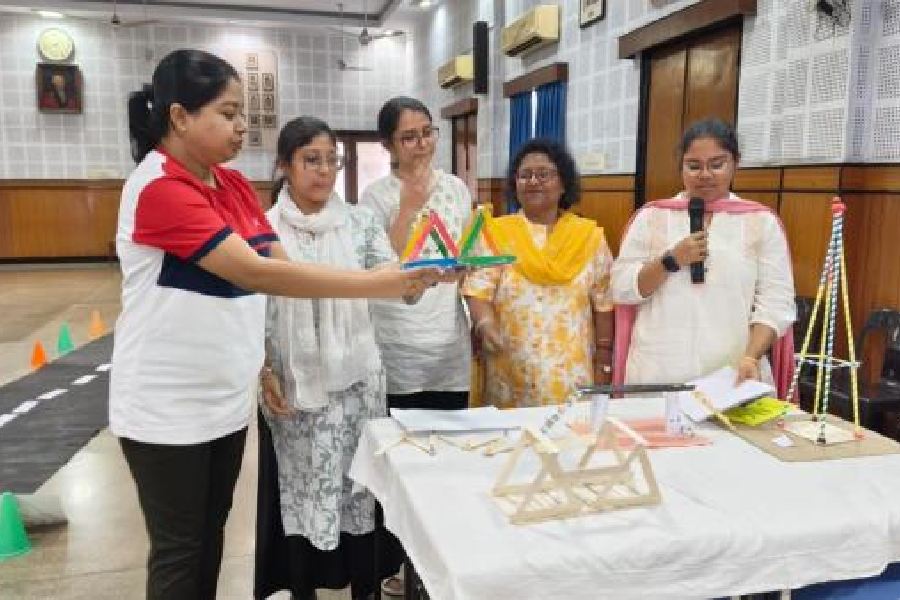
La Martiniere for Girls recently conducted a session with primary, junior and middle school teachers to help them connect mathematical concepts to real-life situations so they can deliver them in a fun, understandable way.
“We are conducting extensive maths workshops for our teachers because we must help children understand that maths is part of everyday life — from the games we play on the field to the food served on our table. Whether children or adults, we constantly perform calculations or talk about shapes and sizes without realising these are mathematical concepts,” said Rupkatha Sarkar, principal of La Martiniere for Girls.
A maths coordinator at the school conducted a three-day workshop for primary and middle school teachers.
“The most common phrase we hear from teachers who are not from a maths background is, ‘I am not a maths person,’ and we need to break away from that,” said Ratuli Mukherjee, maths coordinator at La Martiniere for Girls, who conducted the workshop.
The fear often builds gradually as a child grows.
“Often, adults think children learn maths by writing numbers, but they actually learn through games. What books are to reading, games are to mathematics. A home filled with puzzles and games is a place where mathematical thinking is encouraged,” said Mukherjee.
These could include games like Monopoly, chess, riddles and puzzles. “It is not just about sitting and doing maths, but learning through play. Most mathematical concepts are introduced in junior school,” she said.
Mukherjee’s session was not limited to the classroom but extended to the Birla Industrial & Technological Museum, where teachers engaged in hands-on activities.
Several new-age schools have maths labs where children are given opportunities for hands-on learning.
“A triangle is a 2D shape and a cone is a 3D shape. Unless children are physically shown the difference, it will not be clear to them,” said Gargi Banerjee, principal of Sri Sri Academy.
Teachers play a key role in helping children overcome their fear of maths.
If a teacher shows students how a bridge made with ice cream sticks can bear a certain weight and no more, maths becomes a tangible concept in their lives.
“Teachers play the primary role, and this is where our thinking must be reoriented. Only when teachers demonstrate the practical application of maths will children truly learn,” said Sarkar.
Teachers need to be patient, friendly and accessible too.
“For a child to love the subject, they must also like the teacher. A teacher has to be patient enough to answer repeated questions without getting annoyed. It is not just about overcoming fear but about developing a love for the subject,” said Banerjee.