When educated urban women felt the need to assert their voices through history, they shouted slogans, led protest marches and burnt their bras. Rural women sang.
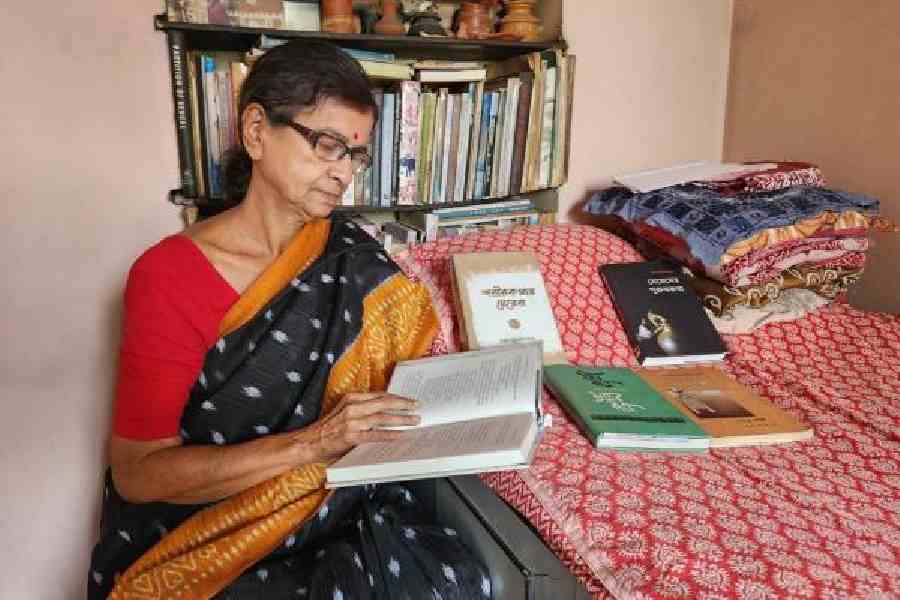
Chandra Mukhopadhyay of Purbachal Cluster IV is a researcher, collector and author of books on women’s songs of Bengal. “It is the female perspective in these songs that attracted me. Yes, we have books written by Bengali women from earlier times, but those were by aristocratic, Brahminised women who had access to education. Even among them, only those with supportive men around them could write. We never know how much was edited out either, so we don’t have a full picture of women’s lives back then. But these songs are our oral tradition — uncensored and participatory. They were not sung on stage for an audience but in a chorus, for themselves, about themselves,” she says.
Mukhopadhyay has spent 40 years researching these songs, consulting scholars and working at the grassroots.
“I taught at a school in a refugee colony in Birati, which became a huge source of songs from opar Bangla,” she recalls. “Once an ex-student called to say she had married into a family in Katwa, where her grandmother-in-law hummed old songs to herself. I went over and found the 92-year-old, bent with age and toothless, singing away. Soon, the entire family joined in to offer whatever they remembered. Their domestic help knew many wedding songs.”
One marriage bidayee song she sang had the daughter asking her mother: When I plucked mangoes from the tree in our courtyard you would scold me. Why, then, are you now hugging that same tree and sobbing as I leave? “I have recordings of women singing such songs and crying. They often ask me, ‘Aage keno aila na?’ as many songs are already lost,” she says.
Another hunting ground has been the Hasta Shilpa Mela, where artisans come from across districts. Mukhopadhyay has approached strangers on buses and trains, and even walked into shops named Cumilla Sweets and the like, hoping they traced their roots to the Bangladeshi district.
Two-note songs
Mukhopadhyay has found that the earliest songs relate to food and survival. “There are songs calling clouds dada and bhai, pleading for rain. Fertility of the soil was equated with fertility of women, and they were encouraged to do the sowing of seeds and weeding, and they sang about it,” she says.
The lady has even discovered melodies using just two musical notes. “The earliest flutes had only three holes, much less than those we have today. Since instruments mimicked the human voice, it can be deduced that people could not sustain seven notes initially. So some mothers’ lullabies use only sa and re, with simple lyrics like sparrows eating leaves.”
Women at work
There are thousands of songs that break the myth that women wouldn’t work outside home — songs by women fishermongers, washerwomen, milkmaids and agricultural labourers. “Women usually moved in groups – a safeguard against snakes, and also as they could spread out in the forests to look for firewood. At such times, they sang high-pitched songs to signal safety to those far away. So music was utilitarian too,” Mukhopadhyay says.
Midwives sang during childbirth, calling upon vasundhara, the greatest mother — earth. Tea garden songs speak of exploitation: “Let us work fast so we can then go fight our miserly babu for wages.” Another song recounts a babu confronting a woman for plucking spinach from his land — first by brandishing a stick to hit her, and then by offering money for inappropriate favours. “But these women could look after themselves. This last song ends with them hurling bricks at the babus,” Mukhopadhyay notes.
While the babus are often depicted in a negative light, the village men respected women. Mukhopadhyay cites rain-invoking rituals where women walked unclothed to rivers to appease rain gods.
“No man would step out or even peep at such times, as otherwise the ritual would fail,” she says.
The female gaze
One of Mukhopadhyay’s books examines songs on men, as seen through the eyes of women. These men include family members such as fathers and husbands, strangers such as farmers and lawkeepers, and even lovers outside marriage.
“When Vidyasagar introduced widow remarriage, it was for the upper classes. Rural women always remarried. They even have words that mean first and second husband. They have songs that compare what the first husband was like and how the second behaves,” she remarks. “Sometimes, fathers accepted money and married daughters off to much older men. Such marriages were loveless, and the wives sought affection elsewhere. One song says: I will not stop eating fish when my husband dies (as was the norm among widows), but will do so when my beloved friend dies.”
There are songs of both lust and romance. “Wealth and love often seem inversely proportional. The more economically backward the couple, the more they must depend on each other to make ends meet. This strengthens relationships,” Mukhopadhyay notes. But then there are also songs of domestic violence, where a husband returns drunk and beats his wife, but she also beats him back. Some songs speak of wanting to smash his liquor pot.
Mukhopadhyay has also found songs with two versions. In one such song, when a groom is asked where he’s off to, says: “to get a dashi (servant)”. In another version, he says: “to get a dosar (friend). In fact, her next book will be on the commercialisation of folk songs. For instance, the popular song Kamala sundari nache originally said “bhalo koira bajaio dhakuia (dhak player)”, but the word was changed to “dotara” as it sounded more sophisticated to urban audiences.
The terrain of the land has shaped music too. “Rivers in Bangladesh are vast, so voices travel far. Songs created there have long, sustained notes. In north Bengal’s hilly regions, people climbing slopes would get exhausted trying to sustain breath, so melodies became shorter and staccato,” said the lady who herself is a trained singer.
Female boding
Far from considering menstruation as unclean, songs have compared it to the blossoming of trees. “In the days of child marriage, a girl stayed with her parents till puberty, and when it arrived, it was celebrated like a second wedding. One song equates a menstrual stain to a red hibiscus blooming on Sita’s anchal,” says the 70-year-old.
When days are short during the Kartik month, and women have nothing to do after dark, they come together for Shanjha (evening) puja in Malda. They simply do floral decorations and sing peppy songs all evening.
In Cooch Behar, Kartik puja is celebrated for more than a month. “If everyone performs puja at home on the same day, they can’t visit one another so they do it on different evenings and only women are invited — save a male dhaki. They spend the whole night singing, dancing and enacting the birth of Kartik,” she says.
Future tense
The researcher believes urbanisation has weakened the musical tradition. “Urban communities, particularly those in the lower income group, are culturally rootless. They imitate the elite or the West without knowing who they are. This is what I’m trying to revive. My research is my matri reen — an attempt to repay the debt to our mothers,” smiles the lady who sings these endangered songs on her YouTube channel Geedali, that means one who knows a lot of songs.
These songs were never written, but have survived generations. “1947 could not destroy them, but now the mobile phone might,” Mukhopadhyay notes. “The younger generation is so engrossed in screens that they no longer participate in community traditions. If they don’t hear their mothers’ songs, how will they teach their daughters?”
saltlake@abp.in