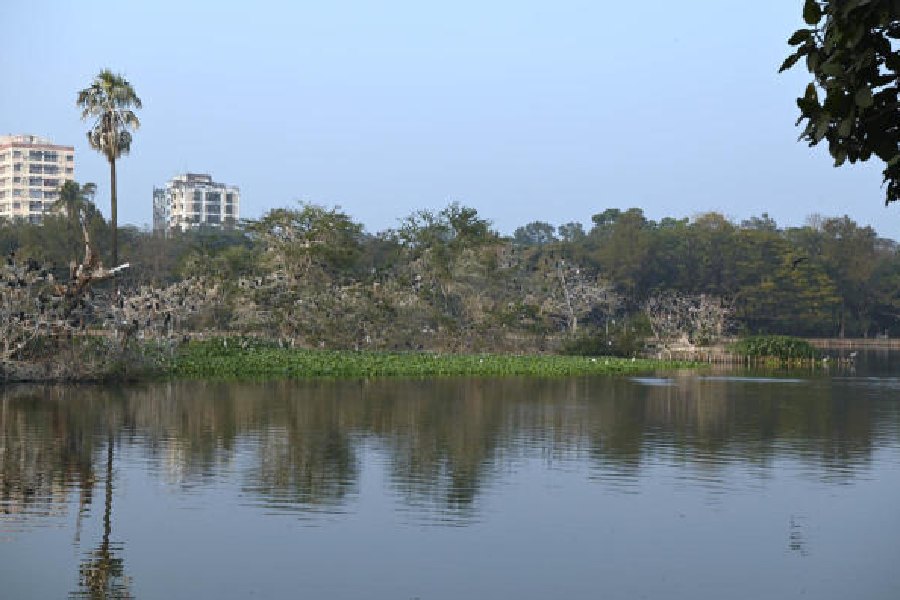
The urban development department has decided to undertake fresh plantation drives on the islands scattered across Rabindra Sarobar to revive bird nesting in the area.
Many of the existing trees on these islands are decaying and appear lifeless from
a distance. Most stand
bare, without leaves, contributing to the diminishing green cover.
Along with the fresh plantation, the authorities also plan to take measures to prevent erosion of the islands.
The initiative aims to restore the greenery, protect the islands’ ecology, and attract birds back by creating a more suitable nesting habitat.
“We have sought the opinion of experts in the state’s horticulture department to identify species that would be suitable for the islands in the lake so more birds can visit and nest on the trees,” said an official of the Kolkata Metropolitan Development Authority (KMDA), the custodian of Rabindra Sarobar. The KMDA functions under the state urban development department.
“The green cover of the islands has depleted, and we want to revive it. We will also try to arrest the erosion,” said the official.
Birdwatchers and ornithologists said it was good to undertake fresh plantation, but the dead trees should not be removed.
“It is best to keep the dead trees undisturbed. The fresh plantation should be done. I will suggest that local trees are selected during the plantation,” said Asad Rahmani, an ornithologist and former director of the Bombay Natural History Society.
Sujan Chatterjee, a birdwatcher for four decades, said the plantation should be done with extreme care.
“There should be minimal disturbance to the place. Even the undergrowth must not be disturbed. The authorities should also bear in mind that bird droppings may fall on the fresh saplings and damage them,” he said.
Bird excreta is acidic and harms trees over a period, said experts.
“The new saplings should be protected and assisted to grow. Otherwise, they will not survive,” said Chatterjee.
KMDA officials said the new saplings will be planted without disturbing the ecosystem and ensuring that birds don’t feel disturbed or threatened.
“Even restoration work at the eroding bases of the islands will be carried out with ecological concerns in mind. Different islands are experiencing varying degrees of erosion,” the official said.
Among the birds that are residents of the islands at Rabindra Sarobar are the grey herons, night herons and cormorants.
The KMDA has drawn up a detailed plan to increase the green cover on the islands after a preliminary survey of the existing condition of the trees and the soil, and the extent of erosion.
The Rabindra Sarobar premises cover 193 acres. Around 38% of the total area — about 73 acres — constitutes the water bodies.
Senior officials in the urban development department said the focus was primarily on two islands, one measuring around 2,600 square metres and another, close to 2,300 square metres.
“The trees look grey from a distance, and there are hardly any leaves on them. The sight of the islands is not pleasing to the eyes in the mornings,” said Sangita Mitra, a resident of Lake Gardens and a regular among the morning walkers.