Anyone living in Salt Lake would have noticed posters of massage parlours — they only have a picture of a woman and a phone number. Most people see them, scoff at them and move on. But have you ever considered that the women in this profession may have been forced into it?” asked social activist Rishi Kant, prompting the audience at Rabindra Okakura Bhavan to sit up.
Kant is executive director of Kosi Lok Manch, a national voluntary group that works to prevent trafficking, child marriages and the like. He had come from Delhi to attend a seminar on women’s safety in Salt Lake organised by the Association of Bidhannagar Citizens (ABC) in association with Kosi Lok Manch, legal firm SRA Law Chambers and women’s empowerment group I Rise Foundation.
“I have been fighting organised trafficking for some 25 years now, and 90 per cent cases happen in West Bengal. Your daughters are being sold across India. You need to be angry about this and pressure the authorities till they take action,” he said. “Women don’t need free money every month; provide them a safe place to work, teach them skills, give them equal opportunities, and money they will earn for themselves. If they have money in their pocket, they will get a say in their lives.”
Advocate Nandini Chatterjee shared her experience of handling cases related to gender violence, POCSO (Protection of Children from Sexual Offences Act) violations, trafficking and organised crime. “The police catching criminals is only the beginning. Fighting cases in court is another difficult battle as the accused tries to frustrate survivors through repeated questioning and delays. Children are made to recall traumatic incidents multiple times, too. Still, we are trying to bring systemic change,” she said.
Advocate Sanjukta Sen reminded residents about the women’s police station in Sector V. “One would think our homes are the safest places, but that is not always true. We receive multiple cases of domestic violence by husbands and in-laws. Violence does not always mean physical assault. It can include sexual violence, taking away a woman’s entire salary, preventing her from working, or throwing her out of the house. Sometimes women do not go the police out of fear, shame or harassment. But Salt Lake residents can approach the women’s police station and speak comfortably with lady officers,” she said.
Survivors all
Chief guest District Judge Durga Khaitan recalled how, at a panel discussion she once attended, speakers kept referring to “the survivors”. “I interrupted and said that it is not “they” but us. Every woman on this planet is a survivor. If not on the street, she has been wronged at home,” she said. “But your weapon is knowledge of the law so muster the courage to use it. If women are empowered, half the universe is empowered — and the other half is raised by her.”
Khaitan praised Bengal as being a state where even domestic helps ensure their daughters sit for Madhyamik exams and later celebrate their success with sweets. “The biggest misconception is that only the poor suffer abuse. In fact, lower-income groups approach the police more readily, while upper-class families often suppress complaints to protect their reputation,” noted the district judge, chairperson, appellate authority, West Bengal board of primary education.
Also present was Santi Das, the first woman aide-de-camp to the governor of West Bengal. She emphasised the role of families. “Women’s safety begins at home, so first educate mothers. Mothers must understand that girls, boys and transgender children all deserve equal opportunities to be self-sufficient,” she said.
Advocate Soumyajit Raha observed that despite many laws being introduced for women, crimes against them have not reduced. “Let us build awareness so Salt Lake can become an example for the state in women’s safety,” he said.
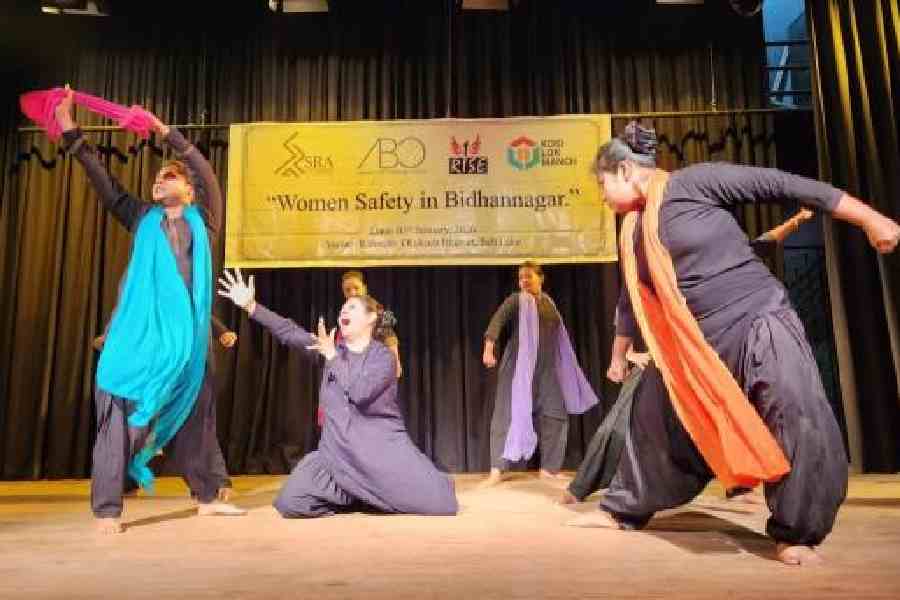
The show also featured cultural performances — dance and music by Hridayangan Institute of AL Block, recitation by Udaan Mahila Kobita Band and a powerful dance-cum-story telling act by I Rise. “We wanted to make this more than entertainment. We wanted the performance to begin a dialogue,” said director Sohini Das Hartmann.
The show depicted child marriage, denial of education to girls and injustices drawn from epics — from Draupadi’s humiliation in the dice game to Sita’s struggles as a single mother. “We wanted to show that injustice anywhere is injustice everywhere,” she said. The act concluded with a participatory segment where audience members were invited to step in and alter enacted situations, encouraging collective action.
“Not just March 8 — every day must be for women,” said Ritesh Basak, secretary of ABC. “Every household has women, so this is not only a women’s issue either. And instead of pointing fingers at the government and others, citizens must wake up and take responsibility themselves.”
saltlake@abp.in