CK-CL Park
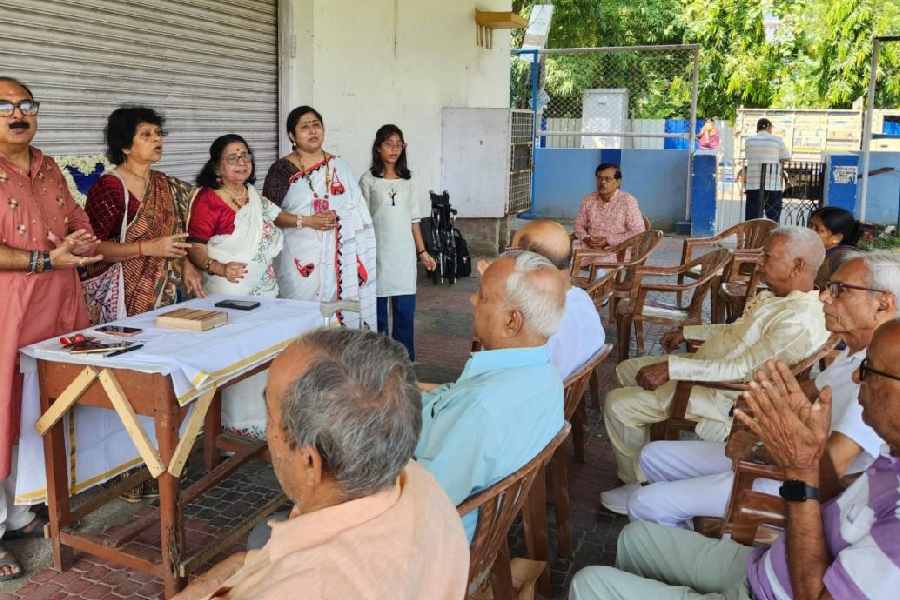
The CK-CL Park Morning Walkers Association celebrated Rabindrajayanti bringing together residents of all ages through songs, recitations and reminiscences.
The youngest performer was Class IV student Ruhani Gupta, who recited Robibar, Tagore’s poem about how Sunday always seems to arrive too late. “I agree with Tagore,” she said with a smile. “Although I love school too.”
There was also Archan Patranobis, who has now moved out of CK Block to New Town but still returned for the occasion. “We celebrated one Rabindrajayanti near the Owl More early in the morning and then came over as we are nostalgic about this one,” said Patranobis, who recited and whose wife, Shanta, sang Pushpo bone pushpo nahi.
Several residents delivered speeches about the bard. “Tagore took India to heights that few have managed. The world continues to remember him as he understood human emotions so deeply. Reading Tagore transforms the reader,” said Dilip Dutta of CL Block.
Lt Col Swapan Kumar Mondal (Retd) recalled how the bard popularised the tradition of celebrating birthdays and tree plantations, and Amal Tapadar reflected on the bard’s influence on different generations. “My peers evoke Tagore at the drop of a hat. But our children and grandchildren, many of whom study in English-medium schools, are not as connected to him. My appeal is that even if Bengali is your second or third language, please read Tagore. Most people grow frustrated with life, but Tagore, despite all hardships, wanted to return to this earth again. That spirit should inspire us,” said the 85-year-old, who along with Dhanapati Bhattacharya of BK Block, were perhaps the senior-most attendees.
Sonali Sen recited a heartfelt piece by Swapnamoy Chakraborty that explored how Tagore accompanies people through every stage of life. Through narration, she recalled the writer’s memories of his mother singing Sonar horin chai during his childhood, and of his father visiting his future bride’s home, where she sang Ki gabo ami. After marriage, however, her talent remained hidden as her father-in-law disapproved of her singing but how, after the loss of a loved one, the writer’s mother would quietly sing Rabindrasangeet to herself again.
Later, Sonali and her mother, Mira Sarkar, performed an excerpt from Raktakarabi, enacting scenes featuring Bishu Pagol and Nandini. “No Tagore event is complete without Raktakarabi,” said Sarkar, who started taking recitation lessons after her husband’s retirement and has continued ever since.
The event was anchored by Chandrasekhar Bag , who recalled how his father and his friends had started this celebration in the late 1980s. “Back then, we would come as children, perform and leave. But with the passage of time, we have realised the depth of Tagore’s work and so are carrying on this tradition,” said the advocate, who also sang Tai tomar anondo.
The show concluded with everyone lending voice to Purano shei diner kotha.
Surer Kheya
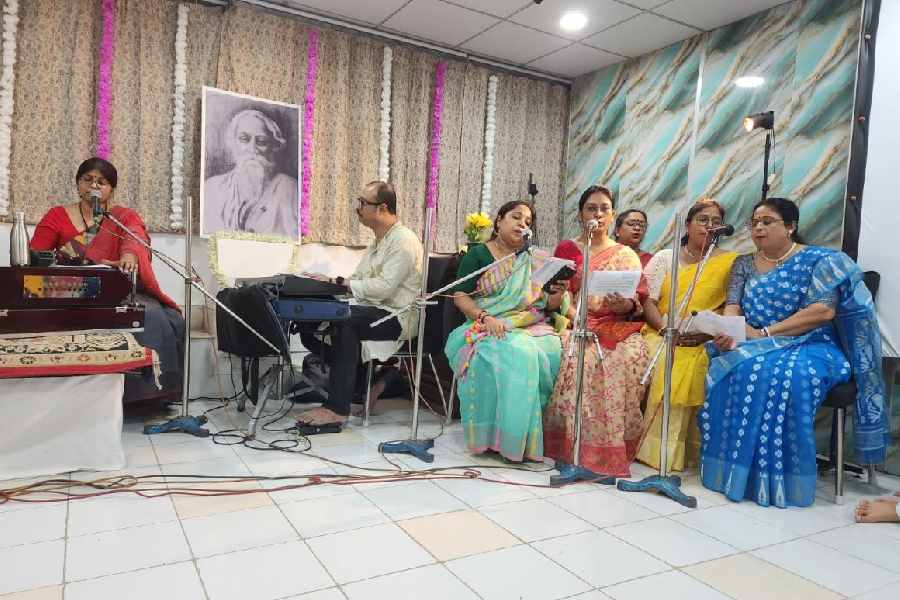
Singers perform in the Pujarini section of the show in AB Block
Tagore may have written Pujarini more than a century ago, but its message was invoked around Rabindrajayanti by the cultural group, Surer Kheya as a plea for peace in a world once again scarred by conflict and tyranny.
The show was held in AB Block, where Tagore’s Pujarini was the highlight. “Aggression and intolerance are taking over the world today. The powerful are forcing their opinions on the powerless, just as king Ajatshatru in Pujarini had ordered that anyone who worshipped the Buddha be killed. Despite that, history has chosen to remember the Buddha over Ajatshatru,” said Anasuya Mitra, a resident of BL Block who had written the script for the piece.
Silva Sarkar of Karunamoyee and Madhumita Mukherjee of BL Block narrated the script and the songs, borrowed from the dance drama Notir Puja that Tagore adapted from Pujarini, were led by Koyel Goswami. Priyanta Chatterjee sang Hingsay unmatto pritthi and those like Tanaya Raychaudhuri, Neeta Das, Sabari Roy and Sathi Das sang the other songs in chorus.
“The common man may feel powerless facing a strong opponent but like Srimati in Pujarini, we can rebel with compassion and kindness,” Mitra explained.
“Children are too young to understand what is happening in the world today, but programmes like these can introduce them to such ideas through art,” said Silva. “In Bengal, we celebrate Eid, Christmas and Durga puja, and there should be no room for religious fanaticism. Freedom of faith must be respected, as is the message of Pujarini.”
“Whenever I teach Rabindrasangeet, I begin with the meaning of a song before the melody,” said Koyel, who teaches music at Dum Dum Park. “That is Tagore’s greatest strength. His songs make people think. Today, the message is to reject war and embrace peace.”
Among the other performances was a dance recital by Sanjukta Bhattacharjee and her daughter Sprihi, who had come down from Odisha during their holidays to take part. “Members of this group are our friends, and I want my daughter to learn our culture,” said Sanjukta. They danced to a recording of Tomar anondo oi elo dware, previously released in a CD by Koyel and Tania Nandy, both of whom performed on the day too.
Tania later sang Ki sur baje, accompanied on the violin by her college-going son, Somshubhro. “Thisis not a common Rabindrasangeet,and my son heard it for the first timefor this show. That is how youths absorb music,” said the CG Block-basedmusic teacher.
Kids like Priyangi Chatterjeeof Class I recited Chitto jetha bhoyshunyo in both Bengali and English,Shamayita Goswami of Class VIIrecited Birpurush, and Gunja Royof Class III danced to Bandh bhengedao. Odissi teacher Raju Mishra, whoteaches in BL Block, and his wife Indrani presented Jagat jure udar sure.
The event was held on the terrace of an AB Block home that hadbeen professionally done up with AC,sound systems and stage facilities.
“I am a patron of the arts and have hosted art exhibitions here as well,” said Abhijit Maitra, whose house it is. “I am delighted to open my doors for Rabindrajayanti and see my friends come together to enjoy a cultural programme.”
Bairag
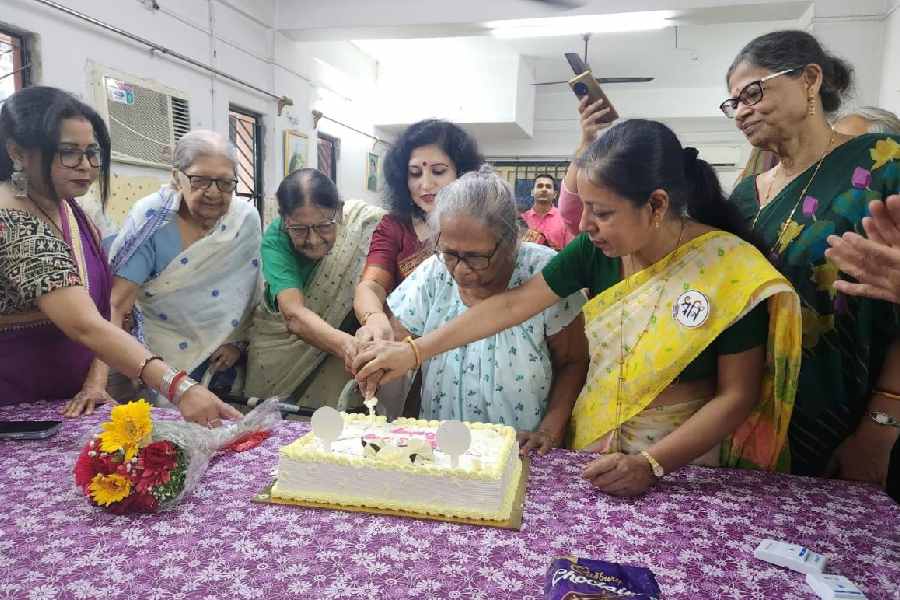
Elderly residents at Bairag cut the cake along with Dhwani members
CJ Block-based recitation group Dhwani celebrated not just Rabindrajayanti but also a belated Mother’s Day in a joint celebration at Bairag senior citizens’ home in IB Block. The event began with the arrival of a cake, that was cut by one of the senior-most residents — 88-year-old Kalyani Das.
Das lives at Bairag with her daughter, Anulekha Das. “I came to Bairag first, liked it, and then brought my mother over,” said Anulekha. “My mother, grandmother, and I were all teachers. We never celebrated Mothers’ Day as children, but I have my mother to thank for my values,” she said, settling in to watch the recitation and music show.
Dhwani members Jayeta Chandra and Kaberi Raha presented a narration on Tagore’s portrayal of love in his works. They spoke of how Chokher Bali asserted a widow’s right to love, Shesher Kobita suggested that love could be greater than domesticity, and Ghare Baire portrayed love as freedom rather than possession. The act concluded with a rendition of Amaro porano jaha chay, that the audience spontaneously lent their voices to.
Mohor Bhattacharya recited Sonar Tori, and Sonali Bhattacharya sang Anandadhara bohichhe bhubane.
Perhaps the biggest compliment for Dhwani came from 84-year-old resident Gopa Choudhuri, a former journalist who enjoyed the show so much that she offered the group a script she has written. “I have written a play and would love for Dhwani to perform it someday,” she smiled.
“In our time, there was no concept of Mother’s Day, but perhaps there was no need for one either,” said 87-year-old resident Sushil Kumar Kahali. “My mother knew how much I loved her, and I get emotional thinking of her. My daughter lives in HA Block, and we may not celebrate Father’s Day, but she visits me often enough for me to know that she cherishes me too.”
The performers reflected on motherhood, too. “I live with my son in AJ Block, and he gives me the two things I value most — independence and his time,” said Alpana Majumdar, who recited Tota Kahini with Ela Chakraborti. “Every morning, he spends an hour chatting with me. He says I make him laugh, and that means a lot. Today I spend time reciting, singing, and ramp-walking when I get a chance, and I’m happy.”
“Our resident Ganesh Chowdhury could not attend this show today as he is unwell, but he often sings Sudhirlal Chakraborty’s Madhur amar mayer hashi, and so well that it brings tears to my eyes,” said Krishna Roy Chowdhury, an executive committee member of Saptadweepa, the NGO that established Bairag in 1993. Her mother, Puspa Dutt, was the founder-president.
“In fact, May 10, which was celebrated as Mother’s Day this year, was also my mother’s birthday, and we celebrated it with a gala meal,” saidRoy Chowdhury. “My mother was a guiding force whose efforts continue to benefit senior citizens today.”
Bairag president Kuntala Patnaik welcomed the initiative. “Most of our residents have children living out of town, so it is not possible for them to visit on Mother’s Day. Every Saturday, our members spend time with the residents, chatting, singing, and keeping them engaged. It helps them stay active and keeps loneliness at bay,” she said.
“Besides cultural activities, our group tries to perform some social outreach too, and this year we could combine two important days together,” said Sangita Saha, founder of Dhwani, who also anchored the show. “Recitation, storytelling, and music are excellent for mental well-being and are a more constructive use of time than endlessly scrolling through reels.”
The event concluded with everyone singing Amra shobai raja together.