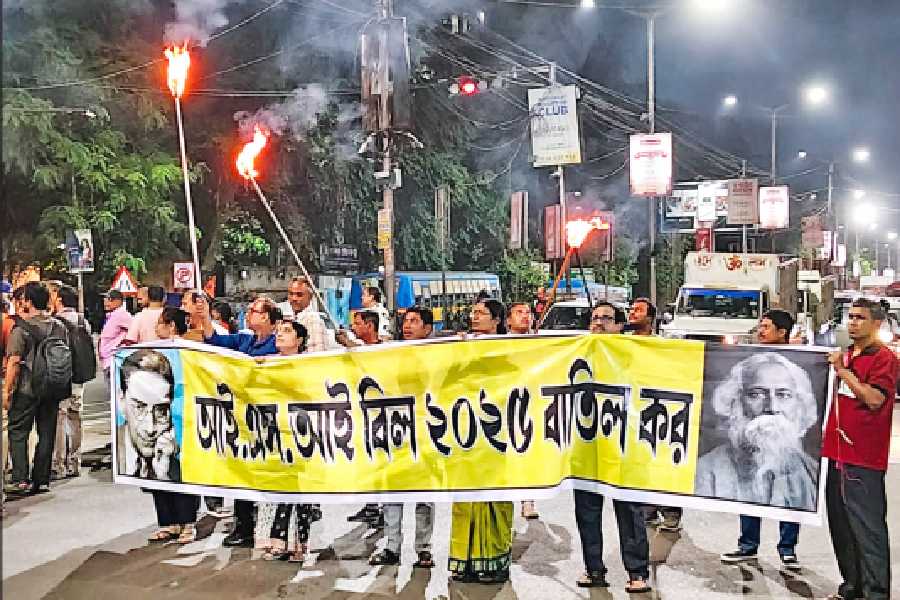
Former and current faculty members, students, and research scholars of The Indian Statistical Institute (ISI), Calcutta, organised a candlelight rally to protest against the ISI Bill on Wednesday.
The protesters are worried that the Centre will present the bill for approval at an upcoming cabinet meeting, overlooking their resistance.
The protesting teachers stated that their fears stem from the Union ministry of statistics and programme implementation’s response to a question raised by a BJP MP in Parliament.
Partha Pratim Majumder, a former National Chair of Science and a former ISI professor, said that Jagannath Sarkar, a BJP MP from the Ranaghat Lok Sabha constituency, asked about the status of the ISI Bill, 2025.
“In its reply, the ministry said that the pre-legislative consultation, including inter-ministerial consultation, on the draft ISI Bill is complete. Legal vetting of the draft is also over. It stated: The process of Cabinet approval has been initiated. The matter is under consideration in accordance with the prescribed procedure,” said Majumder.
“This means the ministry is adamant about passing the bill, which seeks to dismantle ISI’s society-based structure and replace it with an overarching board of governors whose members will be handpicked by the ministry,” Majumder told Metro.
Calls and text messages to BJP MP Sarkar from this newspaper went unanswered.
Calls and text messages to Puja Singh Mandal, an additional secretary of the ministry who looks after the ISI, also did not yield a response
One of the protesting professors said the ministry’s hint has come at a time when the institute’s academic council, the highest decision-making body, and the ISI Society have raised their objections to the bill.
The ISI Society, which met in November, said in a resolution that the general body of the Indian Statistical Institute rejected the draft ISI Bill 2025, which “was brought in without any consultation with the Society or the Governing Council of the Institute”.
The resolution said the Bill “is not consistent with the ISI Act, 1959, the Memorandum of Association and the Regulations of the Institute, and is harmful and detrimental to the object of the Institute”.
The academic council, which has all the ISI professors as its members and met on January 20, said in its resolution that an analysis of the draft ISI Bill, 2025, shows that it “has several inconsistencies and ambiguities that may affect both academic governance and the autonomy of the Academic Council”.
Thus, if the Bill becomes an Act, there may be serious problems in academic governance at the institute for the foreseeable future, the resolution said.
A professor on the ISI council said: “When all the decision-making bodies are deliberating on the pros and cons of the bill, the ministry is going to take it up in the
cabinet.”