On February 10, 2025, a tiger strayed into a Sundarbans village and attacked forest personnel who were trying to rescue a villager who had climbed a tree to save
himself.
Ganesh Shyamal, a member of the quick response team, had his right eye almost gouged out by the tiger’s swipe.
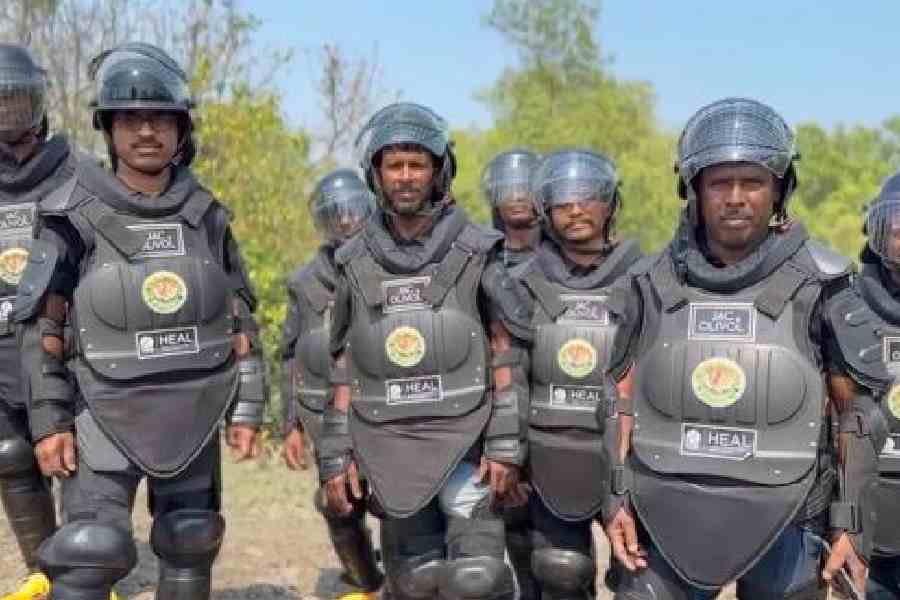
Just over a year later, in April 2026, Shyamal received a set of protective gear — including a full-body suit, helmet, elbow and knee pads, and a pair of shoes — enabling him to resume work.
More than 20 sets were provided to members of two quick response teams in the Kultali block.
Known locally as the “Baghdhora Team” — which means tiger catcher team — they are made mostly of forest villagers familiar with the difficult mangrove terrain and the behaviour of straying tigers. Working alongside the forest department, these teams are the first to assess a situation after tiger movement is reported.
When people find pugmarks, news spreads quickly. A small group of members will check first. If the presence of a tiger is confirmed, the entire team is called. That includes trained forest guards with nets, trap cages and tranquilising guns.
“The gear is designed for close-range wildlife response, intended to improve safety and mobility during emergency operations in the difficult terrain. There are three such quick-response teams in the Kultali area. We have started by providing gear to two teams. The third team will also be provided with such gear in the coming days,” said Suvajyoti Chatterjee, co-founder and secretary of Human and Environment Alliance League, the NGO that provided the protective gear. The project is financed through the Corporate Social Responsibility (CSR) programme of a body oil company.
Foresters said injuries to the head, neck and upper body are common during sudden tiger encounters. Understanding these risks, the lightweight kits were designed specifically for the swampy land.
They are intended to reduce injuries during close-range tiger encounters, while still allowing responders to move quickly through mudflats, embankments and mangrove edges.
“I still work as a senior member of the quick-response team. If I were wearing the gear a year ago, my eye would probably have been saved,” said Shyamal.
The department has identified three panchayat areas in Kultali, under the Maipith Coastal Police Station, as “vulnerable” zones where tiger intrusions are more likely.
The panchayats comprise villages such as Nagenabad, Kishorimohanpur, Ambikanagar, Baikunthapur, Binodpur, Madhya Gurguriya, Purba Gurguriya, Debipur and Bhubaneswari.
On the other side of the river are forest compartments of Ajmalmari 1 and 11 and Herobhanga 9, part of the Raidighi range, one of three tiger ranges in the South 24-Parganas forest division.
Much of the forest boundary is fenced with nylon nets. However, the mangrove terrain, crisscrossed by rivers and creeks, causes daily damage to the barriers. The nets are also often torn by villagers entering prohibited areas to catch fish and crabs, increasing the likelihood of tigers straying into human settlements.
“The protective gear will be of great help to the men at the frontline of human-wildlife conflict mitigation,” said a retired forest official who has worked in the Sundarbans for years.