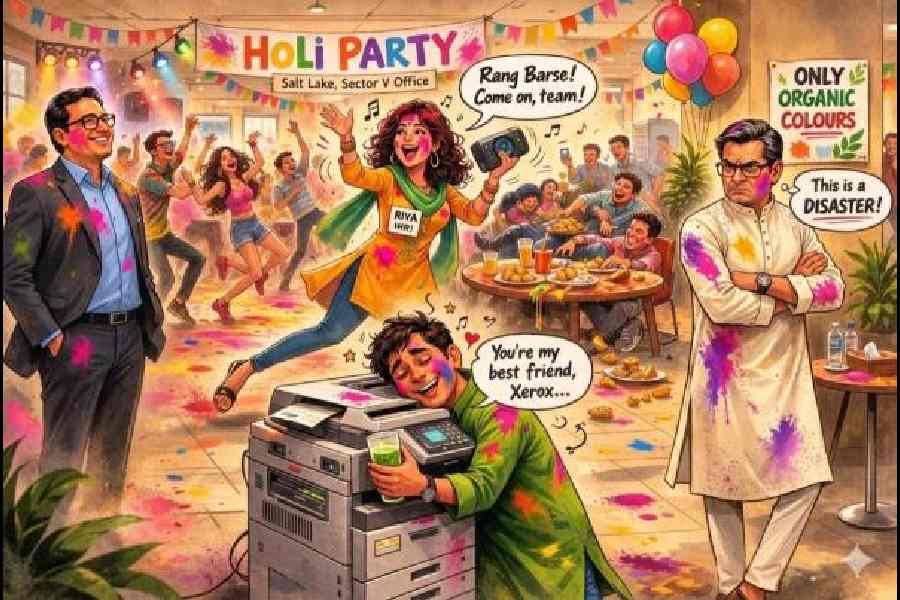
Every year, as spring tiptoes into Salt Lake and New Town, our otherwise dignified, curtain-twitching, morning-walk-obsessed residents prepare for that one day when reputations dissolve faster than gulaal in water — Holi. This year’s celebrations, as faithfully reported by the self-appointed cultural correspondents of our blocks, can be neatly classified into three categories.
Holi, officially
The corporate Holi party, hosted in many a Sector V address, is less about colours and more about career advancement — with a side of bhang-induced honesty.
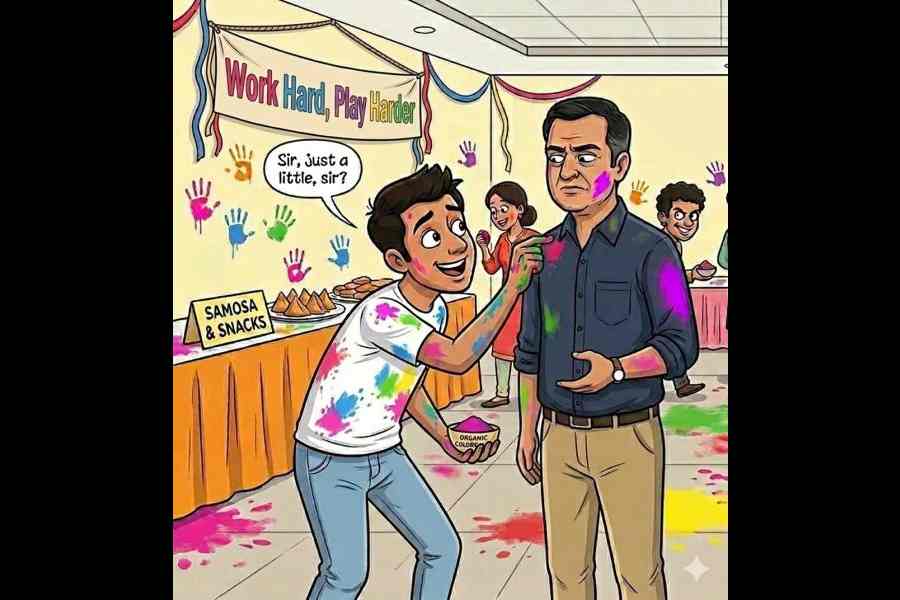
Take Anirban from Accounts. Dressed in an aggressively white kurta clearly purchased for the sole purpose of being “accidentally” smeared by senior management, he stationed himself strategically near the entrance. The moment the boss arrived, Anirban lunged forward with a delicate pinch of pink abir and an even more delicate: “Sir, just a little, sir?” He ensured the colour touched only the boss’s cheekbone — respectful, yet visible enough for social media documentation.
Meanwhile, Riya from HR had taken on the role of Official Fun Facilitator. Armed with a bluetooth speaker and questionable dance moves, she attempted to start a conga line to “Rang Barse,” only to have it collapse near the samosa table. She declared every mishap “great team bonding!”
Then there was Subho, who had sworn he would NOT touch bhang this year. “Last time, I told the admin head what I really thought of his precious entry security protocol,” he had confessed darkly. By noon, however, he was on his third glass of something suspiciously green, hugging the photocopier and calling it “the unsung hero of productivity.”
And presiding over it all was Mr Mukherjee, the department’s resident aesthete, who had arrived in a linen kurta, reportedly flown in from Mumbai. He had announced at the outset: “I only play organic, herbal colours.” But when a rogue intern smeared a streak of neon purple across his sleeve, his expression suggested he had just witnessed the fall of civilisation. He spent the rest of the party guarding his outfit like an ASI-protected site.
By 3pm, the office WhatsApp group was flooded with filtered photos captioned “Work hard, play harder!” — though most were secretly calculating at what hour they should apply for sick leave the next day.
Rooftop revelry
In the housing complexes of New Town, rooftop Holi has evolved into an intergenerational sport.
At 10am sharp, the youngsters take control. Armed with water balloons, pichkaris the size of small plumbing installations, and a belief in their own impeccable aim, they position themselves at strategic corners.
Unfortunately, “strategy” rarely guarantees accurate aim.
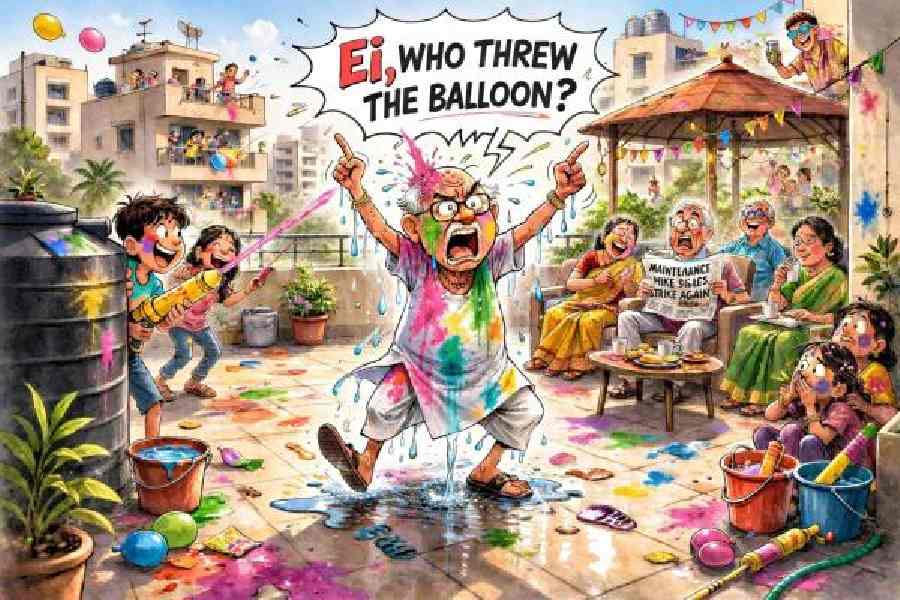
This year’s first casualty was Mr Ghosh from Flat 5D, who had merely stepped onto the terrace to check the water tank. A balloon meant for his teenage grandson, who came accompanying him, landed squarely on his bald pate. There was a stunned silence. Then came the inevitable roar: “Ei! Who did this?” The guilty parties scattered like pigeons.
The other elders, having learnt from past trauma, preferred to remain seated in plastic chairs arranged in a neat semi-circle under the gazebo. They had dabbed a dignified smear of abir on each other’s cheeks and then proceeded to discuss rising maintenance costs, vegetable prices, Trump’s foreign policy and overseas trips of Bangalore or Mumbai-based sons and daughters.
Mrs Sen of 2A attended the housing’s Holi party with a specific agenda — snacks.
She arrived with a Tupperware bag large enough to survive a siege. “Have you tried the gujiya?” she would whisper helpfully, between mouthfuls, whenever her gaze caught anyone looking in her direction. Between sampling nimki and papri chaat, she occasionally waved her hand in the general direction of the colour-play, as though blessing it.
On one unfortunate occasion, a balloon aimed by the overenthusiastic teenagers towards the “enemies” on the adjoining tower’s roof, landed on Mrs Sen’s plate of chana. The silence that followed was louder than scolding. The teenagers apologised profusely, as did the organising committee convenor; Mrs Sen forgave them only after getting a dozen kachuris and two plates of chana packed in her bag as compensation.
Block-level bonhomie
The true heart of Holi in Salt Lake beats at the block level.
It begins with the prabhat pheri — an early morning procession that starts with songs of spring and ends with people arguing about the correct lyrics. Residents in slightly crumpled outfits in various shades of yellow march around the block, singing enthusiastically, if not melodiously. Someone always brings a dhol; someone else always insists he could play it better.
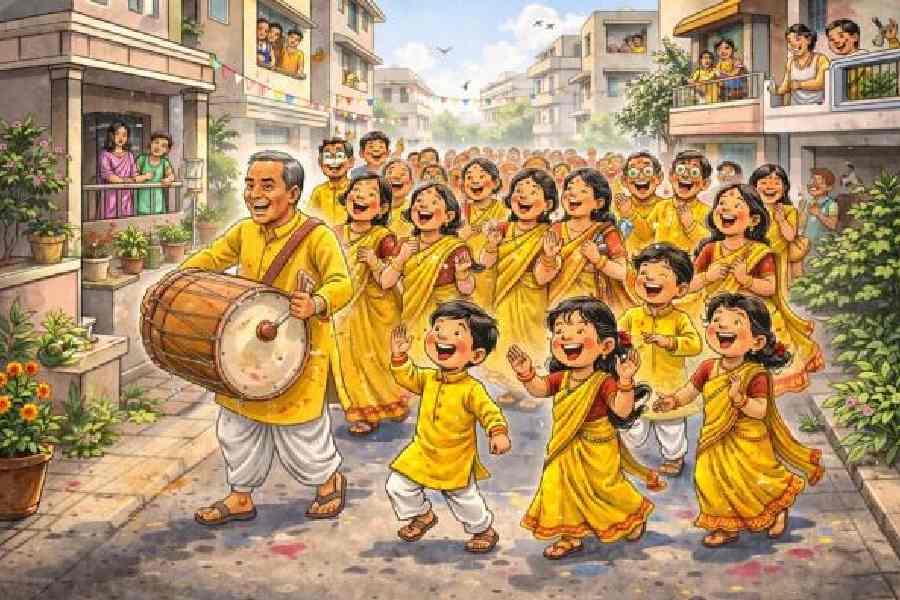
By the time they return to the community hall, spirits are high and voices slightly hoarse. The playing here is gentler — dry abir carefully applied with warm Dol greetings. No water balloons, no ambushes — only pastel camaraderie.
Children run about in clouds of pink and yellow, while the elders supervise like benign monarchs. Even the snootiest residents surrender a little, if only because the block secretary is watching.
And then — the breakfast.
Steel plates clatter as volunteers distribute kachuri and alur dom with military precision. The aroma alone could end neighbourhood disputes. Conversations bloom: about school admissions and ongoing Board exams, Poila Baisakh plans and whose terrace garden bloomed the best in winter.
By the time the last kachuri disappears and the final “Happy Holi” echoes through the hall, everyone looks Instagramable — faces streaked with colour, hair dusted magenta, dignity temporarily misplaced but wan smile in place.
But that, perhaps, is the quiet magic of Holi in the twin townships. For one day, bosses, neighbours, elders, youngsters, snacks enthusiasts and linen-clad fashionistas all become part of the same riotous canvas — only to return, slightly sheepish and thoroughly content, to their orderly lives the very next morning.