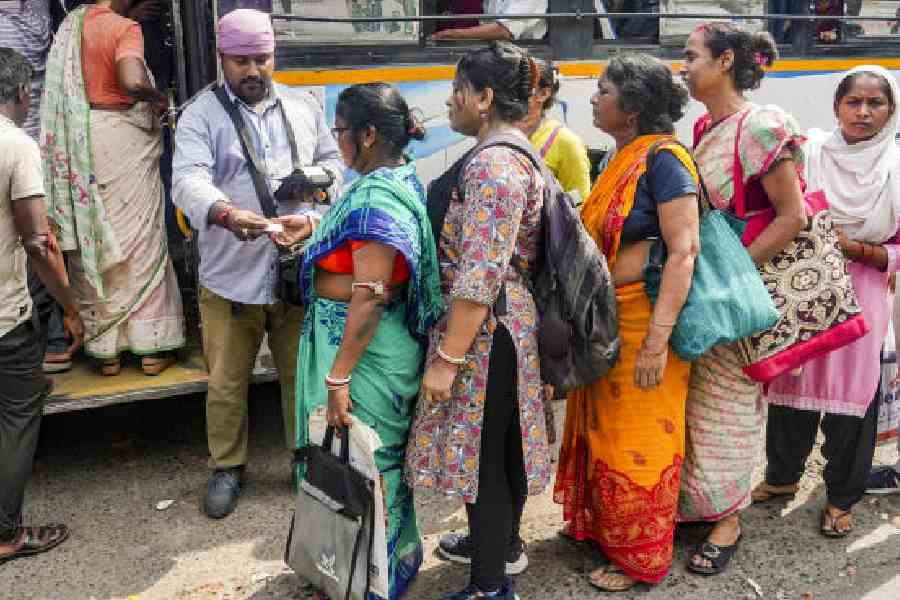
A free bus ride is as much a right for a trans woman as it is for any other woman, several women — both trans and cisgender — said on Tuesday.
The free bus ride scheme for women was rolled out on Monday, but many in the transgender community are unsure whether it includes them or whether they will continue to face the same discrimination they have long encountered in public spaces.
For many trans women who rely on public transport, the waiver would mean not only financial relief but also recognition of their identity.
“The facility should be extended to all trans women. Trans persons face discrimination everywhere, from uncomfortable stares to unequal treatment. For many, the discrimination starts within the family and extends into society. A free ride would benefit many working-class trans women who depend on public transport,” said Anurag Maitrayee, a cultural activist who identifies as a trans woman.
“If trans women are excluded from a state facility meant for women, it reinforces the idea that trans women and cis women are different categories,” Maitrayee said.
In a notification issued in May, the West Bengal Transport Corporation said any woman travelling on buses run by the Calcutta State Transport Corporation, West Bengal State Transport Corporation and Calcutta Tramways Company would be allowed to travel free on city, suburban and long-distance routes.
Many trans women said they were yet to travel under the new system and did not know how inclusively the waiver would be implemented.
“Women as a category include trans women too. But discrimination is deeply embedded in society. Unless there is a clear affirmative statement in policies involving reservation or welfare schemes, people tend to interpret them in exclusionary ways,” said Bappaditya Mukherjee, a bisexual cisgender man and gender-rights activist.
Mukherjee said a statement from the leadership specifying that the facility included trans women would remove ambiguity.
Many said the absence of explicit guidelines often opens the door to harassment.
“If the notification clearly mentioned trans women, it would become easier for us to claim our rights. Otherwise, we are subjected to unnecessary harassment,” said Aishaa Mondal, a trans woman pursuing a PhD in performing arts.
Mondal recalled being stopped from entering a women’s trial room at a mall.
“I wanted to use the women’s trial room, but I was stopped. We require basic respect and dignity. I am not comfortable using the men’s trial room. There should also be trial rooms for others, which would make things easier for everybody,” Mondal said.
A trans woman should be treated with equal dignity and fairness, said Shivali Dalmia, who works with an insurance firm.
“Many trans women are treated differently because they are perceived as men. If women are receiving a special facility while travelling, trans women should receive it too,” Dalmia said.
Kasshvi Doshi, who recently turned 18, said schemes like these were meant to improve women’s mobility.
“A trans woman faces many of the same challenges that a woman does. Accessibility to services should be equal,” Doshi said.
For many in the transgender community, the uncertainty also stems from the Transgender Persons (Protection of Rights) Act, which does not protect a transgender person’s right to self-identify.
“If my identity itself is questioned, how can I confidently claim my rights on a state-run bus?” asked Sudipa Chakraborty, a trans woman working as a project manager at an NGO.
“When the government says a facility is for women, does it include only those assigned female at birth, or also those who transitioned later?” she asked.
Chakraborty travels to work in Kasba from Budge Budge using public transport.
“The number of state buses in the city is very limited. I don’t get a direct bus from Budge Budge to Kasba. That itself limits the usefulness of the waiver. The problems are the same for trans women and cis women, so why should the treatment be different?” she said.