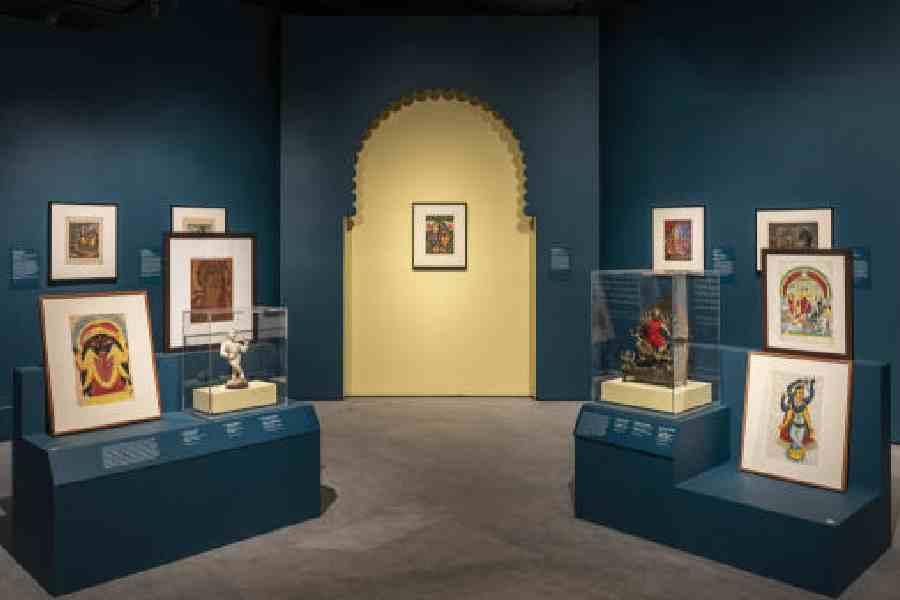
Two major exhibitions of colourful chromolithographs of Hindu gods and goddesses — once mass-produced in Calcutta in the late 19th and 20th centuries — are being held in two leading American museums.
The biggest and most focused of the two is aptly titled Divine Colour: Hindu Prints from Modern Bengal. It is on at the Museum of Fine Arts, Boston, and is organised by Laura Weinstein, MFA’s Ananda Coomaraswamy curator of South Asian and Islamic Art. She describes it thus: “The exhibition is the first of its kind in the US, focusing specifically on the radical creation of these works by Bengali artists in 19th-century Calcutta.”
Featuring 100 objects, including 40 rare lithographs, it is on view till May 31.
The second “encyclopaedic” exhibition, Household Gods: Hindu Devotional Prints, 1860-1930, is at The Metropolitan Museum of Art or Met, in New York. It features about 120 works shown in four rotations, from the Met’s collection of chromolithograph prints, along with paintings and portable triptych shrines. It features chromolithographs from pioneering presses of Calcutta, Pune and Bombay.
John Guy, senior curator of the arts of South and Southeast Asia at The Met, was responsible for building the collection of devotional prints there, and conceptualising and realising the exhibition. It began on January 24 and continues through June 27, 2027.
The two exhibitions indicate a reversal in the fortunes of these “bazaar” prints.
“It is indeed commendable that world museums today are realising the merit of art studio prints both as an aesthetic language and as cultural signifiers,” says Paula Sengupta, pedagogue, curator and co-author of the two-volume The Printed Pictures.
Both exhibitions are drawing strong attendances, and the response from students, artists and the Indian diaspora has been enthusiastic.
These chromolithographs of Hindu divinities that once graced the homes, shops and workplaces of Indians have only recently become collectables and are subjects of research.
In the mid-19th and early 20th centuries, printing presses in Calcutta and elsewhere in India churned out millions of cheap chromolithographs deploying Western technology. Small printing presses flourished around Calcutta’s Battala area at Kansaripara, Chorbagan, Pathuriaghata and Bowbazar.
The best-known of these is the Calcutta Art Studio that still survives at its original Bowbazar address. It was founded in 1878 by Annadaprasad Bagchi, headmaster of the Government School of Art, and his four talented students, Nabo Coomar Biswas, Phanibhusan Sen, Krishna Chandra Pal and Jogendranath Mukhopadhyay.
Initially, chromolithographs were produced in Germany. In these compositions, the physique of the Hindu deities, décor, and topography followed Western models, as the artists who created them were trained in academic realism at the School of Industrial Art (later renamed the Government College of Art & Craft) in Calcutta. Yet they were unmistakably Indian, quite in keeping with India’s syncretic culture.
These popular prints had an impact on the nationalist movement, gaining momentum. The yoke of colonialism had become unbearable for Indians, and those images of Kali vanquishing her enemies, for example, that appeared on cigarettes were coded messages urging the people to rise and shake off their shackles.
Initially, the British rulers didn’t grasp them. The chromolithographs also appealed to Indians to discard imported European products and instead buy local ones. Their aesthetic value may be debatable, but chromolithographs reflected the aspirations of a nation hovering on the brink of modernity.
Considering the countless chromolithographs produced once, precious few have survived. And these exist in private as well as institutional collections. Hence, their enhanced value in the art
market.
Commenting on the exhibitions, Laura Weinstein says: “To my knowledge, most museums in America have only had later 20th-century prints, until a dealer couple (Mark Baron and Elise Boisante) started collecting early prints in India and selling them in NYC. The MFA and the Metropolitan both formed their collections that way. We have about 80 now. Mark helped with research on the catalogue and also wrote the appendix.
“We are displaying virtually all of our early prints from Calcutta. I decided to focus on Calcutta because it was possible to set the prints in context so well, using Kalighat and Battala prints. At the Met, they are doing something broader rather than going deep, showing works from many print centres. I think the shows are complementary in that sense.”
What is the cultural value of chromolithographs?
Weinstein said: “To me, the prints are valuable in many ways. The early ones are quite rare, and in market economies, that makes them valuable. They reflect a short-lived period of about 20 years before the style of Raja Ravi Varma changed things. I think you can say they played a critical role in the making of modern India. So many things!”
At MFA, Boston, the exhibition is spread over six large rooms. Along with the prints are four audio clips. The recitation of a poem on how the Baman avatar crushed the demon King Bali is accompanied by its pictorial equivalent. The same holds for the goddess Kali and the tale of how a meditating Shiva reduced Kamadeva to ashes. There is a snatch of an ancient recording of the kirtan “Kanu kahe Rai” by Punnamoyee Dasi.
Visitors are invited to explore Jean Baptiste Tassin’s 1832 lithographic map of Calcutta. A short film demonstrates how the technology may have been upgraded, but similar prints are ubiquitous even today.