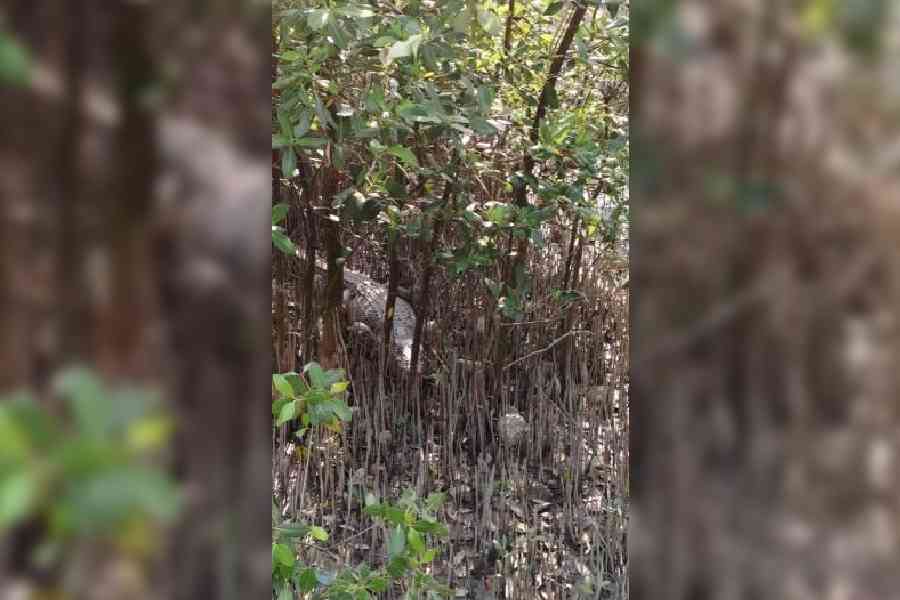
A 12-foot saltwater crocodile strayed into a village in the Sundarbans on Thursday morning, villagers said on Friday.
Sanjib Dalapati, 19, a resident of Purba Sripatinagar Hazar Bigha village in Patharpratima block, South 24-Parganas, was strolling near the Thakuran river beside their village on Thursday morning when he saw the crocodile.
“I saw the huge crocodile lying in the thicket. It was around 10am when I reached the bank of the river just outside our village. I suddenly saw a huge crocodile lying there. This was the first time I saw a crocodile in our village,” said Dalapati on Friday.
Soon, other villagers gathered at the spot to see the crocodile.
They were clicking pictures of the crocodile as it lay motionless.
“Some of the villagers thought the forest department officials should be informed, but after 40 minutes, suddenly the crocodile turned and went back into the water,” said Dalapati. “We didn’t dare to go near the crocodile and were clicking pictures from the road,” he said.
According to forest department officials and the villagers, it is often observed that saltwater crocodiles stray into the villages of the Sundarbans during the winter.
“There are several reasons. Often, the crocodile wants to expand its territory and so enters a village,” said Nilanjan Mallick, director of Sundarban Biosphere Reserve.
“Moreover, during instances when another crocodile intrudes into its territory, the crocodile attempts to locate a new one,” he said.
According to forest officials, in winter mornings when fog is prevalent, the crocodile can swim towards the village instead of the forest bank because of the low visibility. A forest official said: “In the Sundarbans, predominantly, the rivers have forests on one side and villages on the other side.”
Villagers said there was another reason: the tiger-crocodile conflict.
“This period marks the height of the mating season for tigers, prompting them to approach the riverbanks at the forest’s edge. During winter, crocodiles also increase their sunbathing, leading to conflicts between the two species along the banks,” said a resident.
“Consequently, it is common for crocodiles to venture into the villages,” he added.
The saltwater crocodile (Crocodylus porosus) is acknowledged as the largest and heaviest living reptile in existence and is deemed the leading aquatic predator in the Sundarbans.
The saltwater crocodile is found in eastern India, southeast Asia, and northern Australia. There have been instances of males growing up to 20 feet and weighing over 1,000 kg.
In the Sundarbans, the average length of the crocodile is around 12ft, said forest department officials.
During the winter months, saltwater crocodiles exhibit thermoregulation behaviours to increase their body temperature. They typically spend a significant amount of time basking in the sun on land to elevate their body heat.