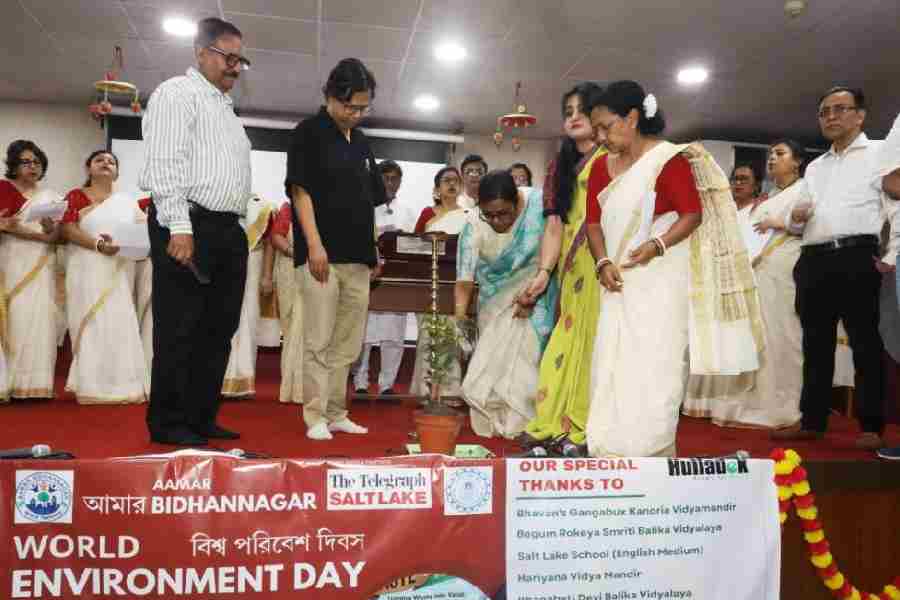
Mushroom cultivation, rain harvesting, e-waste disposal….Township-based citizens’ forum Aamar Bidhannagar celebrated World Environment Day in association with The Telegraph Salt Lake and offered many a tip to the audience gathered at Bharatiya Vidya Bhavan.
Named “Waste to wealth for a clean, green and smart Salt Lake,” the seminar brought together a diverse panel of speakers and students from various township schools.
Cyclone warnings
In her keynote address, environmental scientist Prof. Swati Nandi Chakraborty highlighted the challenges associated with solid waste and urged the audience to become green ambassadors.
“In the Paris Climate Agreement of 2015, nations pledged to limit global warming to 1.5°C. But human-induced climate change continues to accelerate. We are crossing several environmental thresholds, leading to rising sea levels, melting glaciers and increasingly intense and unpredictable cyclones,” she said.
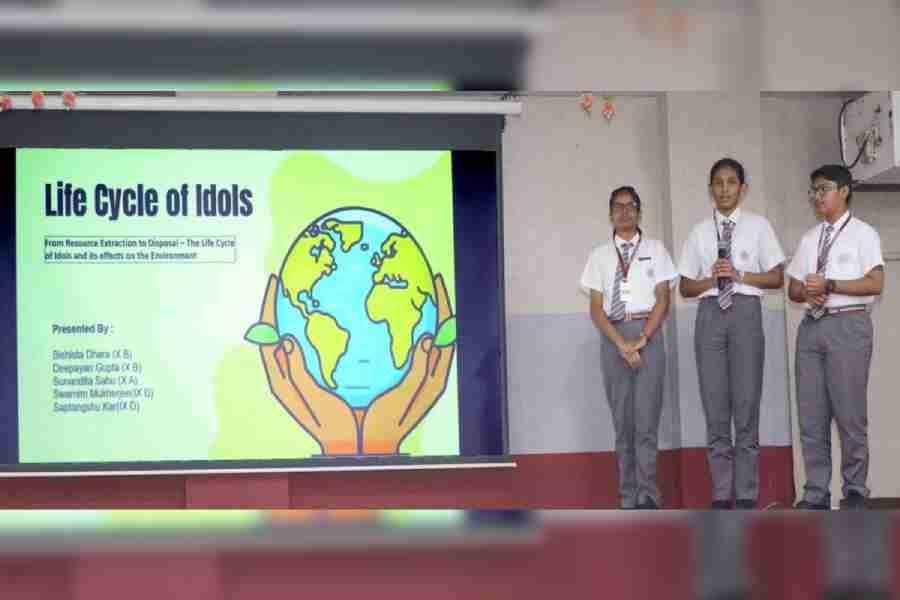
Bharatiya Vidya Bhavan students deliver a presentation against using plaster to sculpt idols
Nandi Chakraborty observed that several recent cyclones have exhibited characteristics of super cyclones, displacing thousands of coastal residents and coining the term “climate refugees” for them. Stressing India’s dependence on fossil fuels, she explained how burning them creates emissions that trap heat in the atmosphere and intensify global warming.
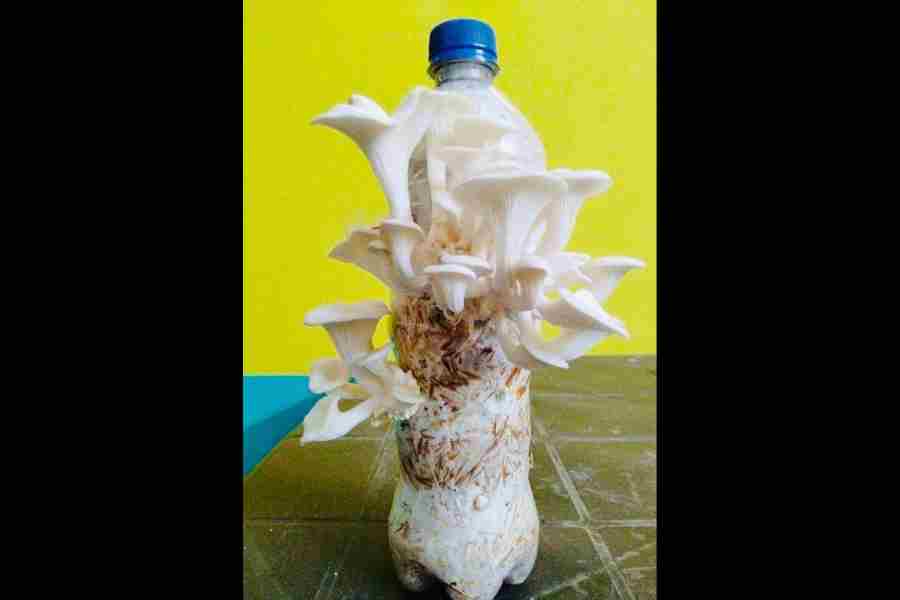
She screened a video demonstrating simple mushroom cultivation using discarded plastic bottles and urged students to practise climate action throughout the year.
E-waste disposal
Also on the speaker list was Sriyam Mall, co-founder and CEO of Hulladek Recycling, that specialises in the ethical disposal of electrical and electronic waste such as old phones, batteries, wires, TV etc.
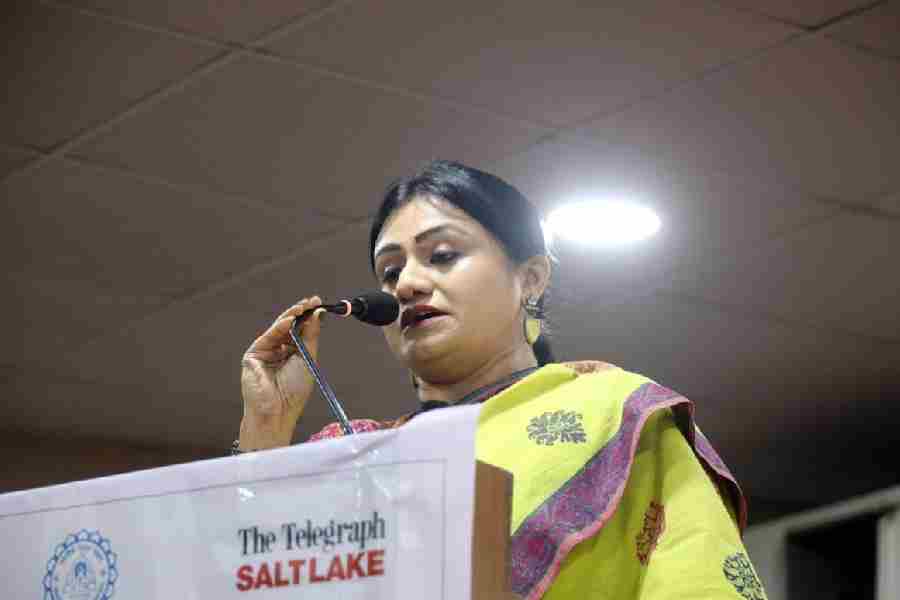
Swati Nandi Chakraborty delivers the keynote address
“Increasing consumerism and the trend of frequently purchasing new electronics have led to a rise in e-waste generation every year. These items end up in landfills, which is dangerous as they leak harmful chemicals and heavy metals into the soil,” Mall said.
For over a decade, Hulladek has been working on a solution. “We ask both residents and institutions to give us a call before they throw away their e-waste. We then send people to pick it up and offer cash or vouchers in return. We dismantle the items to ensure nothing toxic seeps into the ground,” Mall added.
Reuse and recycle
Bidisha Basu, founder of Nutshell Handicraft, shared the journey of her eco-friendly enterprise and shared tips for others to follow.
“Our workshop is in Falta, where we encourage villagers to collect discarded coconut shells and transform them into utility items,” said Basu, a BE Block resident. “If we rub the coconut shells with sandpaper and paint over them, they become attractive. They can serve as beautiful coasters, glass lids and the like. Even items sent home in paper bags by quick-commerce platforms can be cut and folded into beautiful envelopes and notebooks.”
Basu also guided the audience on rainwater harvesting. “Our grandmothers used to ask us to keep bowls out in the rain to catch the water. Well, today, we can easily scale up that old wisdom,” she said. “You can buy 200, 300, or 500-l storage drums available in the market that come equipped with built-in taps. By simply redirecting your terrace rainwater pipe into a drum, you can collect water that would have otherwise gone waste.”
Young minds
Monami Chattopadhyay, principal of BVB, highlighted the superpower of educators in creating a ripple effect through classroom teaching. “Environmental values cultivated in schools become lifelong habits that extend beyond classrooms to families and eventually the wider community,” she said.
Her students delivered a presentation on the environmental hazards of creating idols and decorative items out of plaster of Paris and suggested alternatives. Members of the school’s Eco Club, established last year, also created an interactive game for participants, inviting them to scan QR codes placed on trees outside the auditorium and solve an environmental quiz before leaving.
Students of CJ Block’s Begum Rokeya Smriti Balika Vidyalaya explained how the principles of Reduce, Reuse and Recycle can transform waste into wealth.
Hariyana Vidya Mandir pupils pointed out that Salt Lake’s greatest advantage is that it is a planned city. They said that if residents, schools and civic authorities work together, the township can become a model of sustainable urban living.
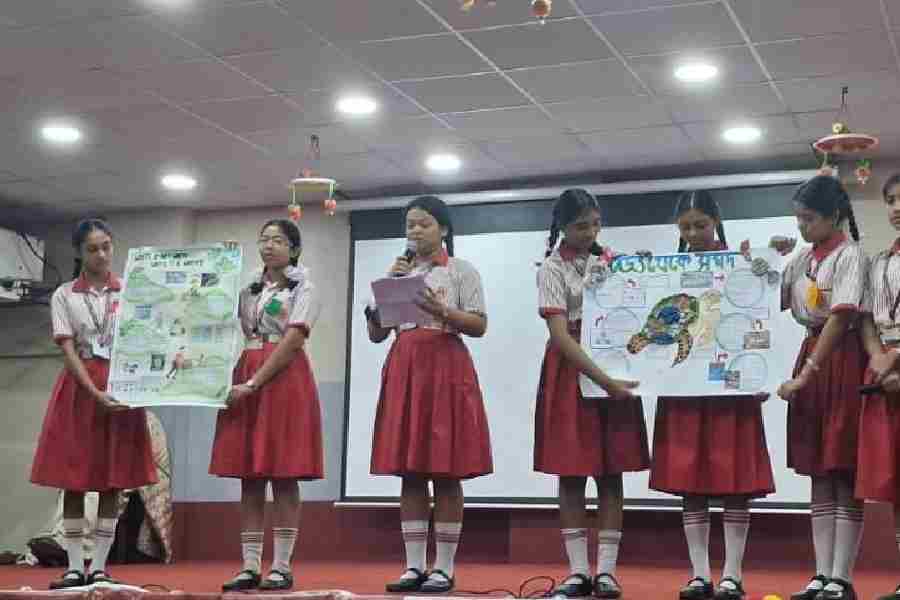
Students of Begum Rokeya Smriti Balika Vidyalaya explain how to reduce, reuse and recycle
Students of Salt Lake School, in CA Block, explained why waste segregation is essential, and those from AE Block’s Bhagabati Devi Balika Vidyalaya spoke on how converting waste into wealth can pave the way for a sustainable future.
Reel advocacy
“All of you are on social media and make reels every day. Can you make reels and avatars that motivate people to segregate waste at source?” president of Aamar Bidhannagar, retired IAS Debashis Sen, asked the students.
He assigned them a project on mushroom cultivation as demonstrated by Nandi Chakraborty’s video earlier. Sen, who used to head Hidco and NKDA, shared his experience of leading the New Town waste management project.
“The most difficult part of recycling is the segregation of organic and inorganic waste, but it should become easier with AI. New AI-enabled technologies are expected to sort nearly 80 items per minute, separating pure organic waste from other waste streams without human intervention,” Sen said. “If waste can be segregated, its organic components can be used to generate methane and electricity, while plastics can be recycled for other purposes.”
Sen suggested that the schools organise educational visits to the New Town bio-methane plant, where waste is being used to produce gas.
Secretary of the group Arunava Das stressed that citizens must take ownership of environmental protection instead of merely pointing out administrative lapses. “Indiscriminate dumping of waste often blocks drainage systems, resulting in water-logging. You students can become change-makers for a better world and encourage your parents and neighbours to follow a sustainable lifestyle,” he said.
Members of Aamar Bidhannagar also sang Akash bhora surjo tara in chorus. The event was anchored by Urmila Sen.