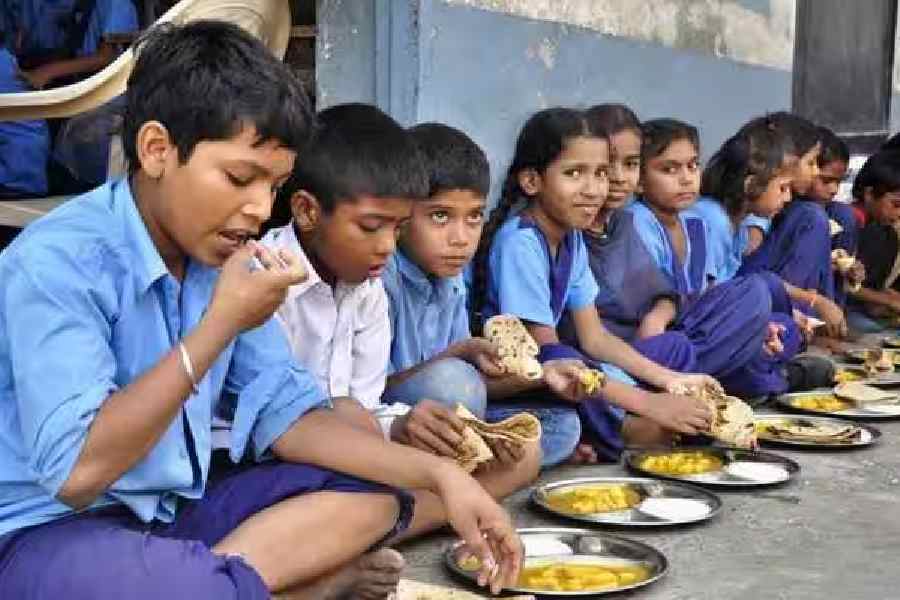
Eggs will no longer be part of mid-day meals. They will be replaced with
paneer and rajma.
A Hindu religious outfit has been entrusted with the responsibility of providing meals to children in government and aided schools in the Kolkata Municipal Corporation area, with the first major change being the removal of non-vegetarian items from the menu.
The pure vegetarian fare served by Iskcon (International Society for Krishna Consciousness) on its premises is popular among some, but unlike before, schoolchildren will no longer have a choice over what they eat.
Bengal finance minister Swapan Dasgupta said in his budget speech on Monday: “The material cost for mid-day meals in primary schools will be enhanced to ₹10 per student from ₹6.78. Iskcon will be engaged to provide nutritious cooked mid-day meals in schools under the KMC area.”
The National Programme on Nutritional Support to Primary Education (NP-NSPE), commonly known as the mid-day meal scheme, was launched as a centrally sponsored programme on August 15, 1995, initially providing a dry ration of 100 grams per child per day. In September 2004, the scheme was revised to provide cooked mid-day meals with 300 calories and 8-12 grams of protein to all children studying in Classes I to V in government and aided schools.
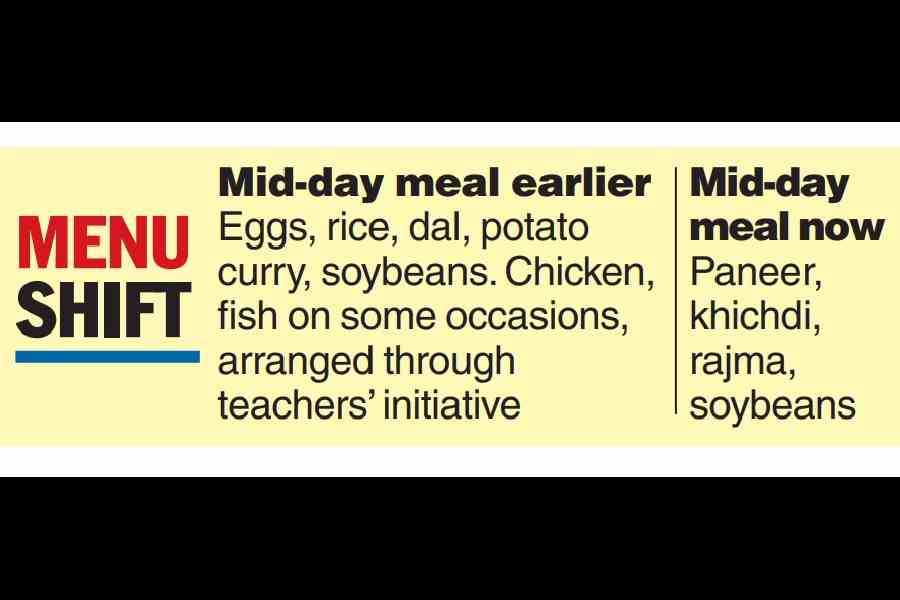
In Bengal, students were provided eggs once a week. On the remaining five days of the school week, they received rice, dal and potato curry. Eggs are considered a key source of protein in combating child malnutrition.
In many schools, teachers also raised funds on their own to occasionally serve chicken.
“We would buy chicken and give it to those who cooked the mid-day meals. They would additionally cook the chicken. On some days, we would make arrangements so the students got fish,” a school head said.
Students who did not like eggs or followed vegetarian diets would avoid the item and opt for other dishes.
Opposition parties have often alleged that the BJP tends to impose restrictions on non-vegetarian food.
Radharaman Das, vice-president and spokesperson for Iskcon in Calcutta, said: “Although our meals will not include eggs, there will be no cut in nutrition. We will compensate by serving items like paneer, rajma and soybeans along with khichdi.”
While teachers welcomed the decision to raise the material cost for mid-day meals, they wondered how children would adjust to a strictly vegetarian menu.
“Students turn up in large numbers on days when eggs are provided. We are sure Iskcon will ensure hygienic food is served. But students may struggle to adjust to pure vegetarian meals. It would be better if the decision is reconsidered,” said Raja Dey, headmaster of Mitra Institution (Bhowanipore).
A teacher at Uttarpara Government School, Saugata Basu, said many students were unfamiliar with items such as paneer or rajma. “In that case, it will come down to the imposition of food habits,” Basu said.
The leader of a BJP teachers’ union also stressed the need to consider student preferences.
Pintu Paruy, co-convenor of the BJP teachers’ cell, said: “We welcome the decision taken by the state government on mid-day meals. We hope the items will be prepared according to students’ preferences.”
Iskcon, which has been engaged by the government for the mid-day meal scheme, is a worldwide Hindu Gaudiya Vaishnava spiritual organisation founded in New York in 1966 by Calcutta-born A.C. Bhaktivedanta Swami Prabhupada.
Das of Iskcon said that the outfit had been engaged as part of a pilot project.
“The programme will be run through our Annamitra Foundation. After we receive the list of schools from the state government, kitchens will be set up to serve pure vegetarian cooked meals,” he said.
“We carry out the same exercise in eight states, including Maharashtra and Haryana. We cater to 12 lakh students in those states. In Bengal, we are looking forward to providing hygienic food to primary school students,” Das added.