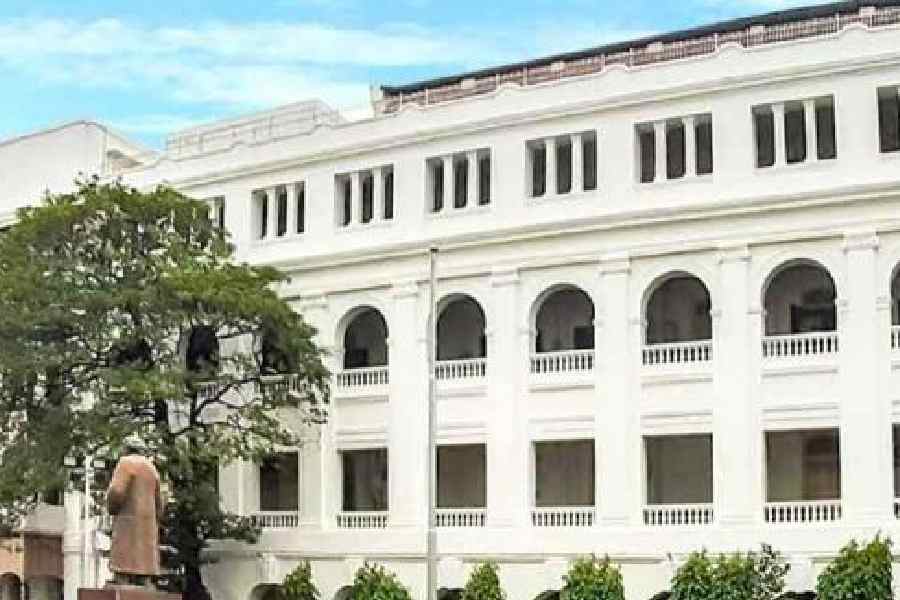
Calcutta: Calcutta University has begun identifying affiliated colleges that lack the infrastructure required to support undergraduate students opting for the fourth year of the four-year undergraduate programme introduced
under the National Education Policy (NEP).
Under the NEP, students completing the fourth year graduate with a research component, making adequate research infrastructure mandatory for colleges offering the extended programme.
Students may exit after the third year and graduate with an honours degree in July this year.
CU vice-chancellor Ashutosh Ghosh said several colleges currently lack the facilities needed to support undergraduate research and that the university has initiated the process of identifying such institutions.
Undergraduate students who exit after three years will have the option to seek admission to the first year of the university’s two-year master’s programme under the NEP.
“These students will have to take admission tests for the master’s programme. Since students graduating with three-year honours degrees will pass out in July, we need to prepare the infrastructure to screen them before enrolling them in the first year of
the master’s programme,” Ghosh said.
“We also need to create a proportionate number of postgraduate seats for these graduating students,” he added.
Those who will be graduating with research after the fourth year in July 2027, having maintained a certain CGPA (cumulative grade point average, equivalent to 75% after completion of the first six semesters), will be admitted to the second year of the two-year master’s programme under the NEP.
Before 2023, when the undergraduate programme spanned only three years, the graduating students from the CU affiliated colleges would be admitted to the two-year postgraduate programmes based on marks.
At present, 80% of the postgraduate seats at CU are reserved for students pursuing undergraduate programmes at colleges affiliated to the university.
Graduate students from other universities are required to take admission tests to secure entry to the master’s programmes for the remaining 20% of the seats.
“This ratio of seat reservation, as fixed by the education department, will continue. The only difference is that even for the postgraduate seats reserved for home students (graduating students from the CU affiliated colleges), they will have to take the admission tests,” VC Ghosh told Metro.
Admission tests
A CU official said most of the departments are of the view that marks do not quite determine whether a candidate deserves to pursue a postgraduate programme.
“They believe admission tests are the most effective way to screen prospective students,” he said.
St Xavier’s College and the three autonomous colleges, which come under the control of the Ramakrishna Mission, admit postgraduate students through admission tests.
According to the CU official, graduating with research after the fourth year in July 2027 and seeking admission to the second year of the two-year master’s programmes will require writing admission tests as well.
The official said that colleges like Lady Brabourne, Bethun and Lady Brabourne have the necessary infrastructure to support undergraduate students in pursuing the fourth year of a four-year undergraduate programme, allowing students to graduate with research.
But there are colleges in South 24-Parganas and Hooghly which lack the infrastructure.
Students who will exit from these colleges after the third year (after the sixth semester) will look forward to taking admission to the first year of the master’s programme.
“I have asked the inspector of colleges to identify such colleges lacking the infrastructure. We hope to come up with a clear guideline on PG admission by mid-January,” said Ghosh.